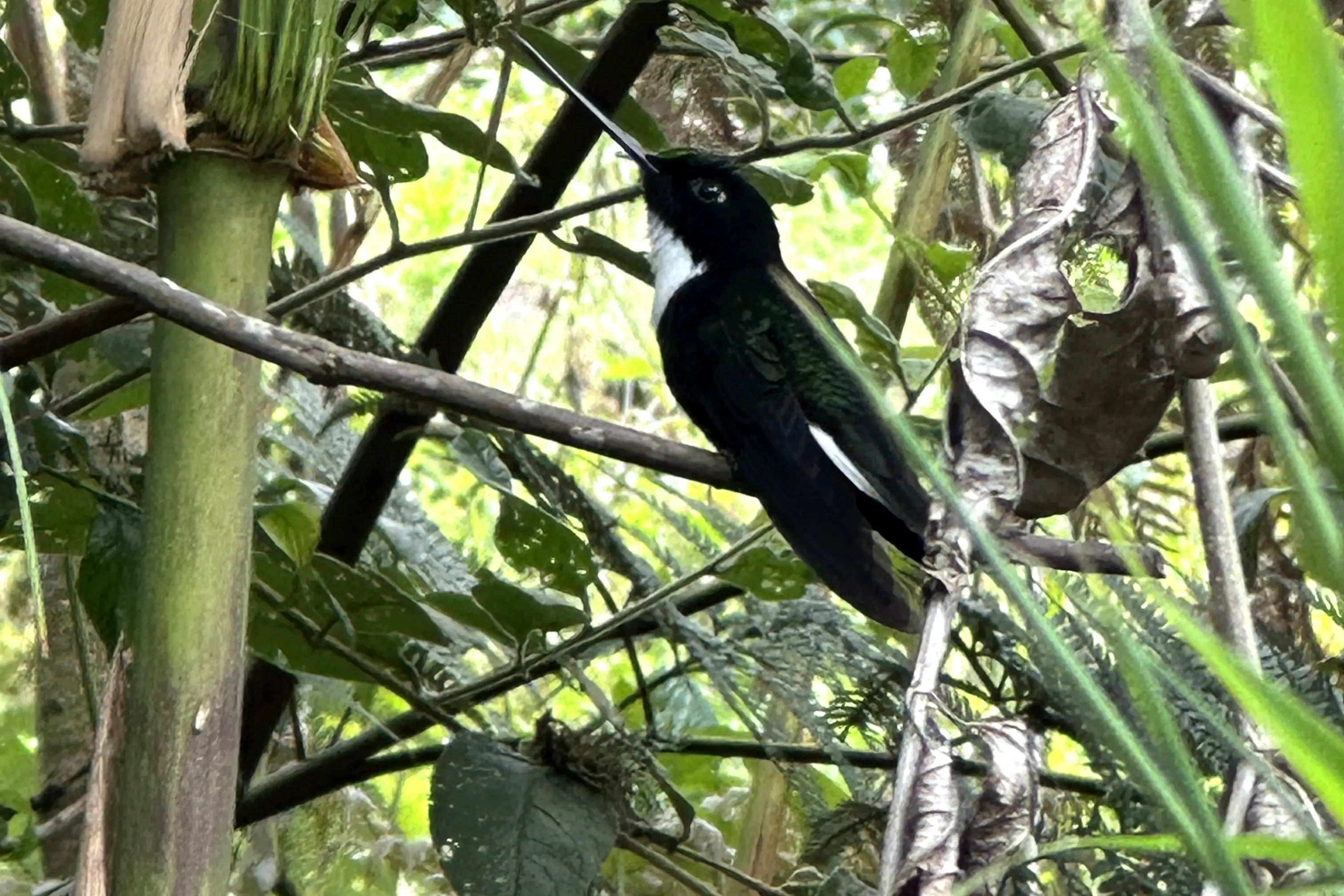
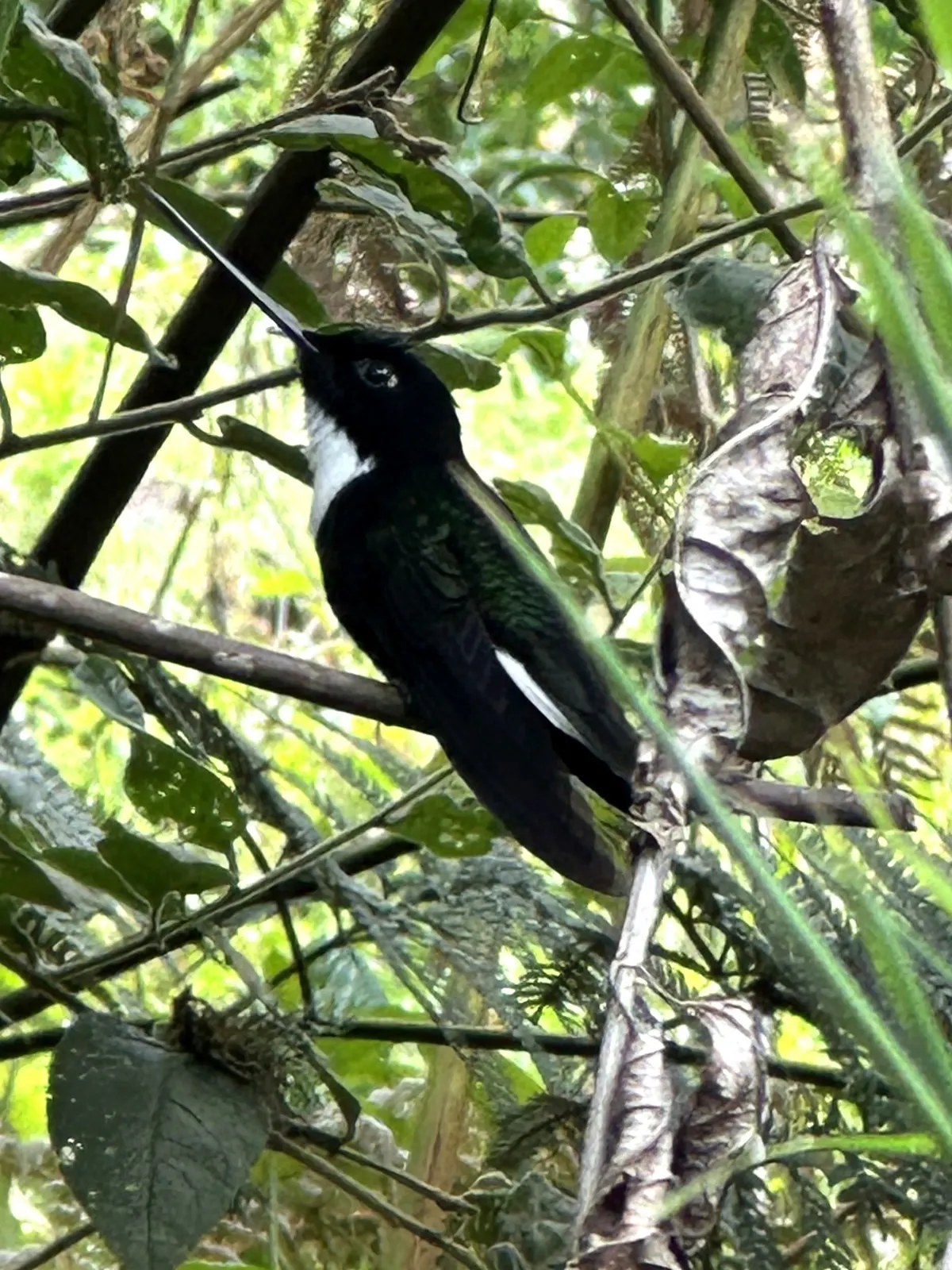
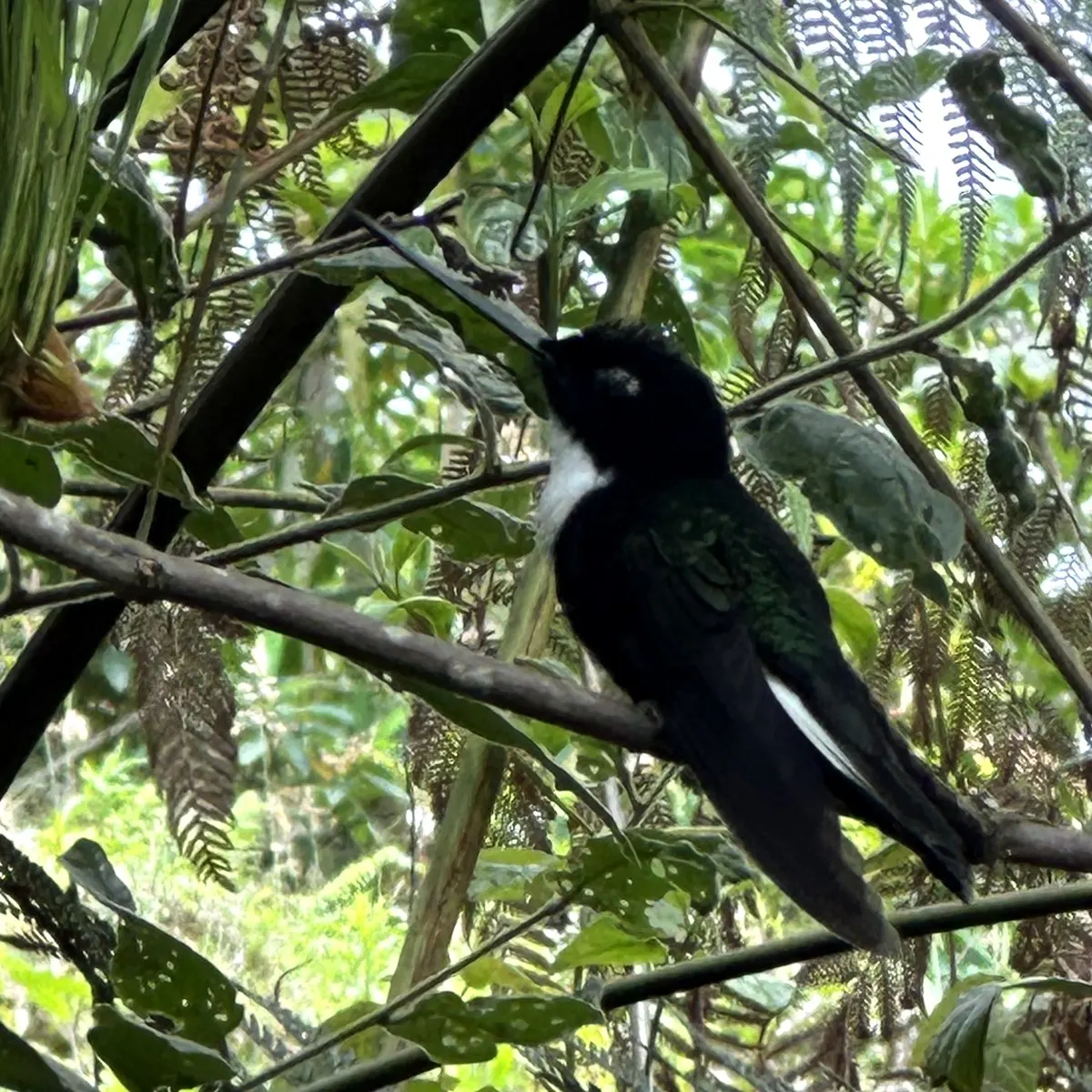
The collared inca is a dark Andean hummingbird with a bright white bib and a straight 3–3.5 cm bill. It lives in cloud forest at about 1,800–3,000 m, from Venezuela to Peru. It was the first hummingbird we photographed on our farm in Cuyuja, at about 2,330 m, on 1 March 2025.
Collared inca at a glance
Coeligena torquata is 10–14 cm long and fairly common through most of its range. Key figures, from its Wikipedia species account:
| Scientific name | Coeligena torquata |
|---|---|
| Spanish (Ecuador) | Inca collarejo |
| Size | 10–14 cm, with a straight black bill of 3–3.5 cm |
| Range | Andes from western Venezuela through Colombia and Ecuador to Peru |
| Altitude | About 1,800–3,000 m; in Ecuador usually above 2,100 m |
| Food | Nectar (often bromeliads and other epiphytes) and small arthropods |
| Races | Five; two of them in Ecuador |
| Conservation | Least Concern (IUCN) |
How do you identify a collared inca?
In the dim light of the cloud forest this bird looks black. It has one striking feature: a large white patch across the chest. When it flies or spreads its tail, you also see white on the outer tail feathers. The bill is long, straight and black.
Good light shows more detail. The body is dark green. Males have a shimmering violet forehead and a green throat. Females are slightly lighter green, with a smaller white patch.
Similar species and how to tell them apart
Nothing else at our altitude looks quite like it. Still, a quick glance in poor light can mislead you. Here is how it compares with the other east-slope hummingbirds on this site.
- Long-tailed sylph: green, with a very long tail and a tiny bill. See the long-tailed sylph.
- Coronets: green or rufous below, and they hold their wings up after landing. See the coronets.
- Sword-billed hummingbird: its bill is far longer, longer than its whole body. See the sword-billed hummingbird.
- Tourmaline sunangel: smaller, with a rosy-pink throat in males and no white bib. See the tourmaline sunangel.
Two races in Ecuador: east slope vs Mindo
The species has five races, and Ecuador has two of them. Our birds on the eastern slope belong to the race torquata, the black-and-white bird in our photos. On the western slope, around Mindo, the race fulgidigula is greener. Its males have a shimmering blue forehead and a turquoise chin. If you have seen one in Mindo, the eastern bird is worth a second look. The other three races live only in Peru.
Behaviour: a quiet trap-liner
Collared incas are usually solitary. Coronets fight over a single flowering bush. This bird does not. Instead, it flies a regular route between scattered flowers, a habit called trap-lining. It often forages below mid-height in the forest, around thickets and edges. It seems to favour epiphytes such as bromeliads.
For a visitor this means patience pays off. An inca may appear at a flower, feed for a few seconds and disappear. Then it returns along the same route a while later.
Voice
The call is a quiet, low, reedy whistle, tu-tee. It also gives a longer series of pip... pip... notes. When foraging, it makes a very quiet spitting sound. In a noisy feeder garden, these soft notes are easy to miss.
Nest and young
The nest is small and low, usually 1–2 m above the ground. It measures about 7 cm tall and wide. Inside, the cup is about 3 cm deep. Its eggs are pure white and roughly 1.5 by 1 cm. The mother feeds the chicks once or twice an hour. Each visit lasts only 9 to 55 seconds.
Where can you see the collared inca?
It is fairly common in Ecuador's cloud forests above about 2,100 m, and San Pedrito is one place to look. On the eastern slope, the Papallacta–Baeza road is a good area. We photographed this one at San Pedrito, at about 2,330 m in Sector Alejandría, Cuyuja. The date was 1 March 2025. How to visit San Pedrito.

Best time to look near Cuyuja
Come in the morning, in any month. Rain falls fairly evenly all year in Cuyuja, so patience matters more than season.
- Mornings: early visits are usually best, before the clouds build up.
- Any month: rain falls fairly evenly all year in Cuyuja. May to August is the wettest stretch.
- Watch low: it forages below mid-height, so scan thickets and forest edges, not only the canopy.
- Be patient: a trap-liner comes back. Wait quietly by a flowering shrub.
How we help it on the farm
This inca feeds from epiphytes and forest flowers. So we are keeping the mossy trees and thickets around the lookout. We are also adding native plants such as bromeliads and fuchsias. That way it has more than a feeder to come for. See our list of Andean hummingbird plants and what hummingbirds eat.
Collared inca: FAQ
How do you identify a collared inca?
Look for a dark, almost black hummingbird with a large white patch on the chest. It has white in the tail and a straight black bill of 3–3.5 cm. In good light you may see dark green on the body and, in males, a violet forehead.
Where does the collared inca live?
In humid cloud forest on both slopes of the Andes, from western Venezuela to Peru. It lives at about 1,800–3,000 m, usually above 2,100 m in Ecuador. It likes thickets and forest edges.
What does the collared inca eat?
Nectar, especially from epiphytes such as bromeliads, plus small insects and other arthropods for protein. It flies a regular route between flowers rather than defending one bush.
Is the collared inca the same in Mindo and in Cuyuja?
It is the same species, but a different race. Ecuador's eastern slope has C. t. torquata. The western slope (Mindo) has fulgidigula, which is greener. Its males have a blue forehead and a turquoise chin.
How big is the collared inca's nest?
Small: about 7 cm tall and wide, with a cup about 3 cm deep. It is usually built 1–2 m above the ground, and the eggs are pure white.
Can I see the collared inca at San Pedrito?
Yes — we photographed one on the farm in March 2025, at about 2,330 m. As with any wild bird, sightings are never guaranteed.
Sources
- "Collared inca", Wikipedia (description, subspecies, range, behaviour).
- Reyes Vargas et al. (2022), bird survey of Cuyuja parish, Siembra 9(2). doi:10.29166/siembra.v9i2.3725