
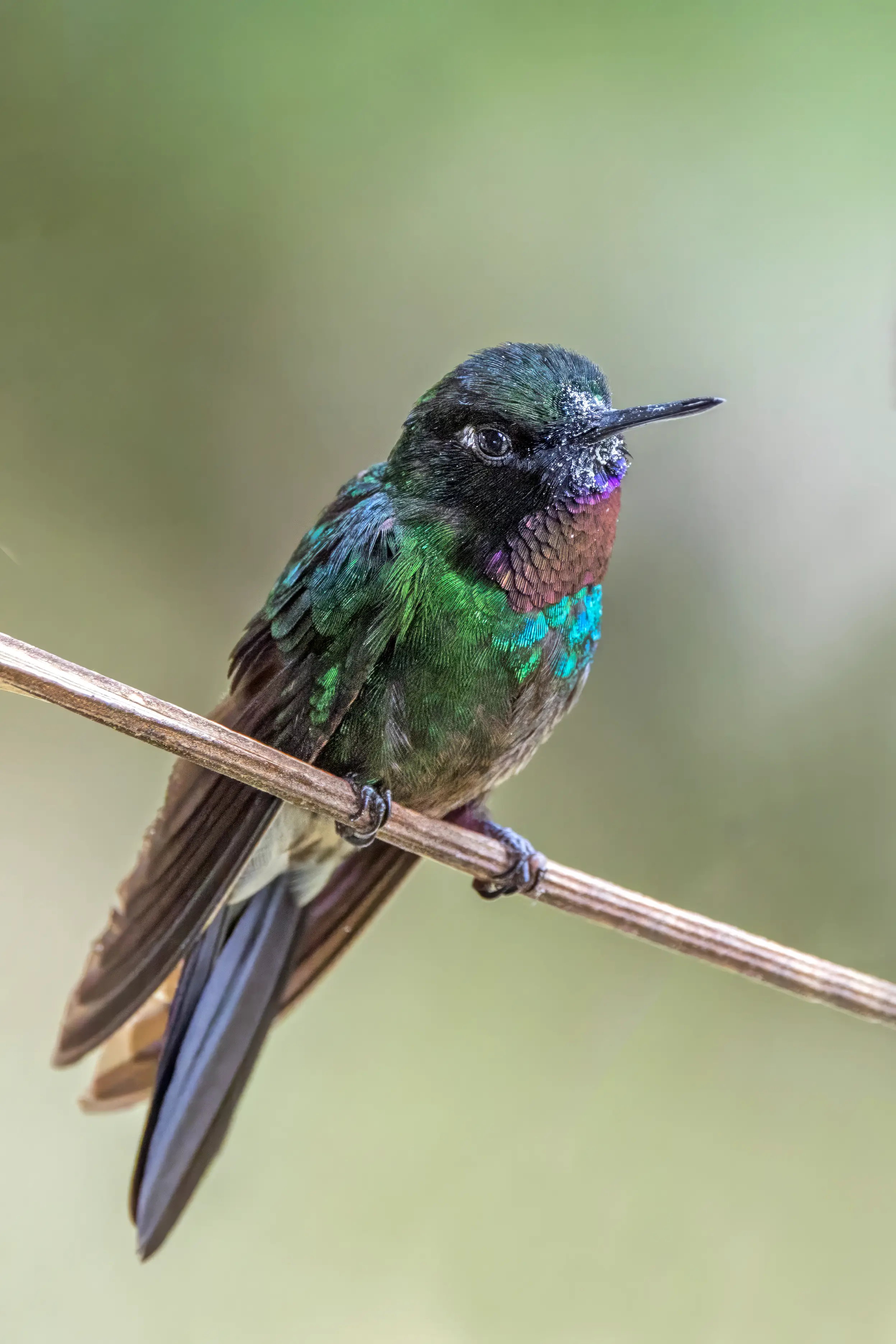
The tourmaline sunangel is a small hummingbird found only in Colombia and Ecuador. In Ecuador it lives only on the eastern slope of the Andes, mainly at 2,300–3,400 m. Males have a glittering rosy-pink throat. Near Cuyuja it is a regular at Guango's feeders, 11 km from San Pedrito.
Tourmaline sunangel at a glance
Heliangelus exortis is 10–11 cm long and weighs 3.5–8.5 g. The figures below come from its Wikipedia species account.
| Scientific name | Heliangelus exortis |
|---|---|
| Spanish (Ecuador) | Solángel turmalina |
| Size | 10–11 cm; straight, medium-length black bill |
| Weight | Males 3.5–8.5 g; females 4–5.2 g |
| Range | Colombia's three Andean ranges; Ecuador's eastern slope south to Morona-Santiago |
| Altitude | Mainly 2,300–3,400 m (as low as 1,500 m) |
| Habitat | Cloud and elfin forest, bushy clearings, shrubby pastures |
| Conservation | Least Concern (IUCN); population thought stable |
6 tourmaline sunangel facts
It is a two-country bird with a gem-like throat and a fierce temper. Six facts explain what makes it special.
- A two-country bird. It lives only in Colombia and Ecuador.
- Named after a gem. The male's throat flashes rosy pink, like a tourmaline, when it turns toward the light.
- A coquette. It belongs to the coquettes, the tribe Lesbiini, and has no subspecies.
- Once lumped. It has at times been treated as the same species as the flame-throated sunangel.
- A homebody. It is almost entirely sedentary and rarely moves far.
- Mum does the sitting. The female incubates a clutch of two white eggs.
How do you identify a tourmaline sunangel?
Both sexes are dark shining green above. Below, they are dusky grey with round green spots. Males add a glittering green spot just above the bill and a dark purple-blue chin. Then comes the feature behind its name: a glittering rosy-pink throat, edged below by an emerald-green band. Like a tourmaline gem, it changes from dull to brilliant as the bird turns.
Females have no green forehead spot. Their throat is whitish and speckled, sometimes with a few rosy feathers. Young males show a white chin.
Similar species and how to tell them apart
In poor light, several dark hummingbirds at this altitude can look alike. Here is what to check.
- Coronets: they also cling to flowers, but they are slightly bigger and hold their wings up after landing. The chestnut-breasted coronet has a rufous belly. See the coronets.
- Collared inca: much darker, with a bright white bib and a longer bill. See the collared inca.
- Female long-tailed sylph: a warm cinnamon belly, not grey with green spots. See the long-tailed sylph.
Behaviour: a small bird with a big temper
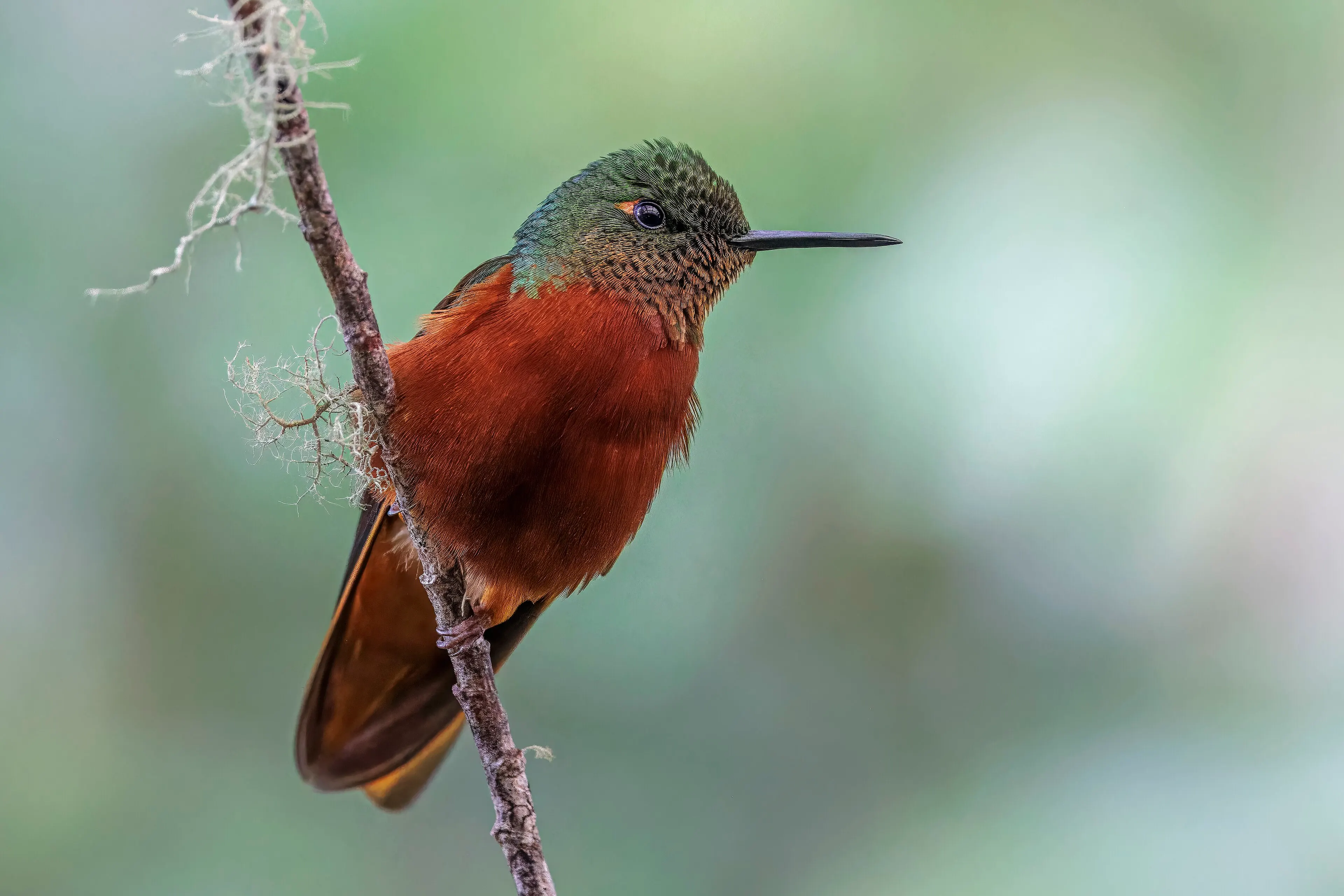
This sunangel is aggressively territorial around its flowers. It usually clings to a flower to feed instead of hovering. Often it chooses plants close to the ground, both in forest and in semi-open places. It also hawks insects from a perch and gleans them from leaves. Its call is a dry, gravelly trrr.
For a visitor, that low feeding habit is useful. Watch the low flowering shrubs, not only the treetops. It is one reason we plant low shrubs such as Andean sage. See our plant list.
Breeding
The breeding season appears to run from March to August. The clutch is two white eggs, and the female incubates them.
Where can you see it near Cuyuja?
On the Papallacta–Baeza road, the tourmaline sunangel is a regular at Guango's feeders. Guango sits at about 2,700 m, 11 km from San Pedrito. Our farm, at about 2,330 m in Sector Alejandría, lies at the bottom of the bird's main range. It has the cloud-forest edges and shrubby clearings it likes.
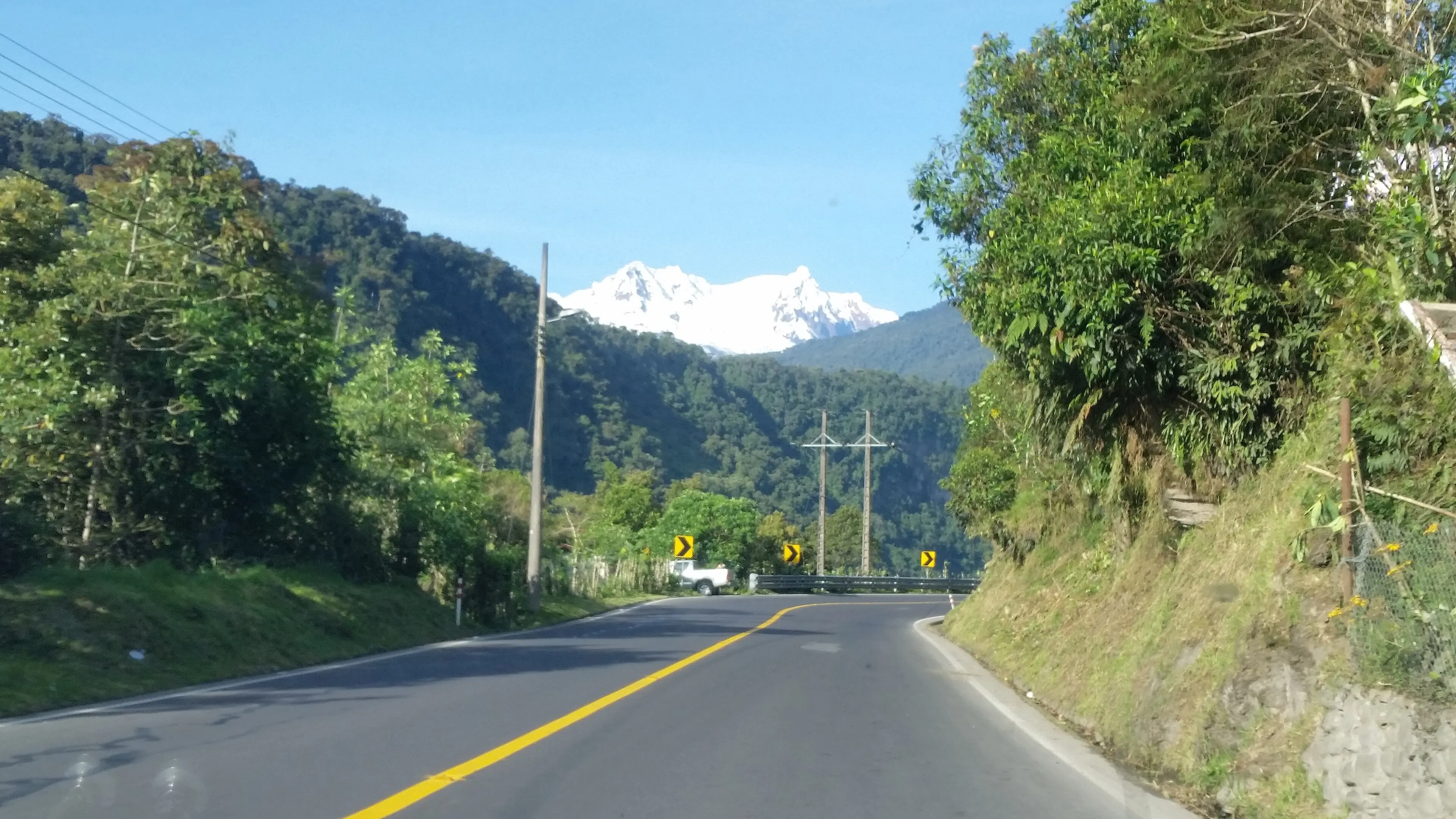
We have not photographed it here yet and will update this page when we do. How to visit.
Best time and place to look
Any month can work, because the bird barely moves. Go in the morning and watch low flowering shrubs.
- Any month: the bird is almost entirely sedentary, and Guango has very little bird seasonality.
- Drier days are likelier from about November–December to February. May to August is wettest.
- Mornings: activity is usually highest early, before the clouds build up.
- Low shrubs and feeders: watch flowers near the ground, where it likes to cling and feed.

Is it threatened?
No. The IUCN lists it as Least Concern, and its population is believed to be stable. It even uses shrubby pastures, so flowering hedges on farms may help it.
Tourmaline sunangel: FAQ
Where does the tourmaline sunangel live?
Only in Colombia and Ecuador. It is found in all three Andean ranges of Colombia and south along Ecuador's eastern slope to Morona-Santiago. It lives in cloud forest, elfin forest, bushy clearings and shrubby pastures, mainly at 2,300–3,400 m.
How do you identify a male tourmaline sunangel?
A small, dark green hummingbird with grey, green-spotted underparts. The male has a green spot above the bill and a dark purple-blue chin. Its throat is a glittering rosy pink, with an emerald-green band below.
What does the female look like?
Females lack the green forehead spot and the pink throat. Their chin is blackish. The throat is whitish with green or dusky speckles, sometimes with a few rosy feathers.
How does it feed?
It usually clings to flowers instead of hovering, often at plants low to the ground. Feeding spots are defended aggressively. It also catches insects in the air or picks them from leaves.
Can I see a tourmaline sunangel at San Pedrito?
Our farm is at about 2,330 m, at the bottom of its main altitude range. It is a regular at Guango's feeders, 11 km away. We have not photographed it on the farm yet.
Sources
- "Tourmaline sunangel", Wikipedia.
- Seasonality at Guango, 10,000 Birds; climate of Cuyuja, GAD Cuyuja.
- Guango reserve checklist and feeder lists, exoticbirding.com.