
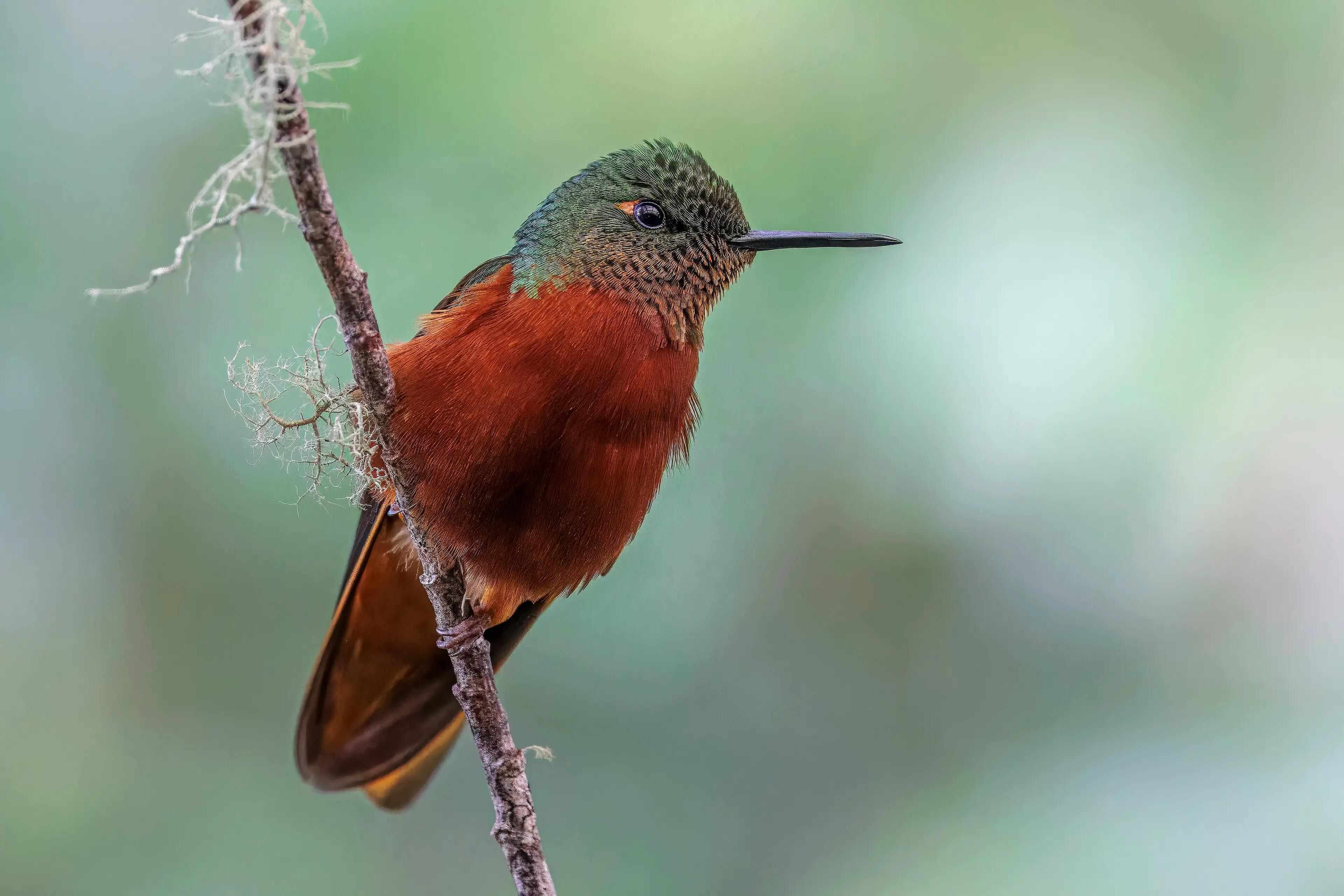
The buff-tailed coronet and the chestnut-breasted coronet are bossy Andean hummingbirds that hold their wings up after landing. Near Cuyuja, the chestnut-breasted is the common one, most numerous at 1,900–2,700 m. The buff-tailed is mainly a western-slope bird in Ecuador, found in only a few eastern places.
Side by side
The two are close in size, about 10.5–13 cm, so colour and slope tell them apart. Figures come from Wikipedia's Wikipedia and chestnut-breasted coronet articles.
| Chestnut-breasted coronet | Buff-tailed coronet | |
|---|---|---|
| Scientific name | Boissonneaua matthewsii | Boissonneaua flavescens |
| Spanish (Ecuador) | Coronita pechicastaña | Coronita colianteada |
| Size | 10.5–13 cm; 6.5–8.3 g | 11–12 cm; 7.3–8.8 g |
| Belly | Reddish chestnut | Buff with green spots |
| Tail | Reddish chestnut with bronzy tips | Buff with bronze tips |
| In Ecuador | Eastern slope (and west slope from central Ecuador south) | Mainly western slope; a few places on the eastern slope |
| Altitude | 1,600–3,300 m; most numerous 1,900–2,700 m | 2,000–3,500 m |
| Near Cuyuja | Recorded in the Cuyuja survey; often dominant at feeders | On Guango's feeder lists |
5 ways to tell a buff-tailed coronet from a chestnut-breasted
Check the belly first: buff with green spots or reddish chestnut. Then confirm with the tail, underwing, legs and slope.
- The belly. Buff with green spots means buff-tailed. Rich reddish chestnut means chestnut-breasted.
- The tail. Buff feathers with bronze tips, or reddish chestnut with bronzy tips.
- The underwing in flight. The buff-tailed shows cinnamon under the wings.
- The leg tufts. Look for small white tufts on the buff-tailed's legs.
- The slope. On Ecuador's eastern slope, the chestnut-breasted is the expected bird. The other is the rarer one here.
Chestnut-breasted coronet
It is metallic green above and rich reddish-chestnut below. The throat is buff, speckled yellow-green. Look for a white spot behind the eye and a short, straight black bill. Males and females look almost the same; females are a little paler below.
In Ecuador it is most numerous between 1,900 and 2,700 m. Our altitude is right in the middle of that band. It lives inside and along the edge of humid montane forest, and in gardens near the forest. It was recorded in the 2019–2020 bird survey of Cuyuja.
Buff-tailed coronet
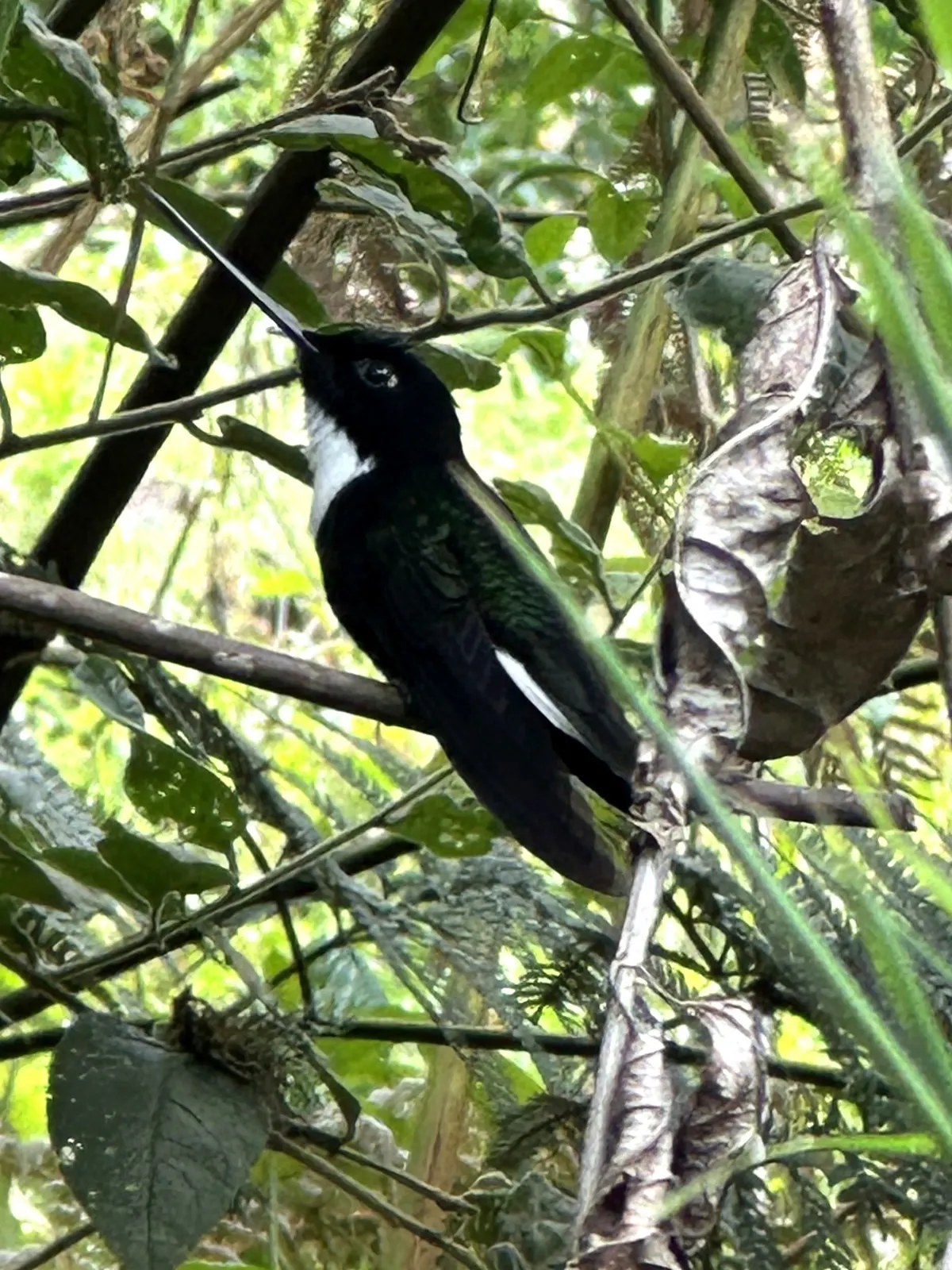
The buff-tailed coronet is mostly shining green, with a buffy belly spotted green. It shows cinnamon under the wings in flight. The tail feathers are buff with bronze tips, and there are small white leg tufts. Females have more buff below and less bronze on the tail.
Two races exist. The nominate race lives from western Venezuela through all three Andean ranges of Colombia. The race tinochlora runs from southwestern Colombia down Ecuador's western slope to Cotopaxi. It also reaches a few places on the eastern slope. So near Cuyuja, this coronet is the rarer of the two.
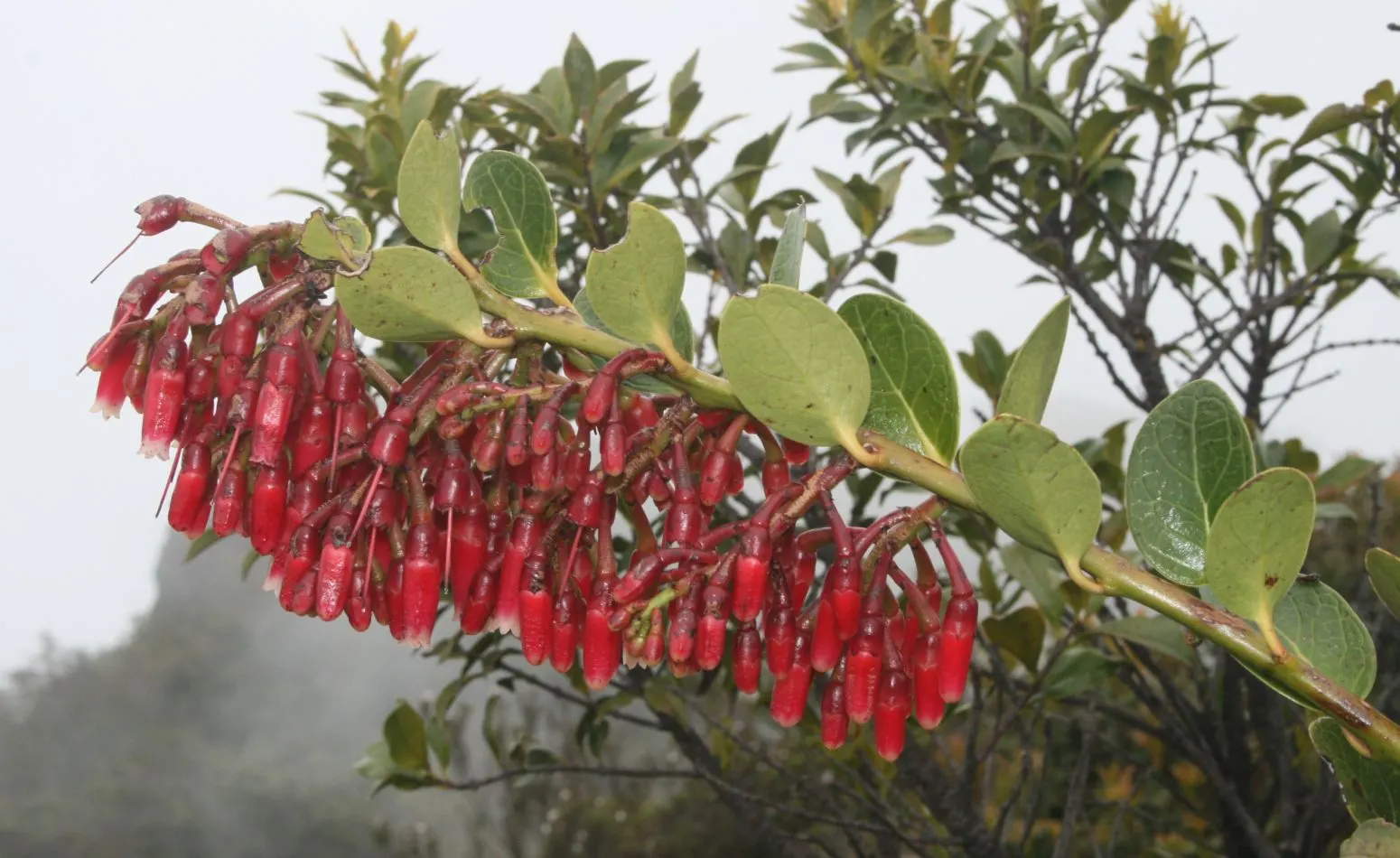
What does the buff-tailed coronet eat?
Mostly nectar, plus small insects. It takes nectar from Andean Ericaceae such as Cavendishia and Disterigma. Other nectar sources are Palicourea and Huilaea. It usually forages in the mid-storey but also feeds in the canopy. Small insects are caught by hawking from a perch. See what hummingbirds eat for the bigger picture.
How do coronets behave?
Both are territorial bullies at flowers and feeders. They cling to feed and flash their wings open after landing.
- Wings up: both species cling to the flower to feed and hold their wings open for a second or two after landing.
- Territorial: both defend clusters of flowers from other hummingbirds. At feeders a single coronet can take over.
- Insects too: they hawk small insects from a perch.
- Stay-at-home: the buff-tailed is sedentary and does not migrate.
That is why, in our garden, we spread flowers and feeders 5–15 m apart. One bossy coronet can't guard everything. Shyer species like the collared inca then get their turn. How we lay out the garden.
Nest and voice
The buff-tailed coronet breeds between November and March. Its nest is a cup of moss and lichen. It is usually fixed to a branch 3 to 10 m above the ground. The female lays two eggs and incubates them alone.
Its song is a steady series of high tsit notes. Sometimes several birds sing near each other. During squabbles with other hummingbirds, it adds squeaky twitters, rising piping notes and stuttering rattles.
Which coronet will you see near Cuyuja?
Most likely the chestnut-breasted coronet. Expect it at forest edges and gardens around 2,330 m, where San Pedrito sits. For the buff-tailed, check feeder gardens upslope: it appears on Guango's feeder lists, 11 km up the road. Mornings are usually the most active time. How to visit.

Conservation status
The buff-tailed coronet is listed as Least Concern by the IUCN. It is also on CITES Appendix II. Its population size and trend are not known, but no immediate threats have been identified. It ranges from rare to locally common across its large range.
Coronets: FAQ
How do I tell a chestnut-breasted coronet from a buff-tailed coronet?
Look at the belly. The chestnut-breasted coronet is reddish-chestnut below. The buff-tailed coronet is mostly green, with a buffy, green-spotted belly. Its tail feathers are buff with bronze tips.
Why do coronets hold their wings up?
Both species feed by clinging to the flower. They hold their wings open for a second or two after landing. It is a quick way to recognise a coronet.
Which coronet lives near Cuyuja?
The chestnut-breasted coronet. It lives along Ecuador's eastern slope and is most numerous at 1,900–2,700 m. It was recorded in the Cuyuja bird survey. The buff-tailed species is mainly a western-slope bird in Ecuador. It occurs in only a few eastern places, but it does appear on Guango's feeder lists.
Are coronets aggressive?
Yes. Both are highly territorial and defend clusters of flowers, and feeders, from other hummingbirds. That is why we spread our flowers and feeders out.
Sources
- Wikipedia: Chestnut-breasted coronet, Buff-tailed coronet.
- Reyes Vargas et al. (2022), bird survey of Cuyuja parish, Siembra 9(2). doi:10.29166/siembra.v9i2.3725