
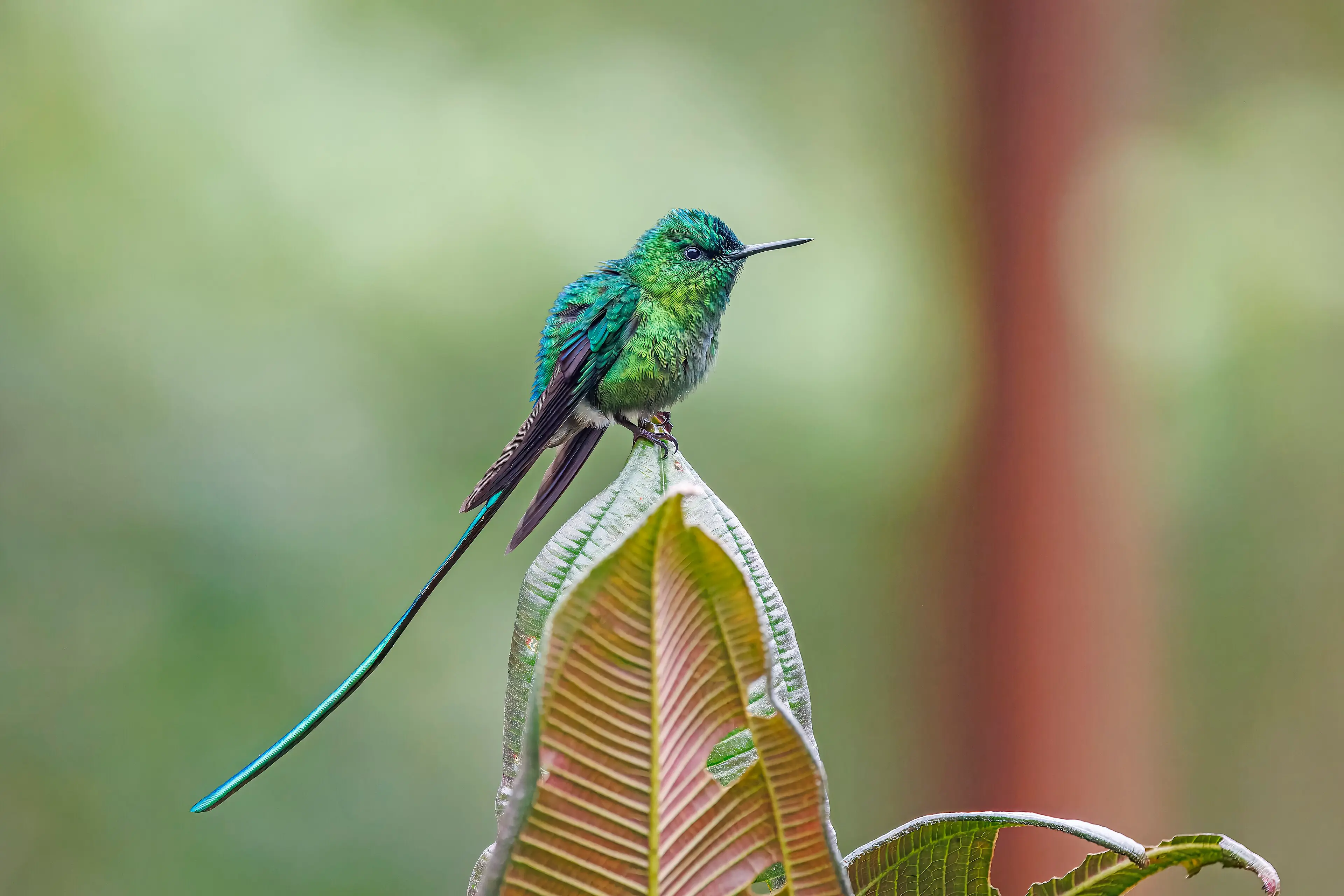
The long-tailed sylph is a tiny Andean hummingbird whose male trails outer tail feathers about 12 cm long. It lives at 900–3,000 m from Venezuela to Bolivia, on forest edges and in gardens. On Ecuador's eastern slope near Cuyuja, any sylph you see is this species, not the violet-tailed sylph of Mindo.
Long-tailed sylph at a glance
Males weigh only 5–6 g despite measuring 16–19 cm with the tail. The figures below come from its Wikipedia species account.
| Scientific name | Aglaiocercus kingii |
|---|---|
| Spanish (Ecuador) | Silfo colilargo |
| Male | 16–19 cm including ~12 cm outer tail feathers; 5–6 g |
| Female | 9.7–11.7 cm, short forked tail; 4.5–4.7 g |
| Range | Andes of Venezuela, Colombia, Ecuador, Peru and Bolivia |
| Altitude | About 900–3,000 m |
| Habitat | Forest edges, clearings, scrub, gardens, secondary forest |
| Near San Pedrito | Recorded in the Cuyuja bird survey; regular in the valley |
5 quick ID tips
Start with the tail, then the belly, then the location. These five checks sort out almost every sylph you will meet.
- Check the tail first. A male's outer tail feathers are about 12 cm long, far longer than the bird.
- Look at the colour of the tail. From above it shines blue, green and violet.
- Note the bill. It is short and black, tiny next to that tail.
- For females, look at the belly. A warm cinnamon belly and a short, white-tipped tail mean a female sylph.
- Use the map. On Ecuador's eastern slope, a sylph is this species, not the violet-tailed.
How do you identify a male?
Males have a short black bill, a glittering emerald crown and bronzy-green upperparts. Its throat is blue to violet. The tail is the giveaway. Its inner feathers are very short and the outer pair very long. In flight the tail streams behind the bird; perched, it hangs straight down. Fun fact: despite the name, its tail is no longer than those of the other sylphs.
How to identify the female
Females are easy to overlook. They are much smaller, with a short, slightly forked dark-blue tail broadly tipped white. The head is metallic green, with a white stripe below the cheek. The throat is white to buff and speckled. Then come the cinnamon underparts. That warm orange belly is the best clue.
Races in Ecuador
This sylph has six races, and two reach Ecuador. The race mocoa ranges from southern Colombia through Ecuador into northern Peru. Its males have a sapphire-blue to purple throat. The race emmae ranges from Colombia into northwestern Ecuador. Its males are paler, with a bright green throat.
Long-tailed vs violet-tailed sylph
They are two different species. The violet-tailed sylph lives on the Pacific slope; the long-tailed sylph lives along the Andes, including Ecuador's eastern slope.
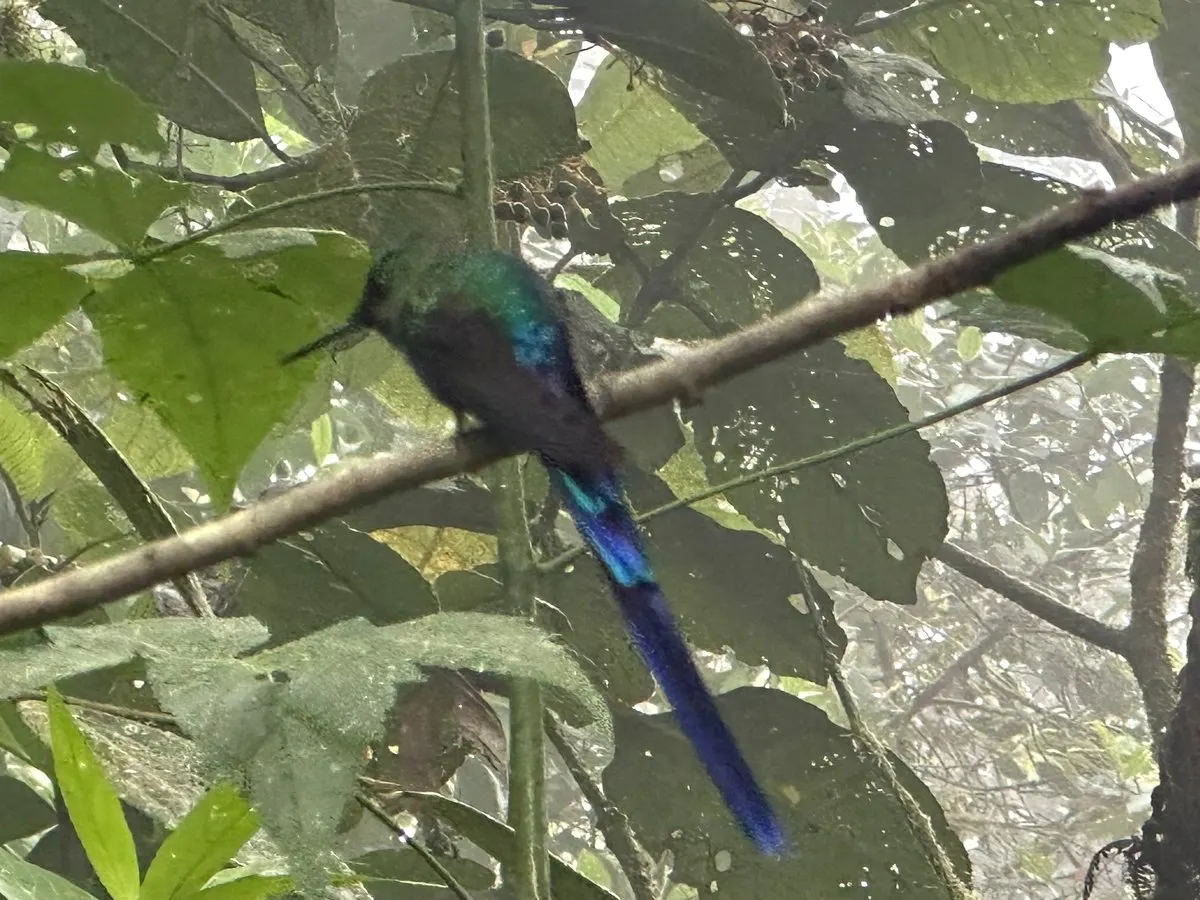
These two are often confused. The violet-tailed sylph (Aglaiocercus coelestis) lives on the Pacific slope of Colombia and Ecuador. It is the sylph most visitors see around Mindo, and the male's long tail glows deep violet-blue.
The long-tailed sylph is widespread along the Andes, including Ecuador's eastern slope. Its tail shimmers blue, green and violet. Location is your first clue. On the Papallacta–Baeza road, any sylph you see is this one. A third species, the Venezuelan sylph, lives only in Venezuela.
Behaviour and feeding
Sylphs are versatile feeders. They fly a circuit of flowers (trap-lining) but will also defend a good patch. Usually they hover at flowers. Sometimes they cling to them instead. And sometimes they cheat, piercing the base of a flower to steal nectar without pollinating it. They also catch small insects in the air from a perch. Populations move up and down the mountains with the seasons.
Nest, eggs and voice
Here the roles are unusual: the male builds the nest. It is a bulky dome of moss and plant fibres with a side entrance. The female incubates two white eggs for 15 to 17 days. Chicks leave the nest 21 to 24 days after hatching. The breeding season is known to run from February to October.
The song is a steady series of buzzy notes, bzzt... bzzt... bzzt. Calls include a short, raspy dzzrt and a longer, higher bzzeeew. Learn the buzz and you will often hear a sylph before you see it.
Where can you see the long-tailed sylph near Cuyuja?
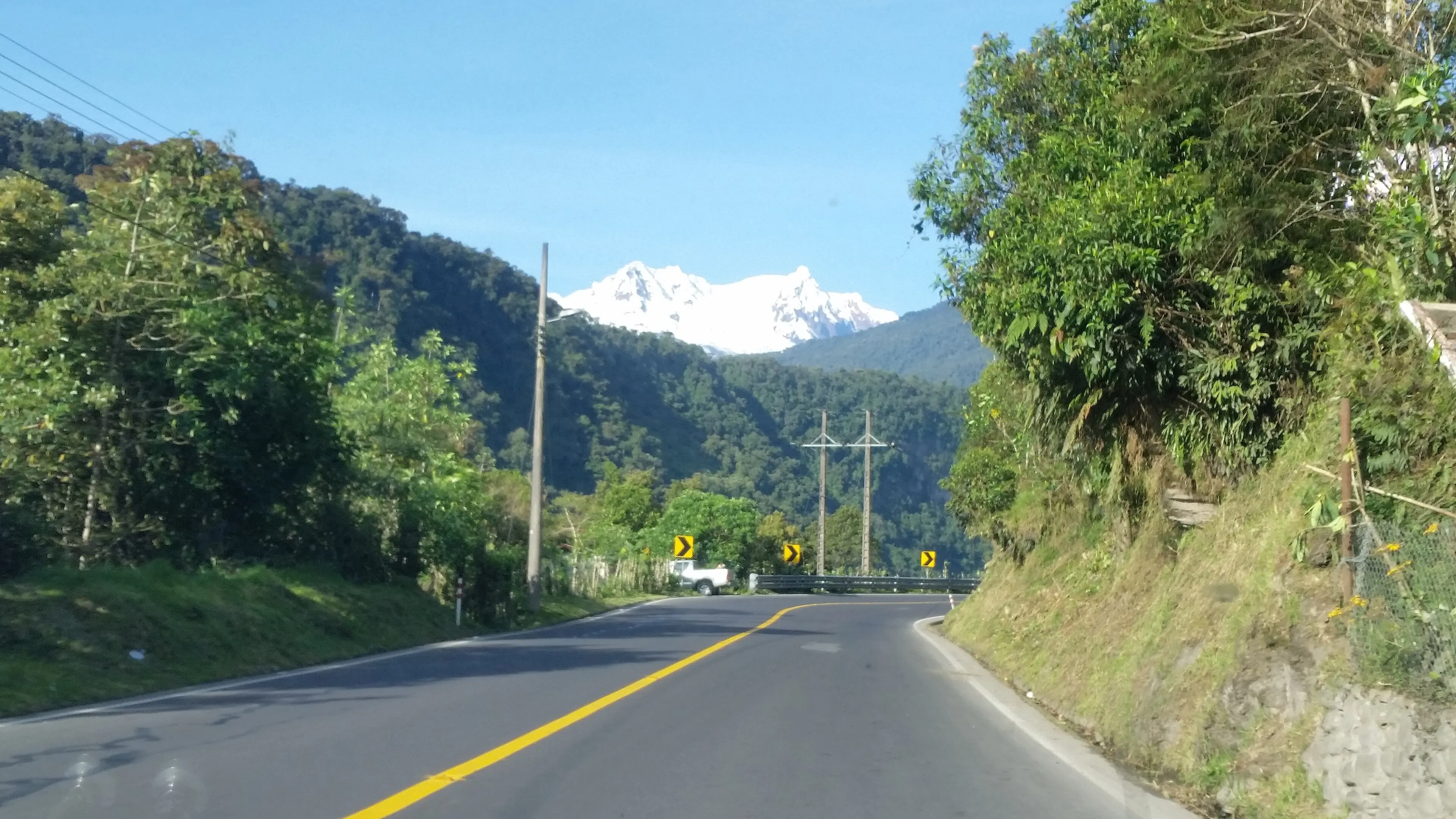
Look along forest edges, in clearings and in gardens. That is exactly the mix of farm and forest around Cuyuja. It was recorded in the 2019–2020 Cuyuja bird survey (Reyes Vargas et al., 2022). It is a regular in this valley.
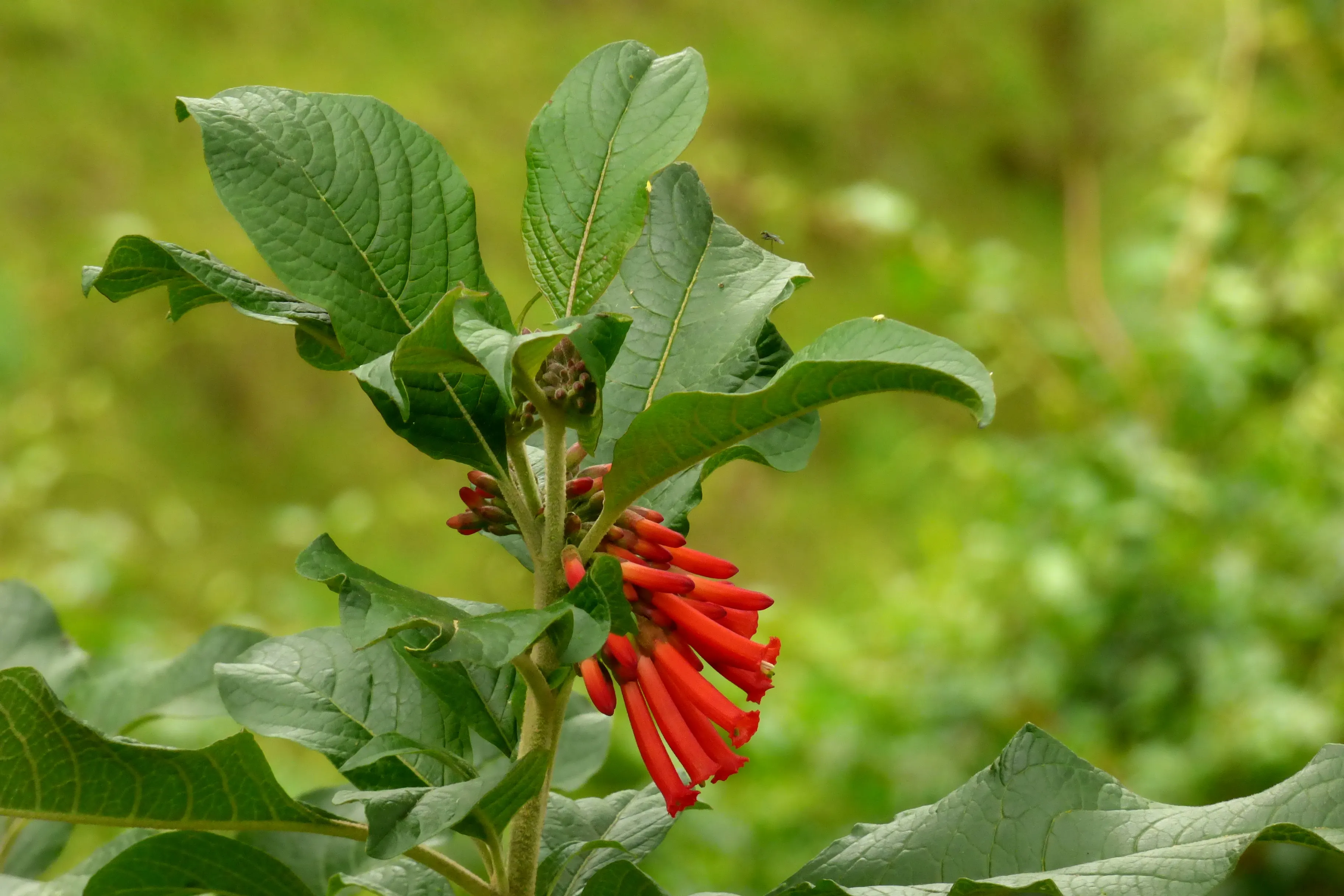
We have not photographed it at San Pedrito yet. Flowering shrubs such as fuchsias and iochroma along our edges are our best bet. See the plants we grow and how to visit.
Best time to look
Go in the morning, in any month. Edges and gardens are better than deep forest.
- Morning: birds are most active early, before the clouds build up.
- Any month: rain falls fairly evenly all year here; May to August is wettest.
- Edges, not deep forest: scan clearings, gardens and scrub along the road.
Is it threatened?
The IUCN lists it as Least Concern, thanks to a very large range. Its numbers are thought to be falling, though. Clearing land for cattle in Colombia and Ecuador is a potential threat. Keeping forest edges and native shrubs on farms helps birds like this one.
Long-tailed sylph: FAQ
How long is the long-tailed sylph's tail?
The male is 16–19 cm long, including outer tail feathers of about 12 cm. Yet it weighs only 5–6 g. Despite its name, its tail is not noticeably longer than those of the other sylphs.
What does a female long-tailed sylph look like?
Females are much smaller, at 9.7–11.7 cm. They have a short, forked dark-blue tail tipped white and a white stripe below the cheek. The throat is pale and speckled, and the underparts are cinnamon.
What is the difference between the long-tailed and violet-tailed sylph?
They are separate species. The violet-tailed sylph lives on the Pacific slope of Colombia and Ecuador, around Mindo. Its male's long tail looks deep violet-blue. The long-tailed species ranges from Venezuela to Bolivia, including the eastern slope at Cuyuja. Its tail shines blue, green and violet.
Where does the long-tailed sylph live?
In open, scrubby places such as forest edges, clearings, gardens and secondary forest. Its altitude range is about 900–3,000 m in the Andes. It moves seasonally between lower and higher elevations.
Can I see a long-tailed sylph at San Pedrito?
It was recorded in the Cuyuja bird survey and is a regular in this valley. We have not photographed it on the farm yet; we will update this page when we do.
Sources
- "Long-tailed sylph", Wikipedia (description, races, range, behaviour).
- Reyes Vargas et al. (2022), bird survey of Cuyuja parish, Siembra 9(2). doi:10.29166/siembra.v9i2.3725