
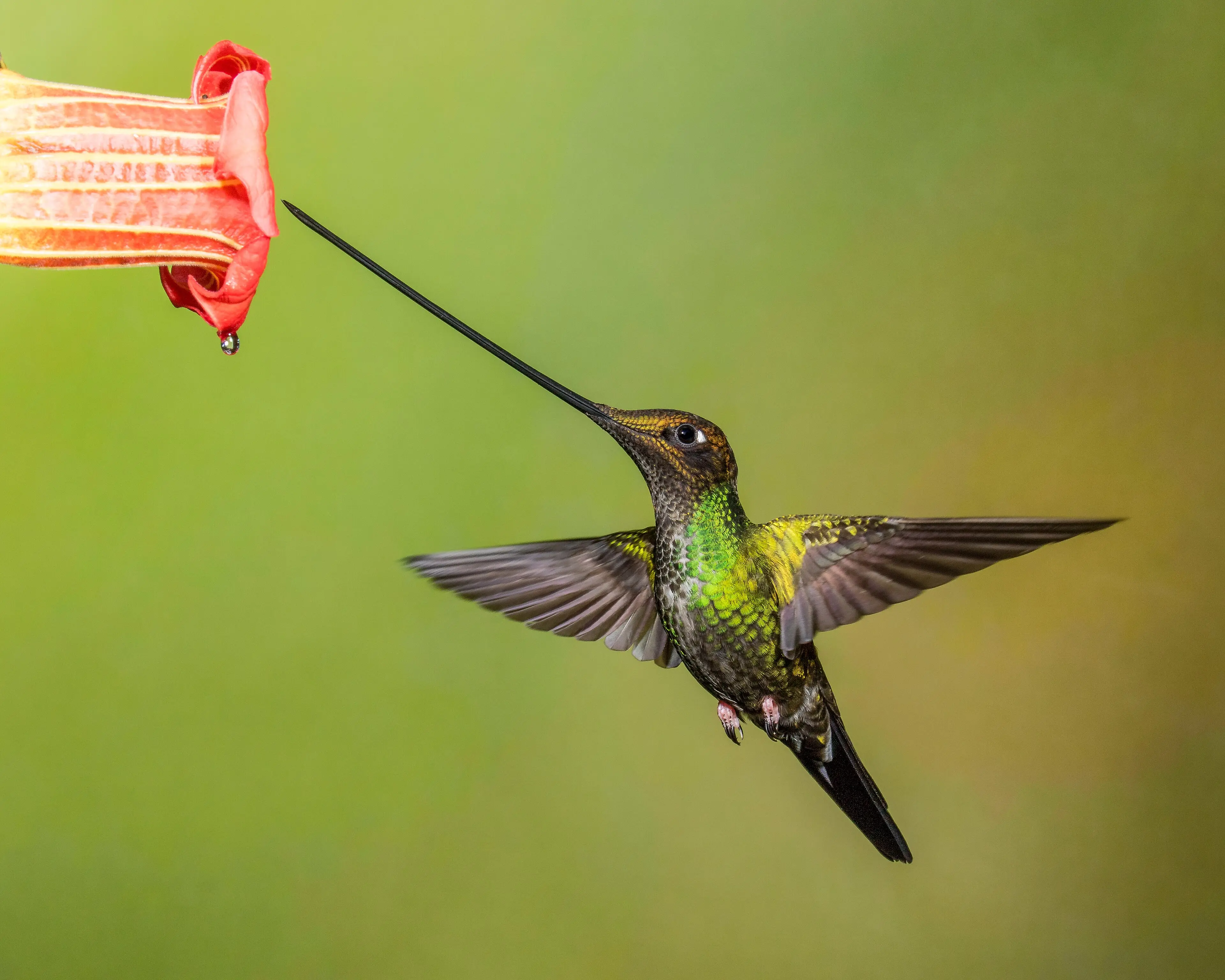
The sword-billed hummingbird is the only bird whose bill, 8–12 cm long, is longer than its body. In Ecuador it lives in Andean cloud forest at 1,700–3,500 m. A reliable place is the Papallacta–Baeza road east of Quito. It is a regular at Guango, 11 km up the road from San Pedrito.
Facts at a glance
It is a large Andean hummingbird, 13–14 cm long without the bill and 10–15 g in weight. The figures below come from its Wikipedia species account.
| Scientific name | Ensifera ensifera, the only species in its genus |
|---|---|
| Spanish (Ecuador) | Colibrí picoespada |
| Bill length | 8–12 cm (3.1–4.7 in), longer than the body |
| Body length | 13–14 cm without the bill; 10–15 g |
| Range | Andes of Venezuela, Colombia, Ecuador, Peru and Bolivia |
| Altitude | 1,700–3,500 m; most common at 2,400–3,100 m |
| Main food | Nectar of long-tubed flowers, especially tacso (Passiflora mixta); also insects |
| Conservation | Least Concern (IUCN); listed on CITES Appendix II |
7 sword-billed hummingbird facts
Its record bill, its partner flower and its odd habits make it one of the Andes' strangest birds. Here are seven facts worth knowing before you go looking.
- The longest bill for its size. It is the only known bird whose bill is longer than the rest of its body, not counting the tail.
- A name that means "sword-bearer". Ensifera comes from the Latin ensis (sword) and ferre (to carry).
- Alone in its genus. Auguste Boissonneau described it in 1839. Since 1843 it has been the only member of Ensifera.
- A flower made for it. The tacso Passiflora mixta hides its nectar so deep that almost no other bird can reach it.
- It sits with its bill up. Perching with the bill angled upward takes the strain off its neck.
- It combs with its feet. The bill is too long for preening, so it scratches and grooms with its feet.
- It hunts with an open bill. Besides nectar, it catches small flying insects by keeping its bill open in flight.
Why is the bill so long?
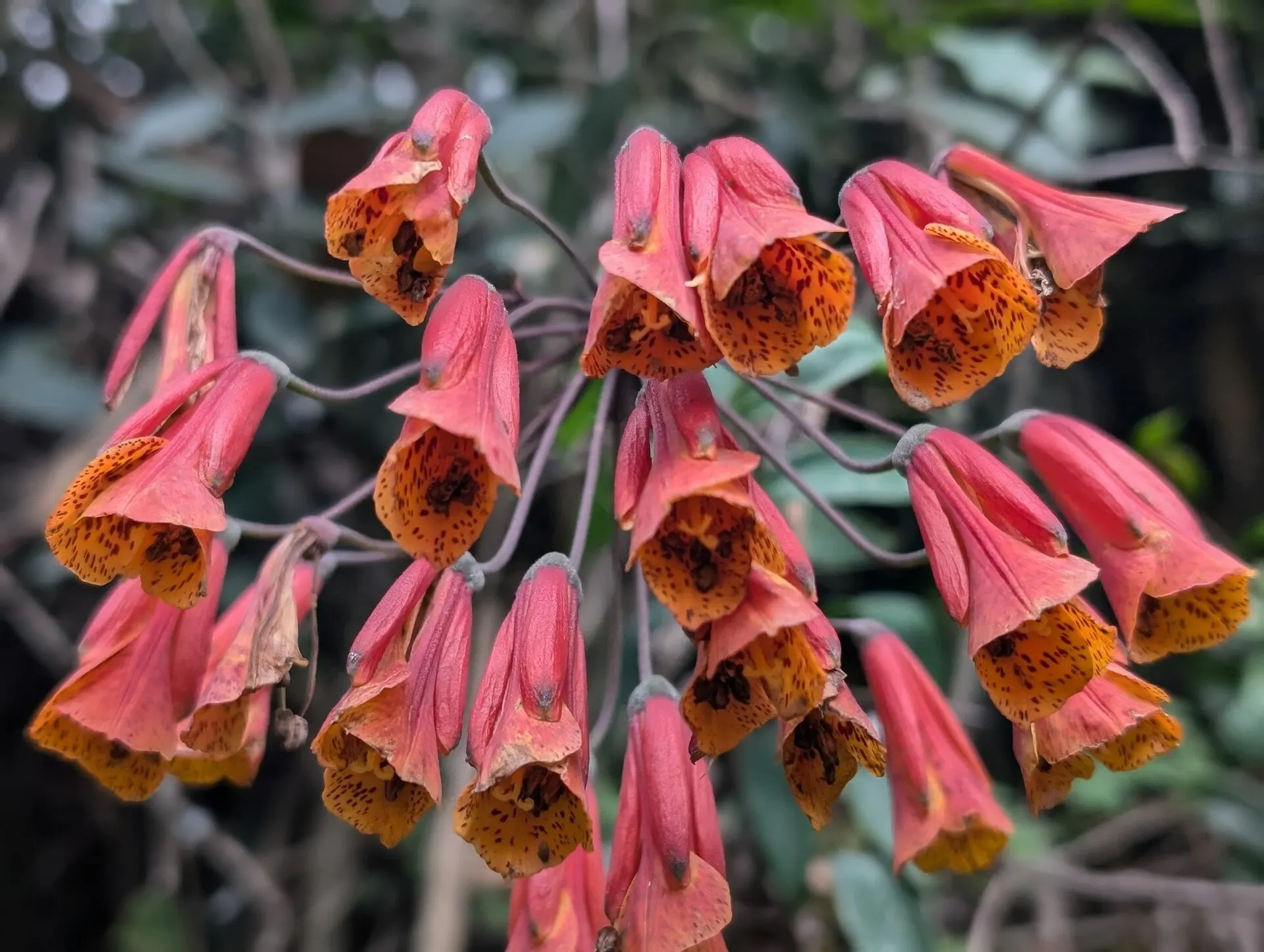
The long bill lets it reach nectar deep inside long-tubed passionflowers. It evolved together with the Andean tacsos (the subgenus Tacsonia), above all Passiflora mixta. Its pink, hanging flowers hide nectar at the end of a very long tube. Almost no other hummingbird can reach it. The swordbill drinks from below and pollinates the flower as it feeds. So the bird's range closely follows where these passionflowers grow.
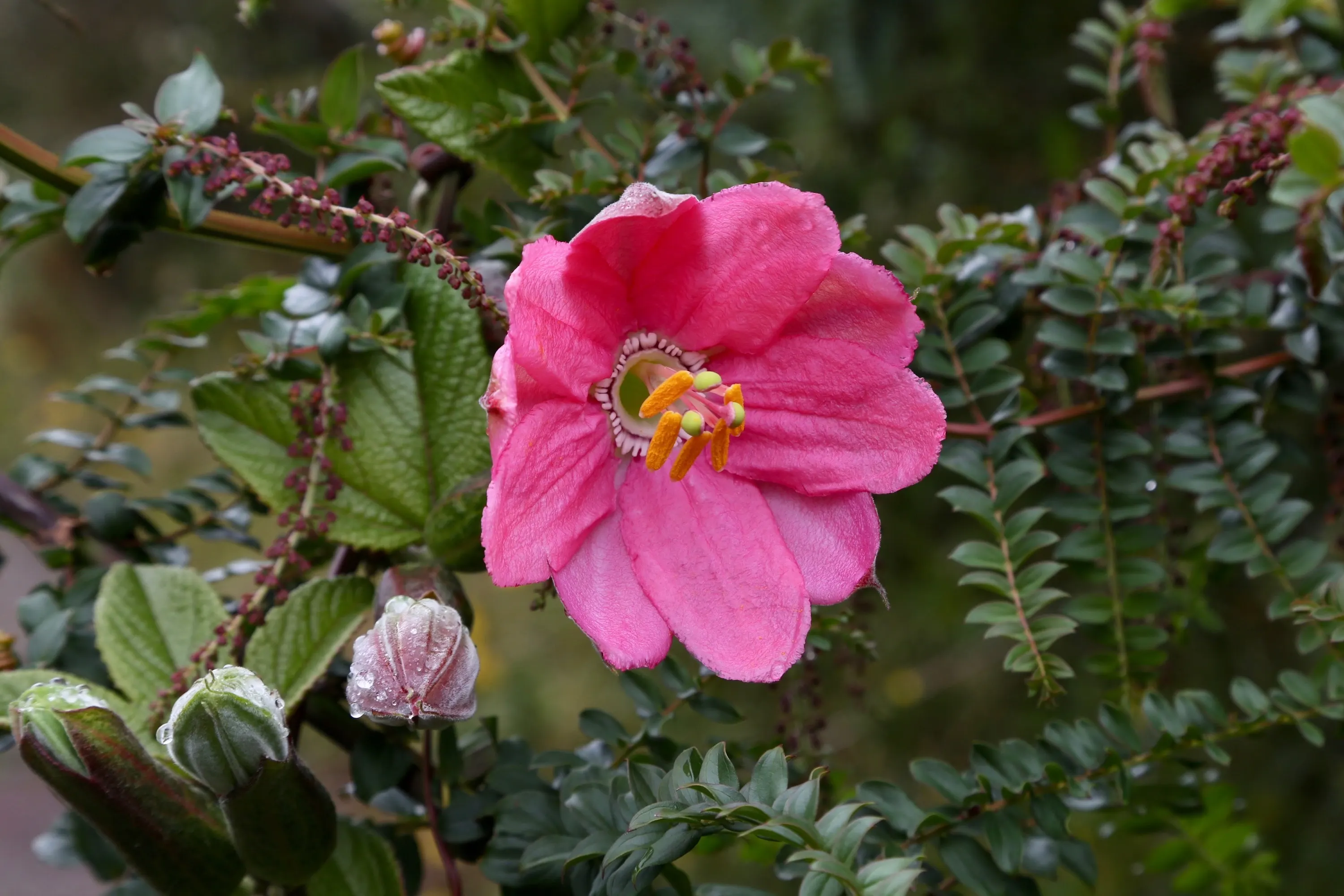
It also feeds on other long, hanging flowers. Red angel's trumpet (Brugmansia sanguinea, called guanto in Ecuador) is a favourite. Fuchsias and Datura are on its menu too.
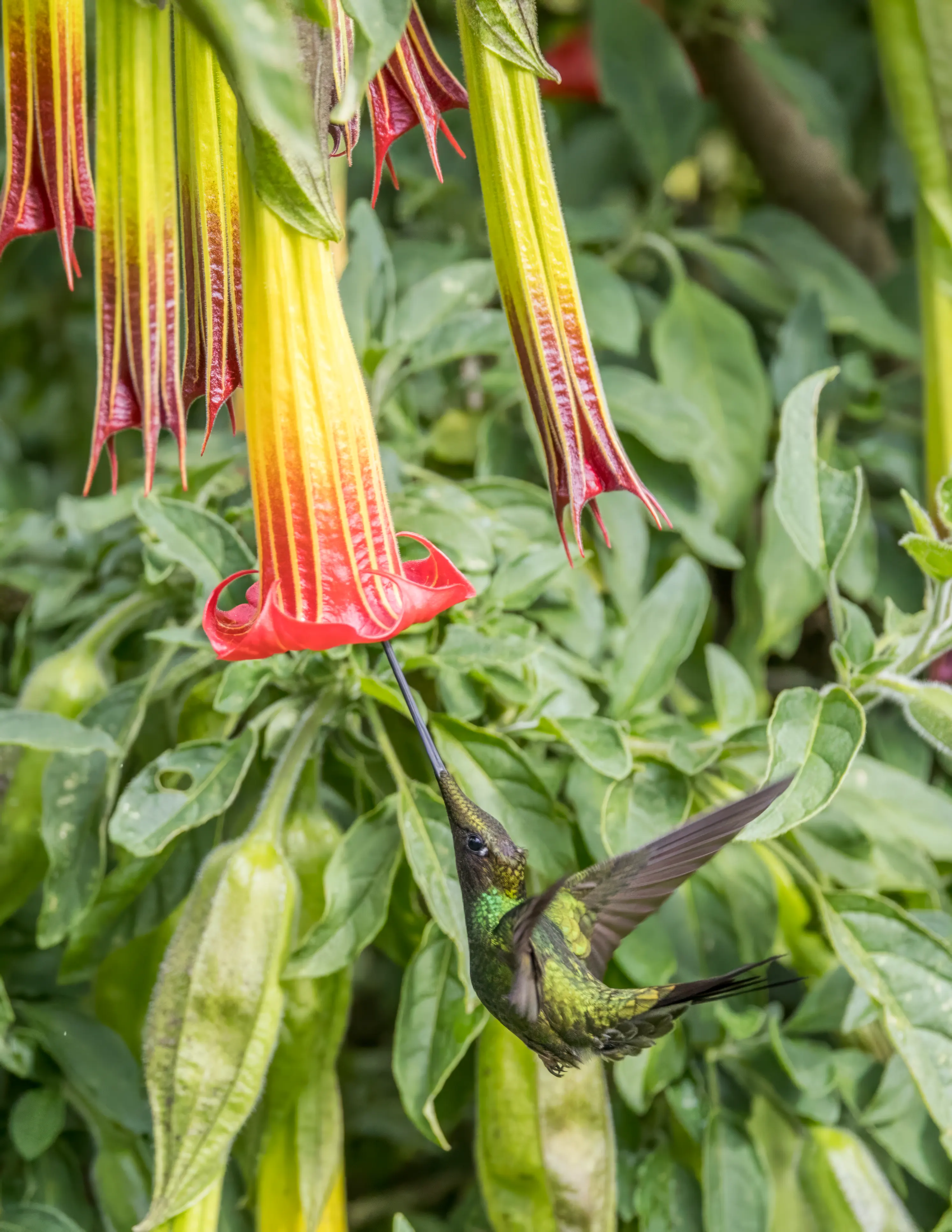
How does it live with such a long bill?
It perches with the bill pointing steeply upward to keep its balance, and it grooms with its feet. For a sword-billed hummingbird, a bill this long changes everything. It cannot reach its feathers with its bill, so the feet do the preening and scratching. It is also a trap-liner. Rather than defending one bush, it flies a regular circuit of flowers. A bird may appear, feed for a few seconds and vanish. Then it comes back on the next round.
How to identify male and female
Both sexes share the giant bill. Males are green below with a forked tail; females are whitish below, speckled with green.
- Both: a large hummingbird with a black, very slightly upturned bill longer than its body. Nothing else looks like it.
- Male: bronze-green above with a coppery head, small white spot behind the eye, dusky throat, green underparts and a forked tail. Males have shorter bills but longer wings and tails than females.
- Female: similar above but whitish below, speckled with green, with a less forked, grey-edged tail.
Similar species and how to tell them apart
Honestly, the sword-billed hummingbird has no real look-alike. The bill settles it at a glance. Confusion only happens when the bird is far away, or when it sits with the bill hidden behind leaves. At that point, other large dark hummingbirds of the same forests can fool you.
- Collared inca: dark, with a bright white bib and a straight bill of only 3–3.5 cm. See our collared inca guide.
- Coronets: shorter, straight bills, and they hold their wings up after landing. See the coronets.
- Long-tailed sylph: a tiny bill and a very long tail, the opposite proportions. See the long-tailed sylph.
Where can you see a sword-billed hummingbird in Ecuador?
Look in humid montane forest and gardens between about 2,400 and 3,100 m, wherever tacso or angel's trumpets bloom. Its range runs from western Venezuela to Bolivia (source: Wikipedia). East of Quito, the Papallacta–Baeza road is a reliable area. The bird is a regular at the feeders of Guango, at about 2,700 m. Guango is roughly 2 hours from Quito.
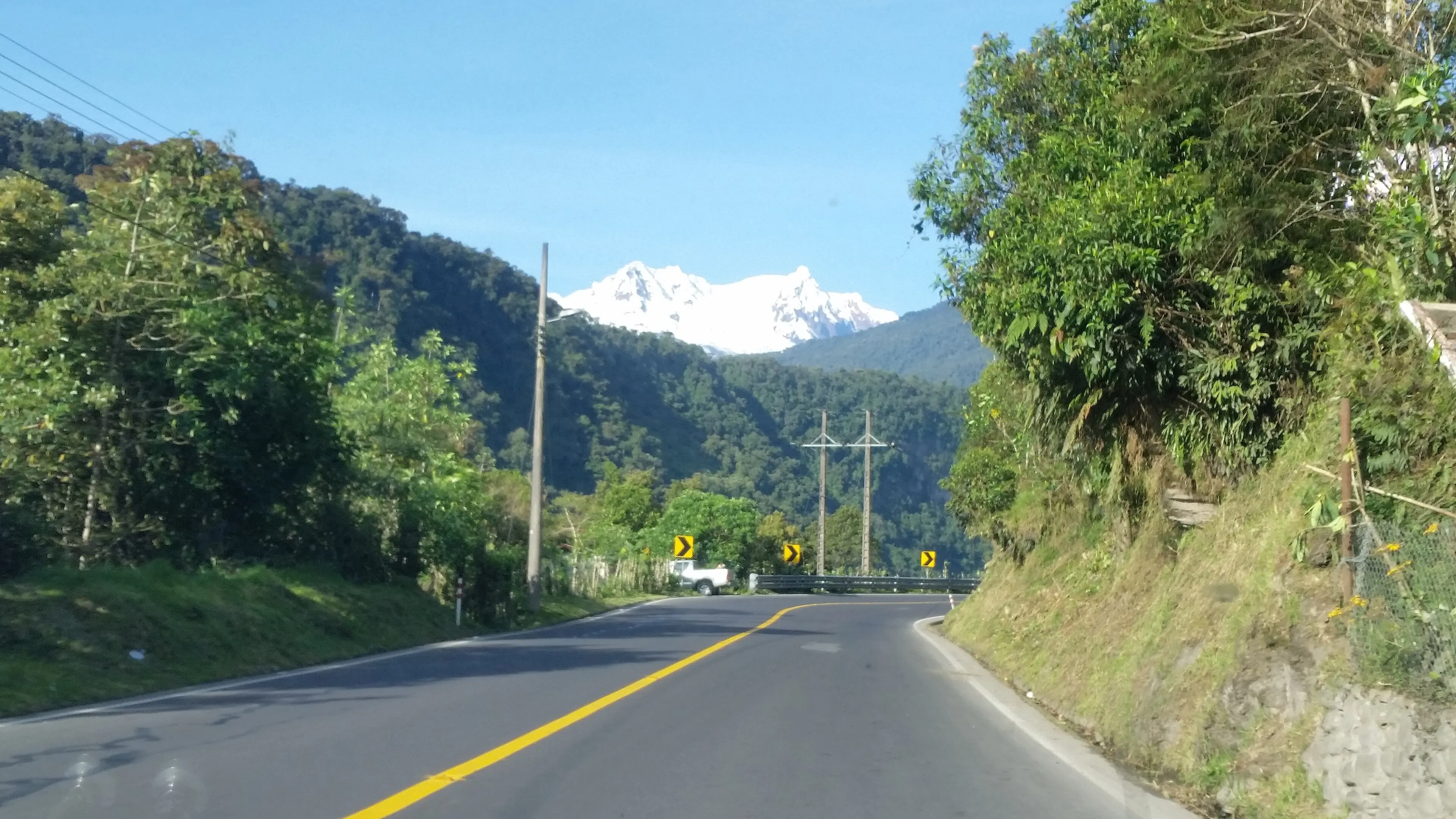
At San Pedrito, 11 km further down the road, the farm sits at 2,330 m. That is the lower edge of its favourite altitude. We have not photographed a sword-billed hummingbird on the farm yet. Our plan is to plant the flowers it depends on, tacso and red angel's trumpet. This page will be updated the day it shows up. The two places are only 10–15 minutes apart, so you can visit both on the same morning. See how to get here.
Best time and place to look near Cuyuja
Any month can work, but go in the morning. Drier, clearer days are likelier from about December to February.
- Any month works. At Guango there is very little bird seasonality, and rain falls fairly evenly all year.
- Drier days are likelier from about November–December to February. May to August is the wettest stretch.
- Mornings are best. Birds are active early, and clouds often build later in the day.
- Bring layers. The populated zone of Cuyuja averages 10–16 °C, with humidity above 80%.
Tips for watching and photographing the sword-billed hummingbird
Arrive early, wait by long flowers rather than feeders, and use a shutter speed of about 1/2000 s or faster.
- Go early. Morning is usually the most active time, and the light is often better before the clouds build up.
- Watch the long flowers, not only the feeders. Find a blooming tacso or angel's trumpet and wait. A trap-liner will come back on its circuit.
- Look up when it perches. Its bill-up posture is the classic photo, and the bird often sits still for a few seconds.
- Use a fast shutter. Around 1/2000 s or faster freezes the wings. Keep the background a metre or more behind the bird.
- Mind the bill in the frame. Leave extra room: the bill is longer than you expect.
More advice in our guide to hummingbird photography in Ecuador.
Breeding and voice
Sword-billed hummingbirds breed around February and March. They build cup-shaped nests of moss. The nests usually hang among root fibres high above the ground. The call is a low, guttural, slightly trilled trrr.
Is it threatened?
No. The IUCN lists it as Least Concern because of its large range and no significant population decline. Climate change and deforestation are the two most likely future threats. Keeping native flowers around farms helps. That is why our garden starts with plants from our list of Andean hummingbird plants.
Sword-billed hummingbird: FAQ
How long is the sword-billed hummingbird's bill?
8–12 cm (3.1–4.7 in), on a body of 13–14 cm. It is the only bird whose bill is longer than the rest of its body, excluding the tail.
Where do sword-billed hummingbirds live?
In humid Andean forest, forest edges and gardens, from western Venezuela to Bolivia. It lives at 1,700–3,500 m, most commonly at 2,400–3,100 m.
Why does the sword-billed hummingbird have such a long beak?
To reach nectar at the bottom of very long flowers, especially tacso passionflowers (Passiflora mixta). The bird and the flower evolved together. Few other hummingbirds can reach that nectar.
Is the sword-billed hummingbird rare?
No. The IUCN lists it as Least Concern, although deforestation and climate change threaten its habitat. It is local, though. You need the right altitude and the right flowers to find it.
Where can I see a sword-billed hummingbird near Quito?
On the eastern slope, the Papallacta–Baeza road is a classic area. It is a regular at Guango, about 2 hours from Quito. San Pedrito, 11 km further down the same road, is at the lower edge of its range.
What is the sword-billed hummingbird called in Spanish?
In Ecuador it is the colibrí picoespada (also written pico de espada). Its scientific name, Ensifera ensifera, means "sword-bearer".
Sources
- "Sword-billed hummingbird", Wikipedia (description, range, diet, behaviour, breeding).
- Reyes Vargas et al. (2022), bird survey of Cuyuja parish, Siembra 9(2). doi:10.29166/siembra.v9i2.3725
- Climate of Cuyuja, GAD Cuyuja; seasonality at Guango, 10,000 Birds.
- Guango reserve checklist and feeder lists, exoticbirding.com.