
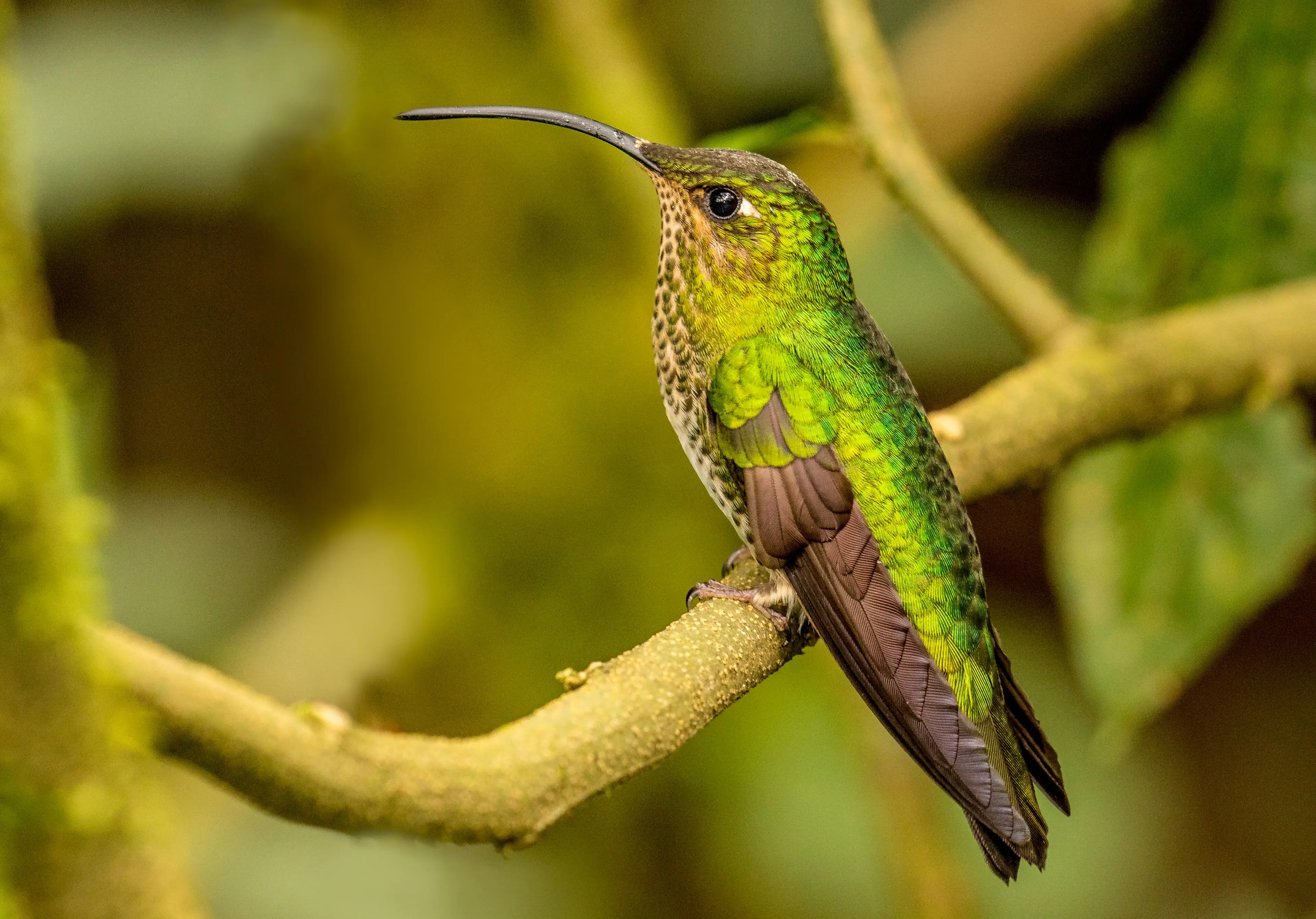
The hummingbirds of Ecuador number 136 recorded species. This guide covers 14 of them that live in the eastern Andes around Cuyuja, at 2,300–2,700 m on the Papallacta–Baeza road. A 2019–2020 survey found 14 hummingbird species in Cuyuja parish, and we have photographed the Collared Inca on our farm.
How we chose these hummingbirds of Ecuador
A species is on this list only if we photographed it at San Pedrito, the Cuyuja survey recorded it, or it is regular at Guango's feeders. We never list a bird just because it is famous.
Here is what each label means. Photographed at San Pedrito means we have seen and photographed it on our farm. Recorded in Cuyuja means it was found in the 2019–2020 bird survey of Cuyuja parish (Reyes Vargas et al., 2022). That survey logged 14 hummingbird species. Regular at Guango means it appears on the feeder lists of Guango, 11 km up the road at about 2,700 m.
So far only one species is in the first group: the Collared Inca. As our feeders and garden mature, we will add a bird to that group only when we see it ourselves.
The 14 hummingbirds of Ecuador's east slope at a glance
These are the 14 species you can realistically meet between 2,300 and 2,700 m on this road. Only the Collared Inca has been photographed at San Pedrito so far.
| English name | Scientific | Ecuador Spanish | Status near Cuyuja |
|---|---|---|---|
| Sword-billed Hummingbird | Ensifera ensifera | Colibrí picoespada | Regular at Guango feeders; recorded in Cuyuja |
| Collared Inca | Coeligena torquata | Inca collarejo | Photographed at San Pedrito |
| Chestnut-breasted Coronet | Boissonneaua matthewsii | Coronita pechicastaña | Regular, often dominant at feeders; recorded in Cuyuja |
| Buff-tailed Coronet | Boissonneaua flavescens | Coronita colianteada | Regular at Guango feeders |
| Tourmaline Sunangel | Heliangelus exortis | Solángel turmalina | Regular at Guango feeders |
| Long-tailed Sylph | Aglaiocercus kingii | Silfo colilargo | Regular; recorded in Cuyuja |
| Mountain Velvetbreast | Lafresnaya lafresnayi | Colibrí aterciopelado | Regular; most numerous at 2,000–2,800 m |
| Sparkling Violetear | Colibri coruscans | Orejivioleta ventriazul | Regular; recorded in Cuyuja |
| Tyrian Metaltail | Metallura tyrianthina | Metalura tiria | Regular at Guango feeders |
| White-bellied Woodstar | Chaetocercus mulsant | Estrellita ventriblanca | Regular; recorded in Cuyuja |
| Gorgeted Woodstar | Chaetocercus heliodor | Estrellita de gorguera | Scarcer; recorded in Cuyuja |
| Speckled Hummingbird | Adelomyia melanogenys | Colibrí jaspeado | Recorded in Cuyuja |
| Bronzy Inca | Coeligena coeligena | Inca bronceado | Recorded in Cuyuja (lower forest) |
| Peruvian Racket-tail | Ocreatus peruanus | Colibrí de raquetas | Recorded in Cuyuja |
Sword-billed Hummingbird
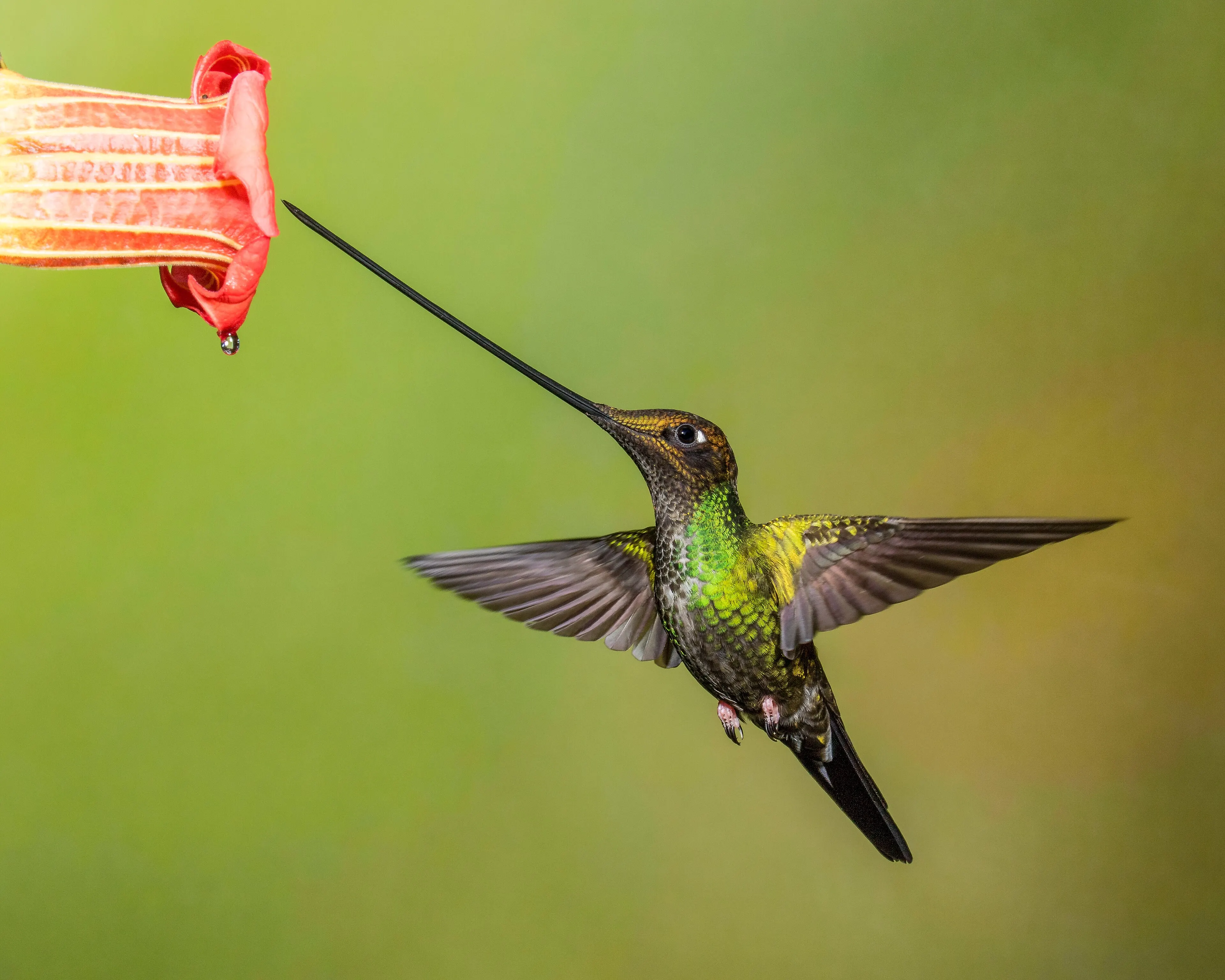
This is the star of the road. It is the only bird whose bill is longer than its body, not counting the tail. It feeds on long, hanging flowers such as tacso passionflowers and red angel's trumpet. When it perches, it points its bill up to balance the weight.
It is most common at 2,400–3,100 m. That makes it a regular at Guango, while our 2,330 m sits near the lower edge of its range. Full guide to the Sword-billed Hummingbird
Collared Inca
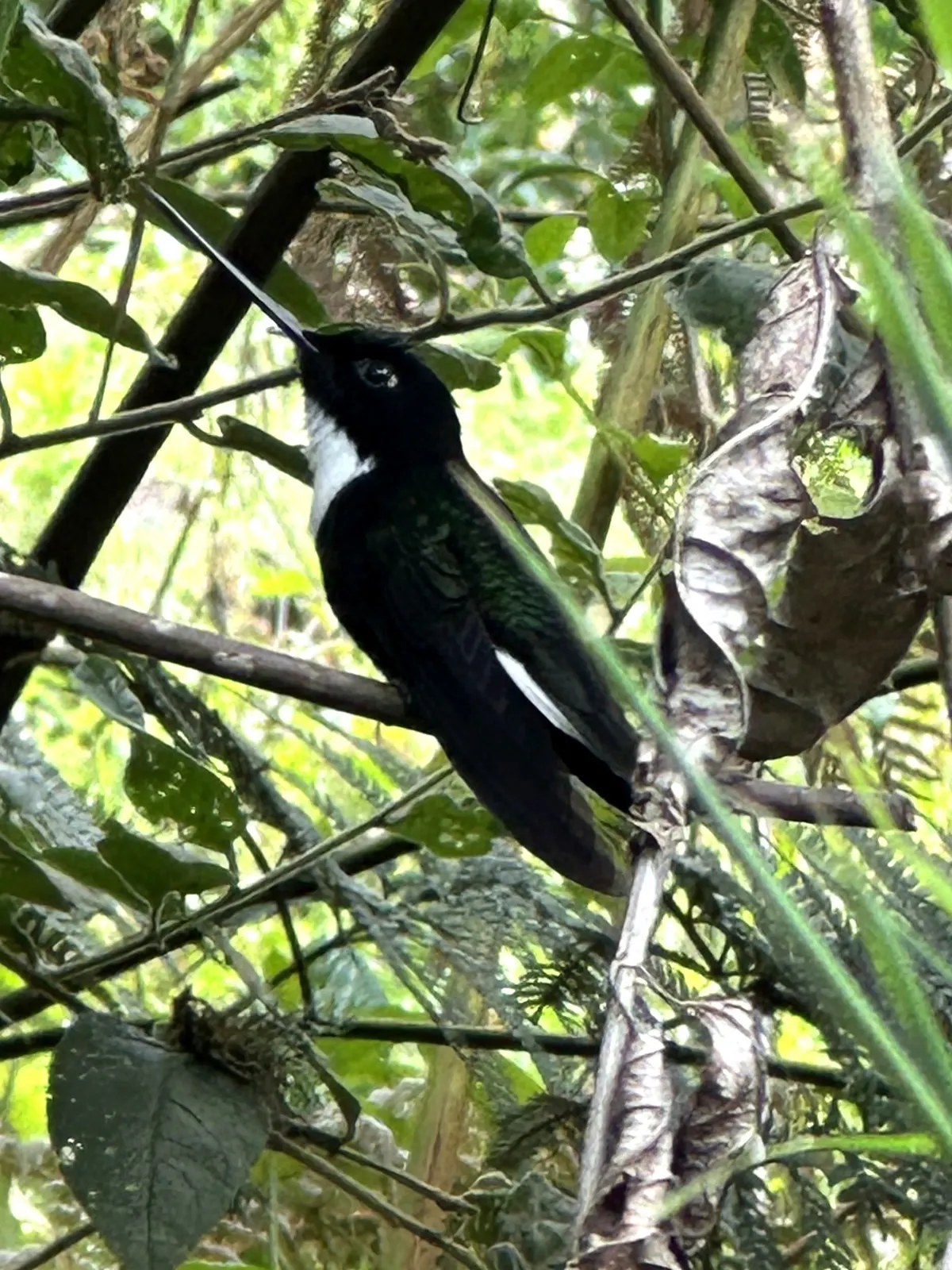
The Collared Inca is easy to recognise. It is a dark, almost black hummingbird with a bright white bib, white flashes in the tail and a long straight bill. The race on Ecuador's eastern slope is C. t. torquata. In Ecuador it usually lives above 2,100 m.
It feeds alone along a fixed route of flowers, often epiphytes and bromeliads. That is why bromeliads are on our planting list. This is the first species we photographed on the farm. Full guide to the Collared Inca
Chestnut-breasted and Buff-tailed Coronets
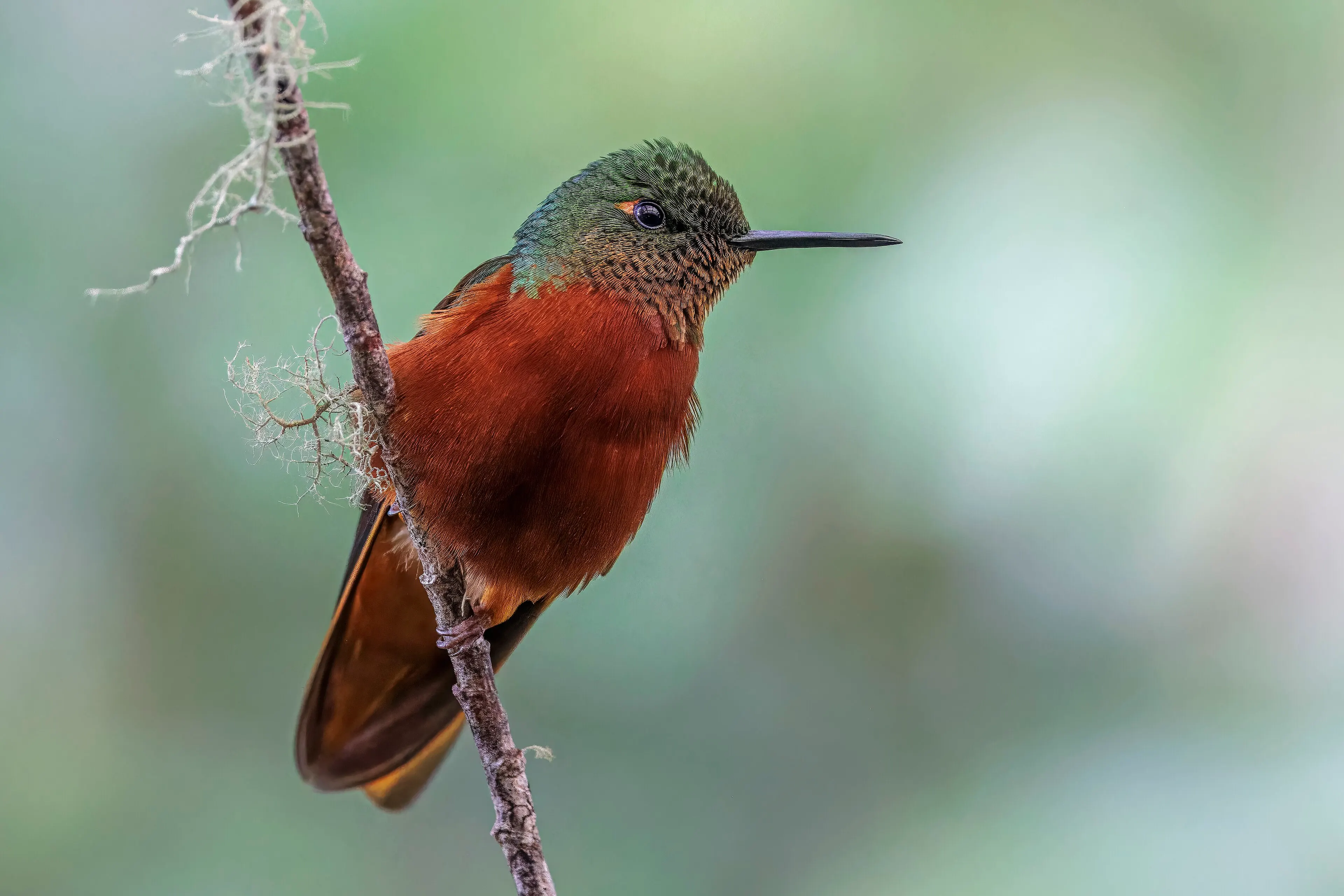
Coronets are chunky, bossy hummingbirds. They hold their wings up for a moment after landing. The Chestnut-breasted Coronet is green above and rich rufous below. It is often the dominant bird at feeders in this valley, and it was recorded in the Cuyuja survey.
The Buff-tailed Coronet is all green with buffy tail feathers. It is a regular at Guango. How to tell the coronets apart
Long-tailed Sylph
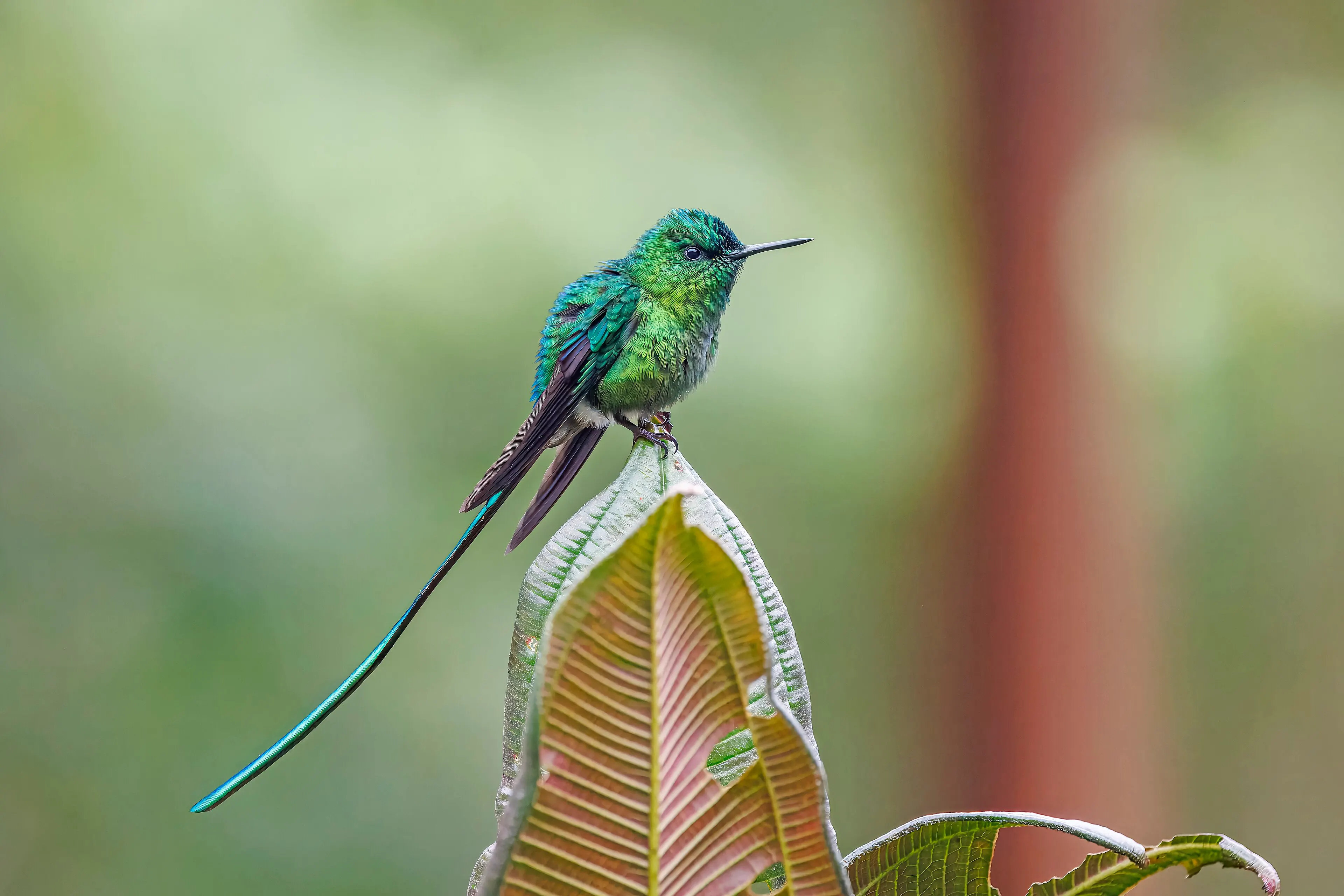
Males trail a glittering blue-green tail longer than the rest of the bird. It was recorded in Cuyuja. If you have birded Mindo, you may know its look-alike there. That is the Violet-tailed Sylph, a different species of the western slope. Full guide to the Long-tailed Sylph
Tourmaline Sunangel
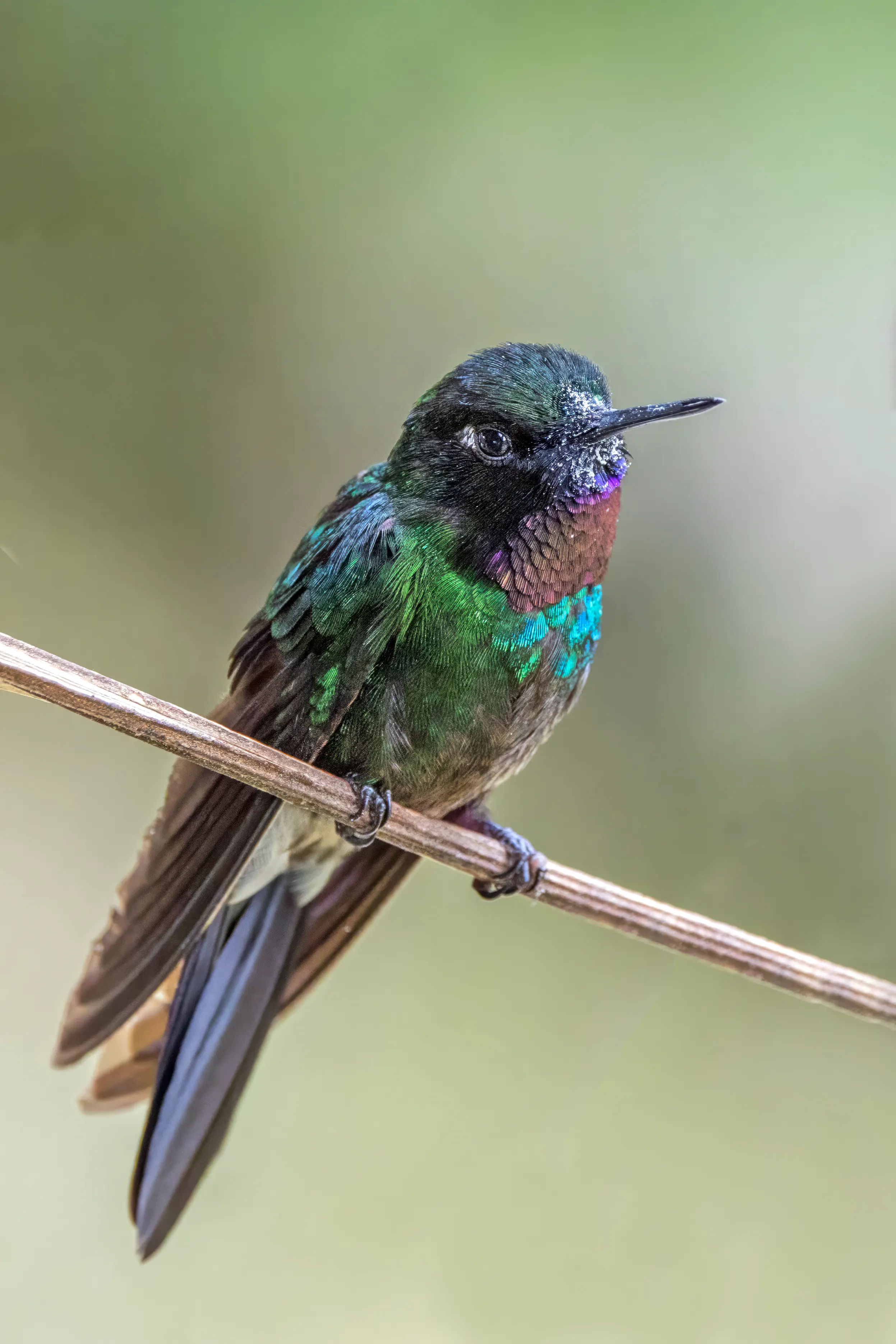
This is a small, dark sunangel. When the male turns toward the light, it flashes a glittering rosy-pink throat, edged emerald below. It is a regular at Guango. Many visiting birders put it high on their list of hummingbirds of Ecuador to see. Full guide to the Tourmaline Sunangel
Mountain Velvetbreast
A velvety, dark-bellied hummingbird with a gently curved bill. It is most numerous between 2,000 and 2,800 m, which is exactly our altitude band. Guango's feeder lists show it as a regular. This bird likes the tubular flowers of Siphocampylus and Centropogon, shrubs of the forest edge.
Woodstars, metaltails, violetears and racket-tails
The tiny White-bellied and Gorgeted Woodstars fly like bumblebees. Both were recorded in Cuyuja. The Tyrian Metaltail is a short-billed bird of higher, colder forest that visits Guango's feeders. The Sparkling Violetear is the loud, common species you also see in Quito. It was recorded in Cuyuja too.
The racket-tails here are Peruvian Racket-tails, also recorded in Cuyuja. Until recently they were lumped with western birds as the "Booted Racket-tail". That species has now been split. The bird in Mindo is the White-booted Racket-tail.
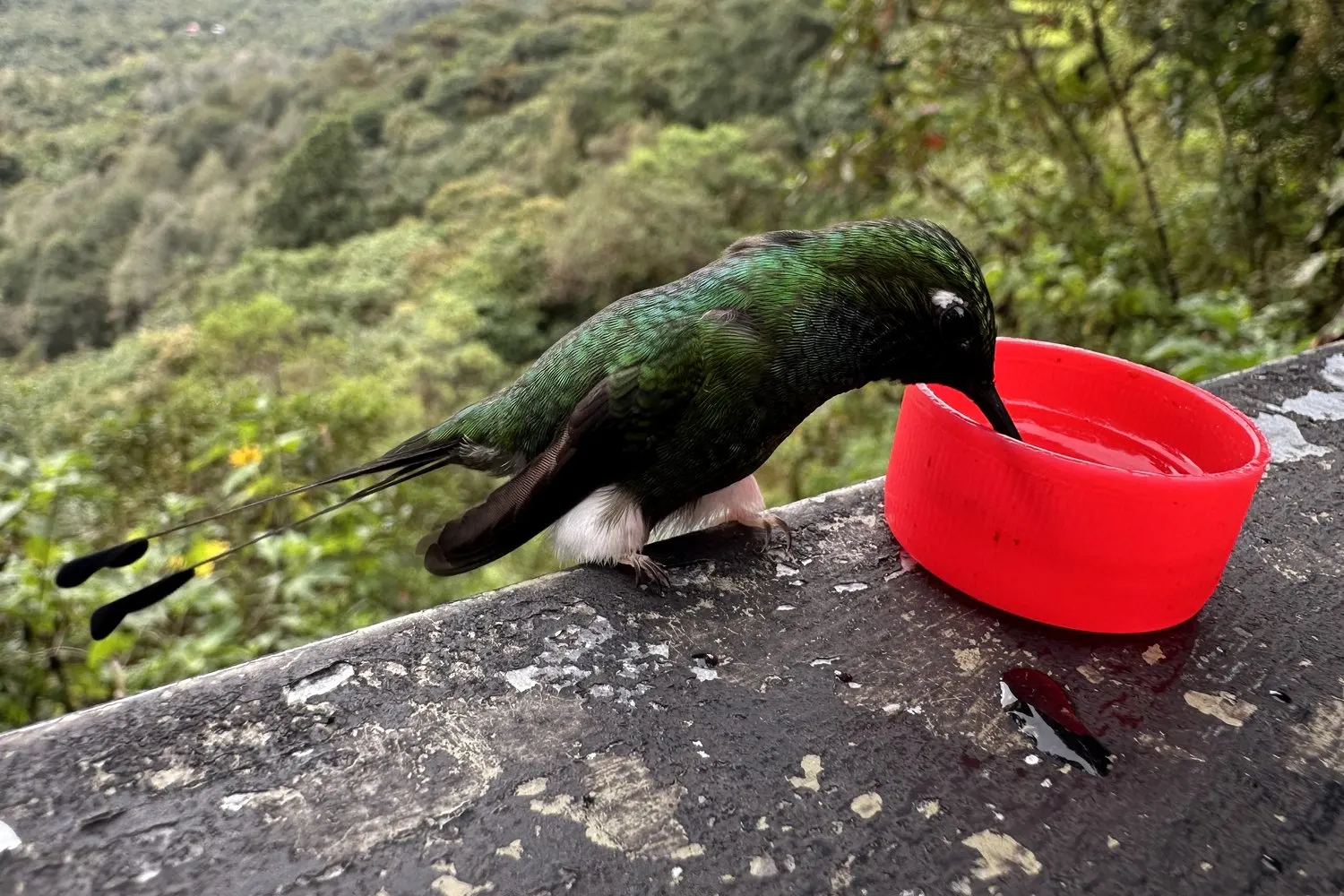
Two more birds from the Cuyuja survey complete our list of 14 hummingbirds of Ecuador. The Speckled Hummingbird is a small, plain bird of the forest interior. The Bronzy Inca is a cousin of the Collared Inca that keeps to lower forest.
Are east-slope and west-slope hummingbirds of Ecuador the same?
No. Ecuador's cloud forests are split by the Andes into two slopes, and many hummingbirds live on only one side. Mindo and Tandayapa, west of Quito, have specialties such as the Velvet-purple Coronet and the Violet-tailed Sylph. Our eastern slope has the Chestnut-breasted Coronet, the Long-tailed Sylph and the Peruvian Racket-tail.
If you have already birded Mindo, the east slope gives you a new list of hummingbirds of Ecuador. The road from Quito to Cuyuja takes about 1 h 30 to 2 h.
The hummingbirds of Ecuador in numbers
Five numbers sum up hummingbird diversity here, from the whole country down to our farm.
- 136 hummingbird species recorded in Ecuador (SACC list).
- 1,718 bird species in the country, about 18% of the world total (CERO 2021, cited by Reyes Vargas et al.).
- 141 bird species logged in the Cuyuja survey, 14 of them hummingbirds.
- 36 hummingbirds on the Guango reserve checklist, out of 298 bird species.
- 1 species photographed at San Pedrito so far: the Collared Inca.
Species you should not expect at 2,330 m
Some famous hummingbirds of Ecuador live much higher or lower than we do. The Giant Hummingbird, Shining Sunbeam, Great Sapphirewing and Ecuadorian Hillstar belong to the páramo and the dry inter-Andean valleys. The Black-breasted Puffleg lives only on the northwest slopes of Pichincha volcano. We won't promise them here.
When is the best time to see hummingbirds in the eastern Andes?
Any month can be good, and mornings are usually busiest. Birders at nearby Guango report very little seasonal change in the species. Drier, clearer days are more likely from about November or December to February, while May to August is the wettest stretch.
The hummingbirds of Ecuador's cloud forest come and go with the weather and with what is flowering. Plan your trip with our visiting guide. If you are a photographer, a fast shutter (1/2000 s or more) freezes the wings, and our photography tips cover the rest.
Hummingbirds of Ecuador: FAQ
How many types of hummingbirds are there in Ecuador?
136 hummingbird species have been recorded in Ecuador (South American Classification Committee list). They live from the Amazon lowlands up to the páramo.
Where is the best place to see hummingbirds in Ecuador?
Cloud forests between about 1,500 and 3,000 m hold the most species. West of Quito, Mindo and the Tandayapa valley are famous. East of Quito, the Papallacta–Baeza road (Guango, Cuyuja) has a different set of high-elevation hummingbirds of Ecuador, such as the Sword-billed Hummingbird and the Chestnut-breasted Coronet.
Can you see hummingbirds in Quito?
Yes. The Sparkling Violetear and Black-tailed Trainbearer visit parks and gardens in Quito. For variety, though, head to the cloud forest 1–2 hours away.
Can you find the long-tailed hummingbird in Ecuador?
Yes. The Long-tailed Sylph lives in Ecuador's Andes and was recorded in Cuyuja. Around Mindo, on the western slope, you may also meet its look-alike, the Violet-tailed Sylph. How to tell them apart.
Are the east-slope and west-slope hummingbirds the same?
Many are not. The Andes act as a wall between the two slopes. Mindo has western specialties such as the Velvet-purple Coronet and Violet-tailed Sylph. The eastern slope has the Chestnut-breasted Coronet and Long-tailed Sylph.
Sources
- Reyes Vargas, M.V., Salagaje Muela, L.A. & Ortega Ocaña, Á.F. (2022). Estado actual de la avifauna en Quijos Huayco, parroquia Cuyuja, provincia de Napo, para promover el aviturismo. Siembra 9(2): e3725. doi:10.29166/siembra.v9i2.3725
- Guango reserve bird checklist, exoticbirding.com.
- Guango seasonality, 10,000 Birds.
- List of birds of Ecuador (SACC taxonomy), Wikipedia.