
The best hummingbird plants for the Andes are native, tubular flowers that fit local bills, such as tacso, fuchsias and bomarea. These are the 10 we are planting at our lookout in Cuyuja, Ecuador, at 2,330 m. Here it is 10–16 °C and rains in every month. Feeders bring hummingbirds in; flowers make them stay.
Why do native hummingbird plants matter at 2,330 m?
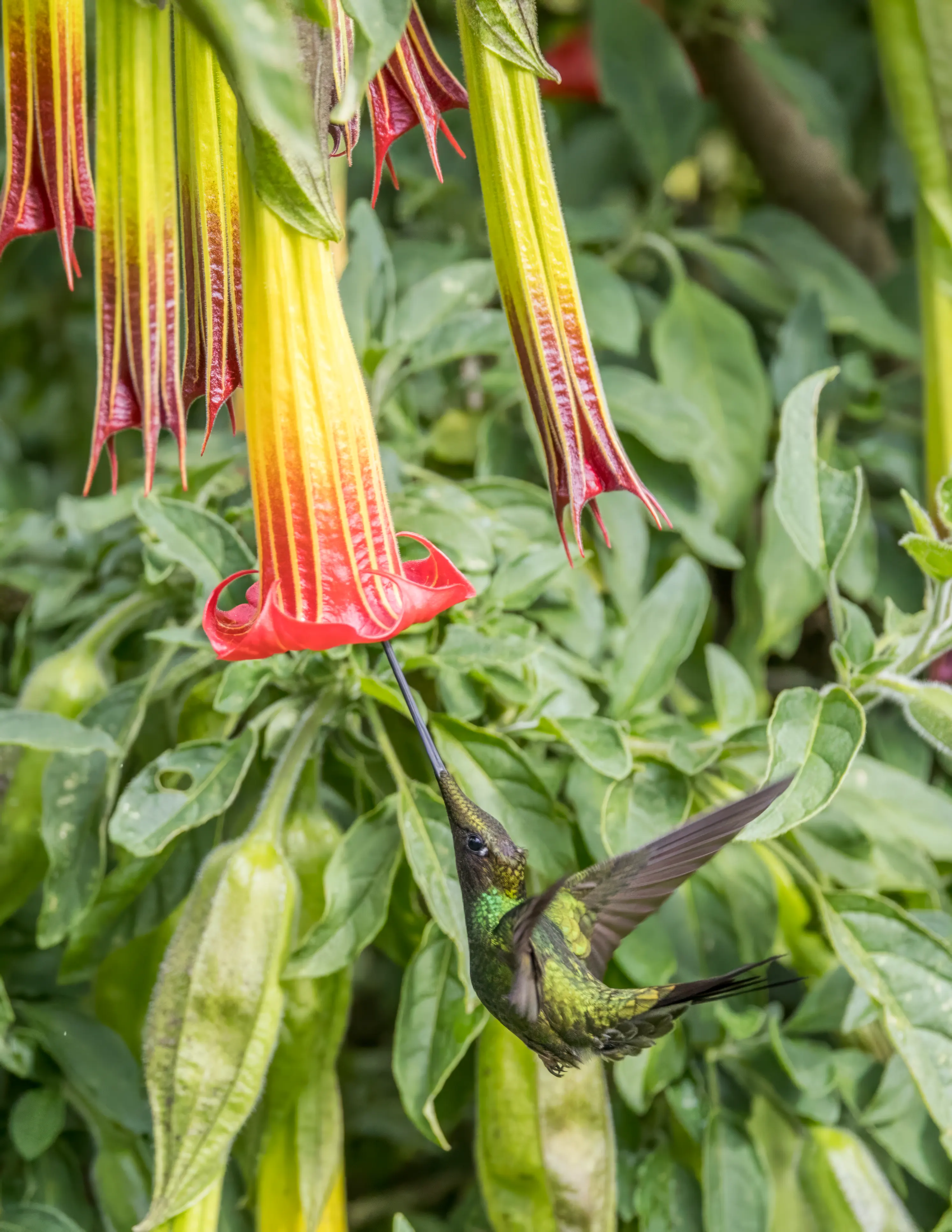
Native flowers fit the bills of local hummingbirds and survive the constant rain. Andean hummingbirds and flowers have shaped each other for millions of years. A sword-billed hummingbird needs flowers with very long tubes. A short-billed metaltail cannot use them. Garden plants bought for colour often don't fit the local bills, and some exotic plants escape into the forest.
Native plants also do better in our climate. Here it is about 10–16 °C, often cloudy, and it rains in every month. Dry-valley plants tend to rot in that much water.
Research in the Andes of southern Ecuador found that shrubs with many flowers are keystone plants for hummingbirds (Tinoco et al., 2022). A study in the Peruvian Andes found that when a plant flowers matters most for which birds use it (González & Loiselle, 2016). So we plant many species in groups, and something is always in bloom.
Our 10 hummingbird plants at a glance
All 10 are native hummingbird plants of the Andes, and they grow at or near our altitude. Each row shows the plant's type, its altitude range and the hummingbird it serves.
| Plant | Scientific name | Type | Altitude | Hummingbird link |
|---|---|---|---|---|
| Tacso | Passiflora mixta | Vine | 1,700–3,700 m | Sword-billed Hummingbird — its long tube is made for that bill |
| Red angel's trumpet (guanto) | Brugmansia sanguinea | Shrub / small tree | 2,000–3,000 m | Sword-billed Hummingbird. Toxic — see below |
| Native fuchsias | Fuchsia spp. (e.g. F. vulcanica) | Shrub | F. vulcanica 2,500–4,000 m | Almost all American fuchsias are hummingbird-pollinated |
| Iochroma | Iochroma fuchsioides | Shrub | 2,400–3,500 m | Tubular-flowered iochromas are hummingbird-pollinated |
| Bomarea | Bomarea spp. (e.g. B. patinii) | Climbing herb | B. patinii 1,800–3,300 m | "A variety of hummingbirds"; Sword-billed feeds on Bomarea |
| Joyapa | Macleania rupestris | Shrub / epiphyte | 2,000–4,267 m | Tubular Ericaceae are visited by incas (Coeligena) |
| Siphocampylus & Centropogon | Siphocampylus spp., Centropogon spp. | Shrub | Andean cloud forest | Preferred by the Mountain Velvetbreast |
| Bromeliads | Guzmania, Tillandsia | Epiphyte | Varies by species | Collared Inca favours epiphytes, especially bromeliads |
| Andean sage | Salvia corrugata | Shrub | About 2,400–3,000 m | Attracts hummingbirds |
| Porotón / guato | Erythrina edulis | Tree | 2,000–2,800 m | Red flowers with nectar; also edible beans |
1. Tacso, the swordbill's flower
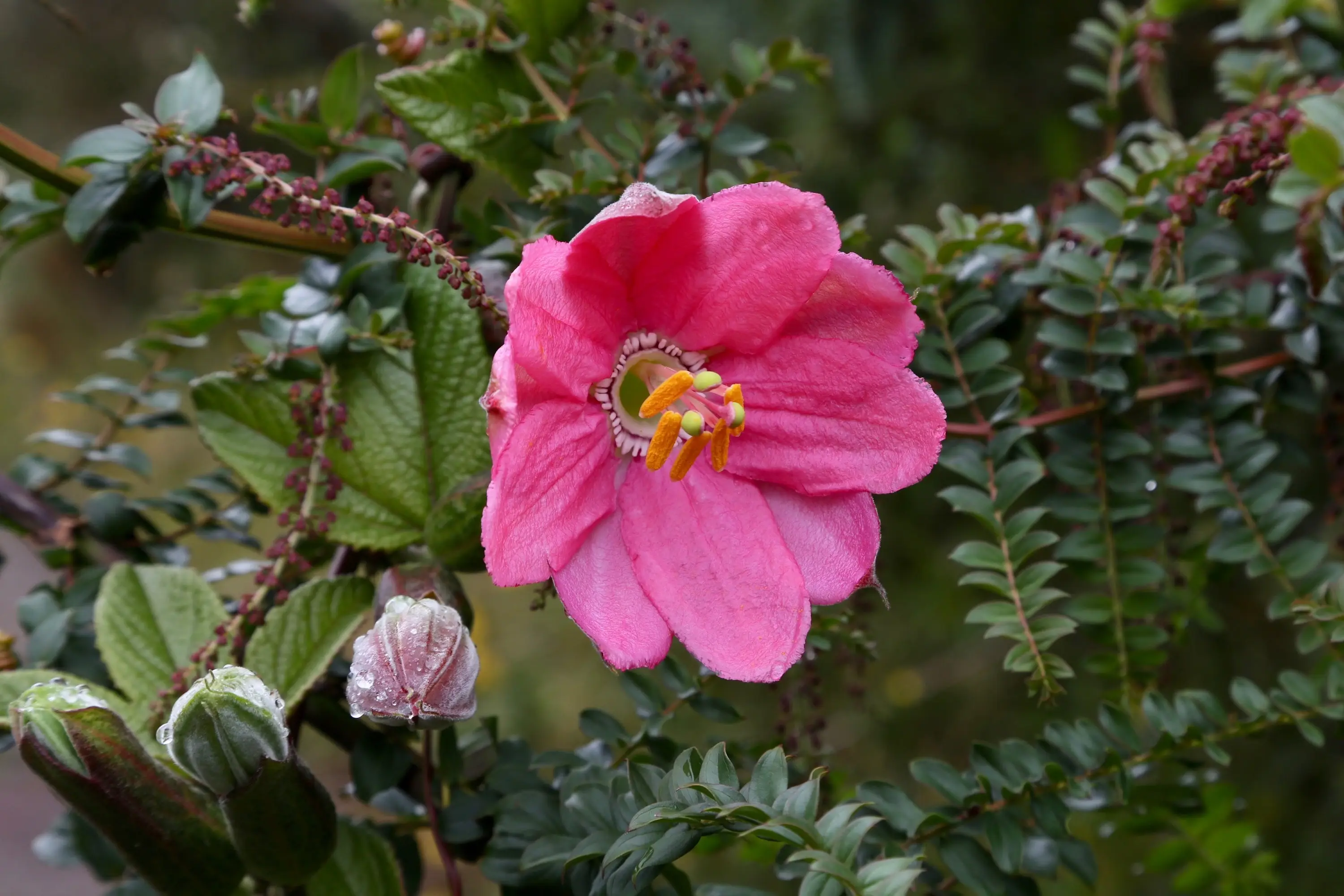
The pink, hanging flowers of Passiflora mixta hold their nectar at the end of a very long tube. The sword-billed hummingbird is one of the few birds that can reach it, and the plant depends on it to set seed. Tacsos grow as vines. We are training them over fences near the lookout.
Plant several, because the flowers need pollen from another plant. Prune them too: outside its home range this vine has become naturalised in places such as New Zealand.
2. Red angel's trumpet (guanto)
Brugmansia sanguinea has red-and-yellow trumpets without scent. That marks a hummingbird flower. The white, fragrant angel's trumpets are pollinated by moths instead. It grows easily from cuttings of 10–20 cm.
Remarkably, the IUCN lists it as Extinct in the Wild. Today it survives in gardens, so growing it helps keep it around.
Warning: every part of angel's trumpet is poisonous. It contains scopolamine and related alkaloids. We plant it away from paths, children and animals. We prune it with gloves and never leave cuttings where livestock can eat them.
3. Native fuchsias
Almost all fuchsias from the Americas are pollinated by hummingbirds. We prefer native species with simple, long-tubed red or orange flowers over garden hybrids. Fuchsia vulcanica, a native of Colombia and Ecuador, usually grows a little higher (2,500–4,000 m). We are testing how it does at our 2,330 m.
4. Iochroma, a living fence
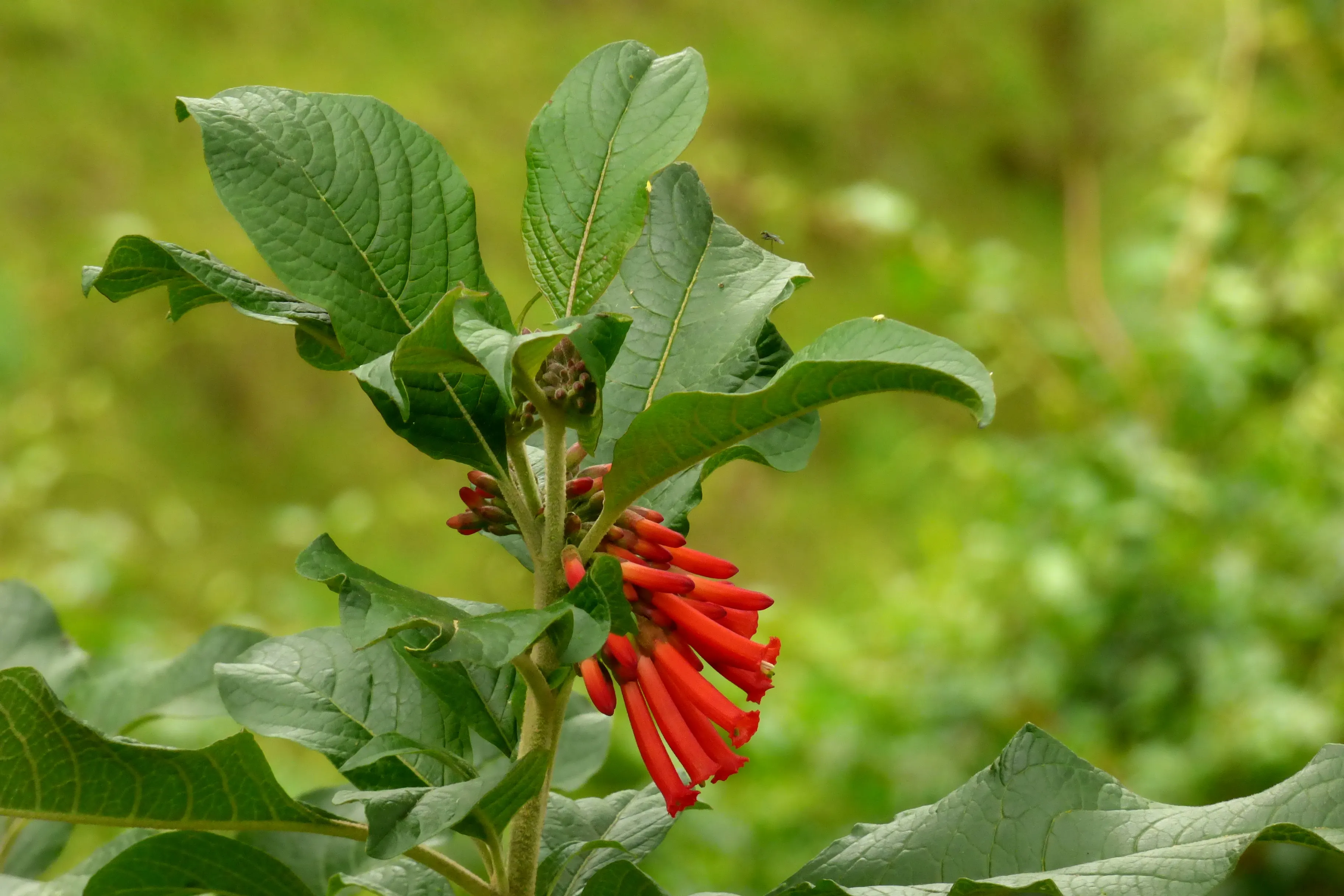
Iochroma fuchsioides is a cloud-forest shrub of 2,400–3,500 m. It grows naturally along pasture fences and roadsides, so it is perfect for the living fence along our boundary. Its tubular orange-red flowers are a hummingbird design.
5. Bomarea, vines full of flowers
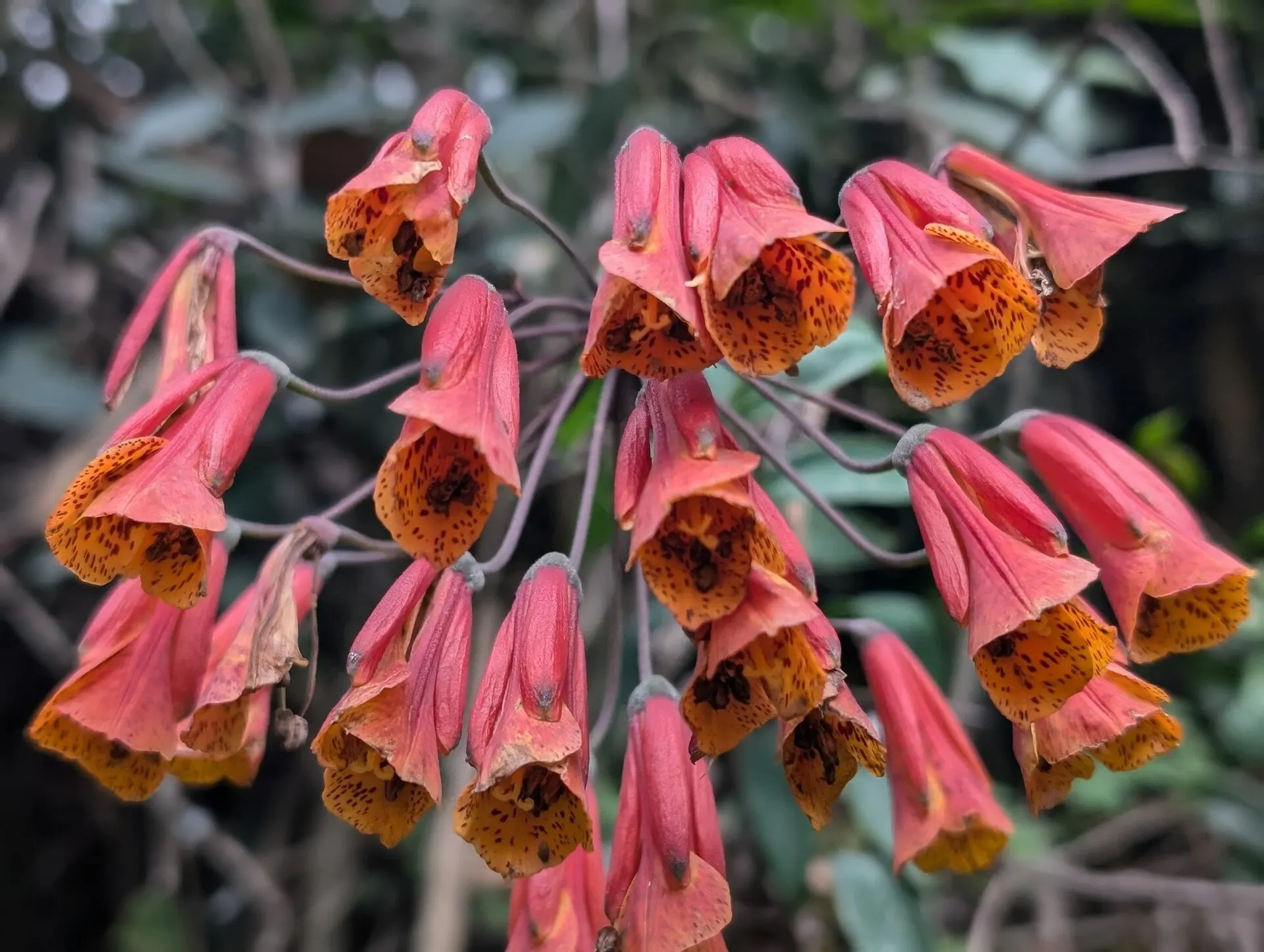
Bomareas climb through shrubs and open huge clusters of bell-shaped flowers. Bomarea patinii can carry up to 100 per cluster. Many hummingbirds visit them, including the swordbill.
6. Joyapas and other Andean Ericaceae
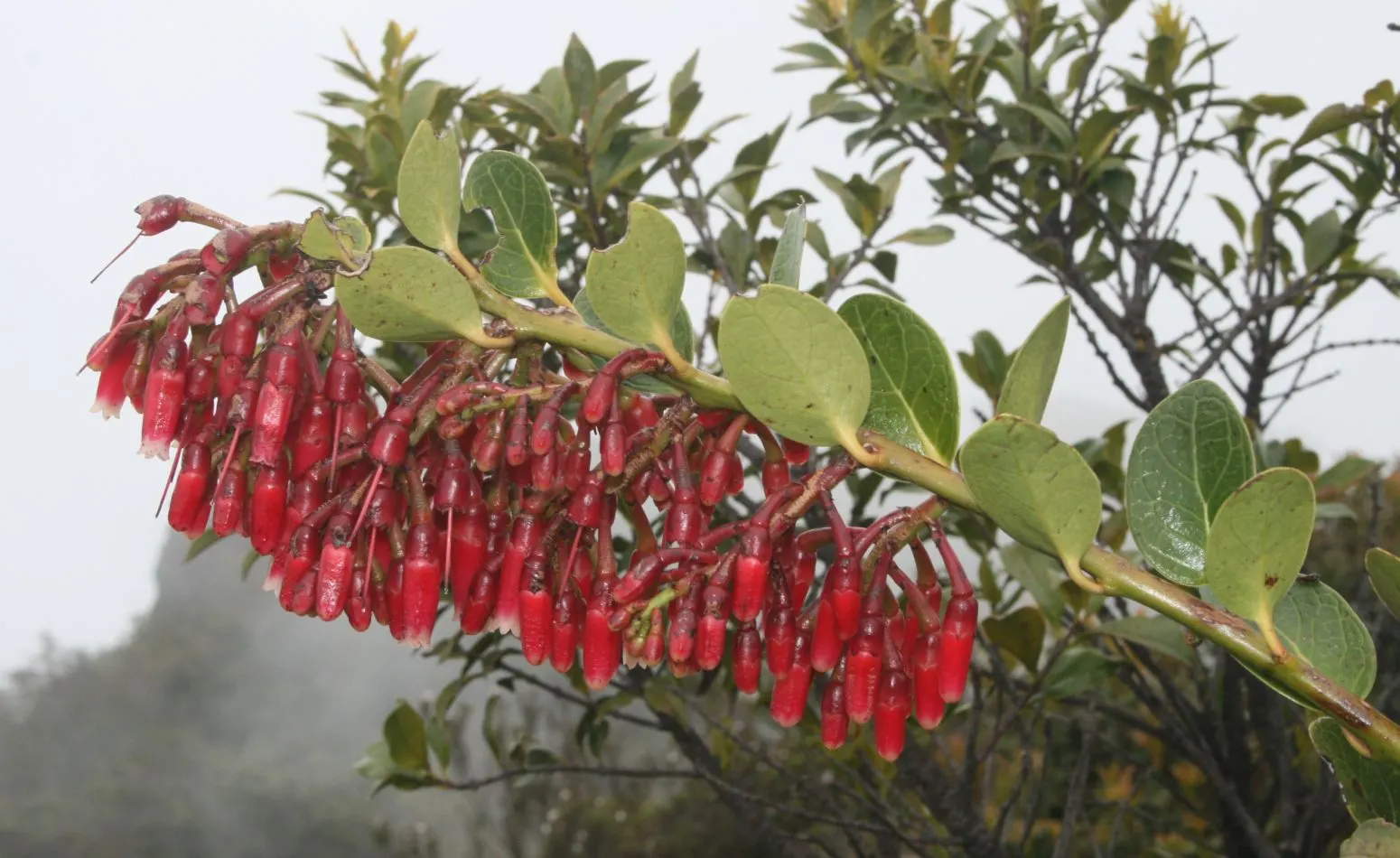
The blueberry family is a big part of Andean cloud forest. Macleania rupestris (joyapa) grows from 2,000 m up to the páramo. Tubular Ericaceae like it are visited by incas such as the Collared Inca.
Cuyuja even has its own: Psammisia cuyujensis, named after the parish. But it was collected far higher, at about 3,450 m, and must never be taken from the protected forest.
7. Siphocampylus and Centropogon
These relatives of the bellflowers are shrubs of the forest edge. The Mountain Velvetbreast prefers their flowers. We leave the edge of our forest wild so they can grow there.
8. Bromeliads
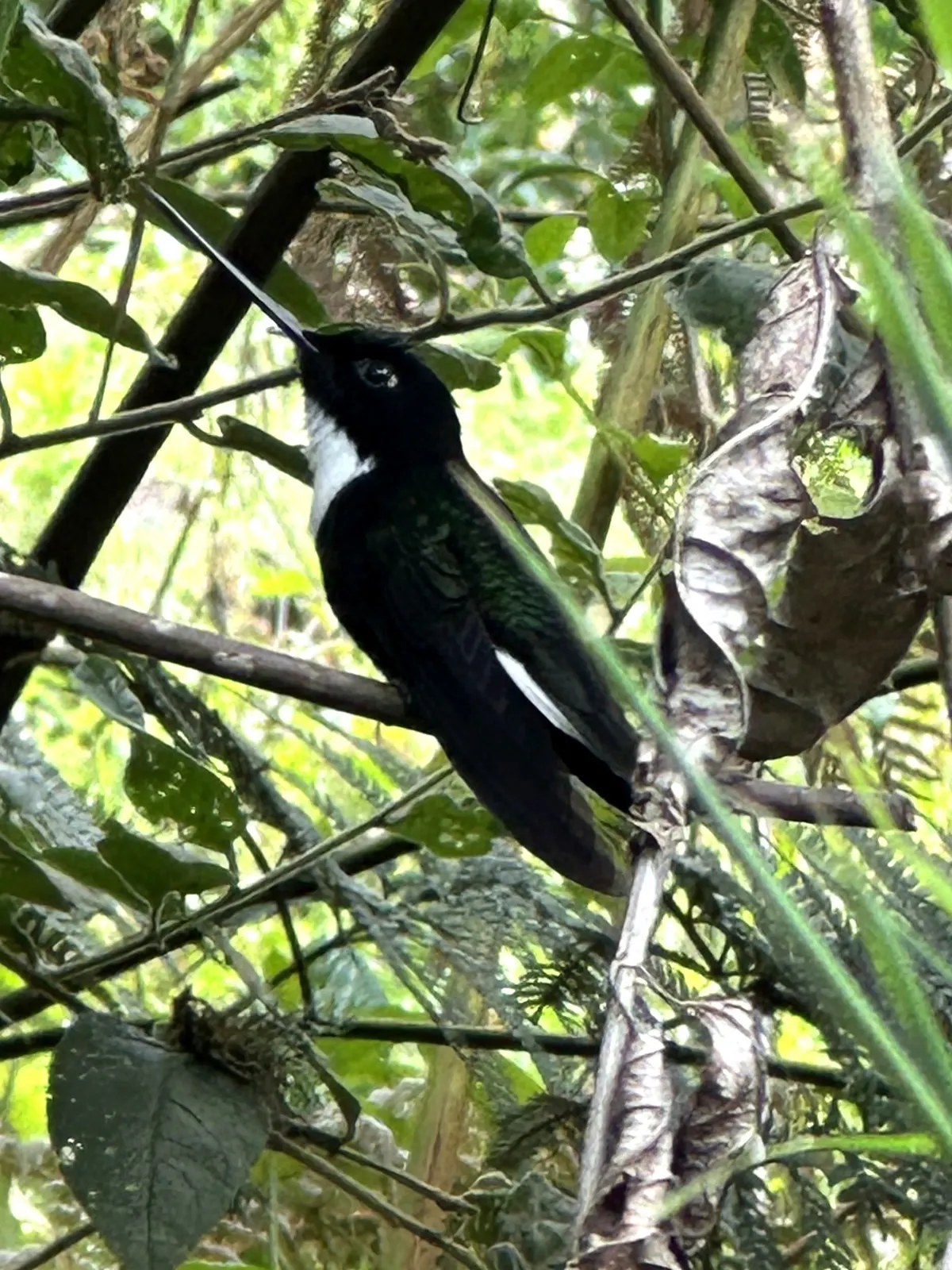
The Collared Inca favours epiphytes, especially bromeliads. We keep the mossy trees and add legally sourced bromeliads from nurseries or from fallen branches on our own land. More on the Collared Inca.
9. Andean sage
Salvia corrugata is a native shrub of about 2,400–3,000 m that attracts hummingbirds. It is one of the easiest hummingbird plants to grow, because it roots easily from cuttings. The Tourmaline Sunangel often feeds at low flowers, so low shrubs like this one help.
10. Porotón (guato)
Erythrina edulis is an Andean tree of 2,000–2,800 m with red flowers and nectar. Its beans are edible too, so it feeds the family as well as the birds.
Hummingbird plants for specific birds
Match the flower to the bill: long tubes for the swordbill, epiphytes for the Collared Inca, low shrubs for the sunangel.
- Sword-billed Hummingbird: tacso, red angel's trumpet, bomarea. More on the swordbill.
- Collared Inca: bromeliads and tubular Ericaceae such as joyapa.
- Mountain Velvetbreast: Siphocampylus and Centropogon.
- Tourmaline Sunangel: low shrubs such as Andean sage.
Don't cut the mistletoe
Some of the best hummingbird plants can't be planted at all. Hummingbird-pollinated mistletoes such as Tristerix longebracteatus are recorded along the Papallacta–Baeza road. They grow on trees, so the best thing is simply to leave them where they are.
Which hummingbird plants should you avoid?
Avoid invasive exotics such as busy lizzie, anything taken from the wild, and pesticides of any kind.
- Busy lizzie (Impatiens walleriana): from East Africa and naturalised in humid Andean areas up to 2,800 m. In Cuyuja it would spread into streams.
- Plants taken from the wild: we use nursery plants and cuttings from neighbours (with permission), never plants from the national park or reserve.
- Pesticides: hummingbirds also eat insects.
How we lay out the garden
We plant in layers and in groups, a short walk from the feeders, with perches for photographers.
- Layers: trees and living fences, then shrubs (fuchsias, angel's trumpet, joyapas, sage), vines on fences and pergolas (tacso, bomarea), and epiphytes on trunks.
- Groups, not single plants: 3–5 of each species, because more flowers of one kind attract more visits.
- Flowers 5–15 m from the feeders, spread out so that one bossy coronet can't control everything.
- Natural perches with a clean, distant background for photographers, facing the morning light.
- Wild corners: streams and the forest edge stay untouched.
A garden of hummingbird plants also helps photographers. Birds rest on twigs near the flowers between feeds, so a good perch next to a flower patch gives natural pictures. Our photography tips explain how.
Hummingbird plants: FAQ
What flowers attract hummingbirds in the Andes?
Long, tubular flowers that hang or point outward, often red, orange or pink. Good Andean hummingbird plants include tacso passionflowers, fuchsias, iochromas, bomareas, joyapa and Siphocampylus. Different hummingbirds match different flower shapes.
What is the best plant for the sword-billed hummingbird?
Tacso (Passiflora mixta). Its very long floral tube evolved together with the swordbill's bill. Red angel's trumpet (Brugmansia sanguinea) is another favourite.
Are hybrid fuchsias good for hummingbirds?
They can feed hummingbirds, but native species give more ecological value. Ask nurseries for the scientific name. Prefer simple, long-tubed red or orange flowers.
Which plants should I avoid?
Avoid busy lizzie (Impatiens walleriana). It is naturalised in humid Andean areas up to 2,800 m and escapes into streams. And never plant angel's trumpet where children or animals can reach it: all parts are poisonous.
How do I keep nectar available all year?
Mix many hummingbird plants that flower at different times, and plant each one in groups. Andean studies found that flowering time is the strongest factor in which birds use which plants. More flowers of the same species also attract more visits.
Sources
- Abrahamczyk, S., Souto-Vilarós, D. & Renner, S.S. (2014). Escape from extreme specialization: passionflowers, bats and the sword-billed hummingbird. Proc. R. Soc. B 281: 20140888. PMC4213610
- Tinoco et al. (2022), keystone plants for hummingbird–plant communities in the southern Andes of Ecuador. REDI/CEDIA
- González, O. & Loiselle, B.A. (2016). PeerJ 4:e2789 (flowering phenology and bird–plant networks). PMC5157195
- Wikipedia: Brugmansia, Passiflora mixta, Iochroma fuchsioides, Salvia corrugata, Tristerix longebracteatus, Mountain velvetbreast, Collared inca.
- ICRAF Agroforestree database: Erythrina edulis.
- NYBG: Macleania rupestris, Psammisia cuyujensis.
- POWO (Kew): Impatiens walleriana.