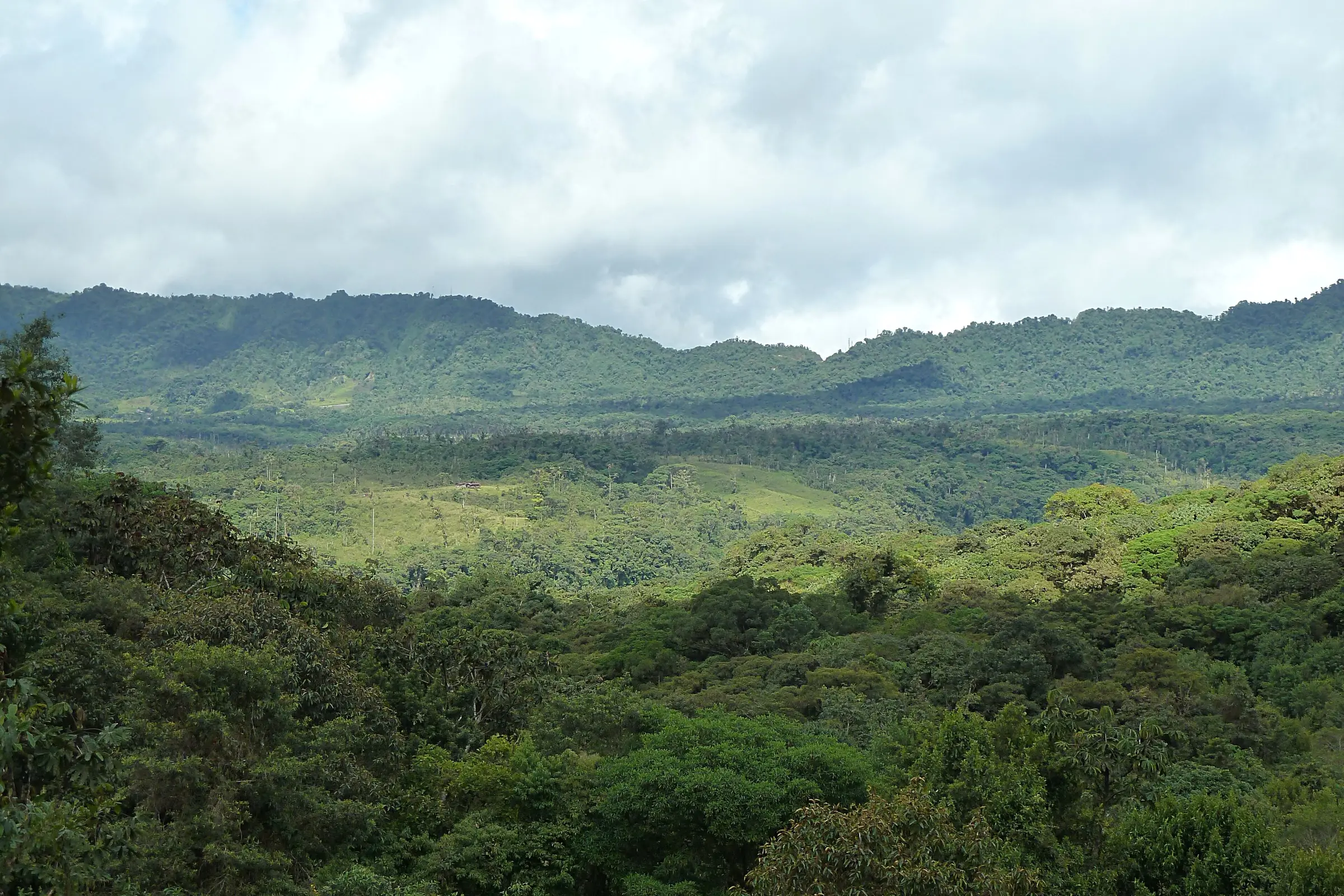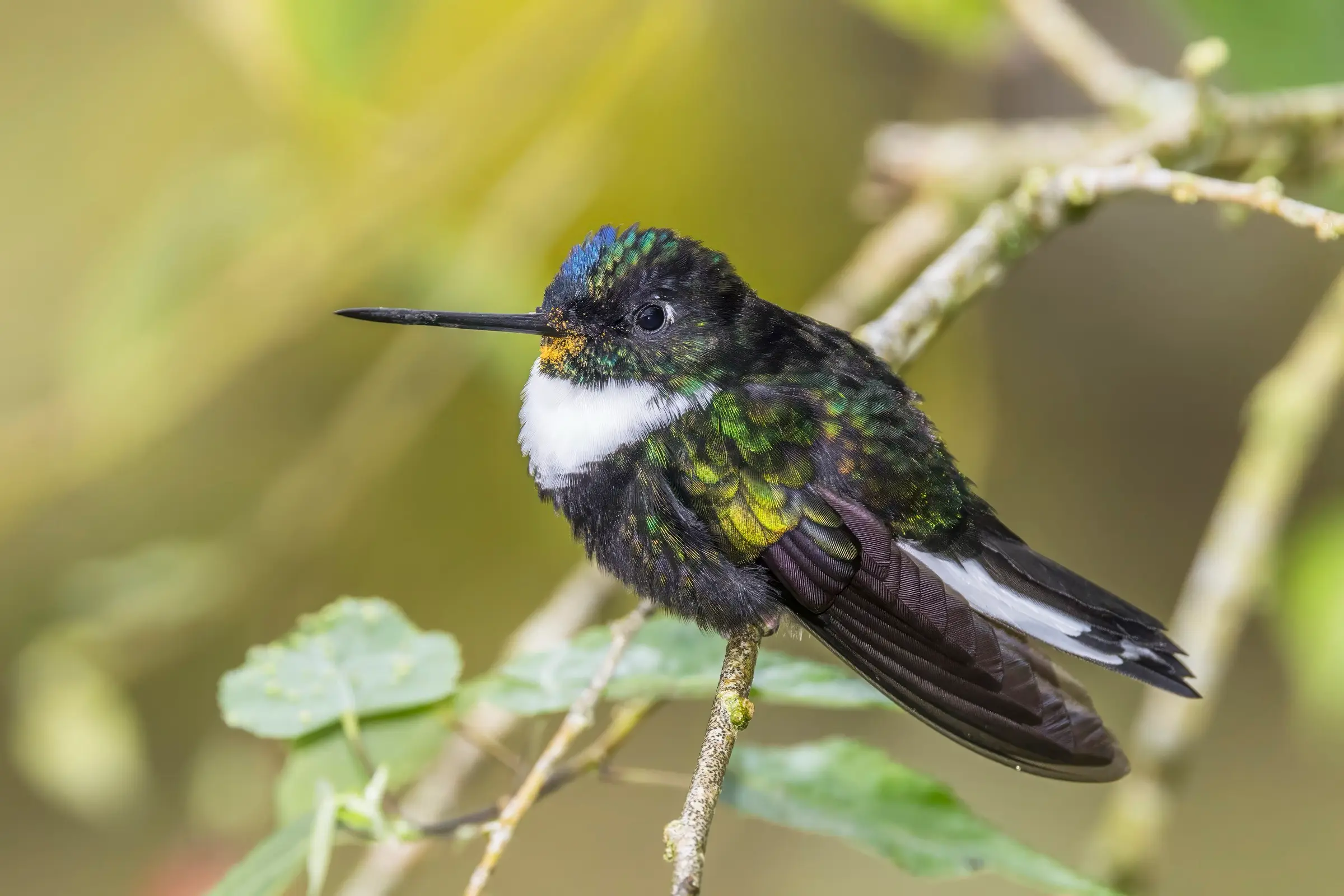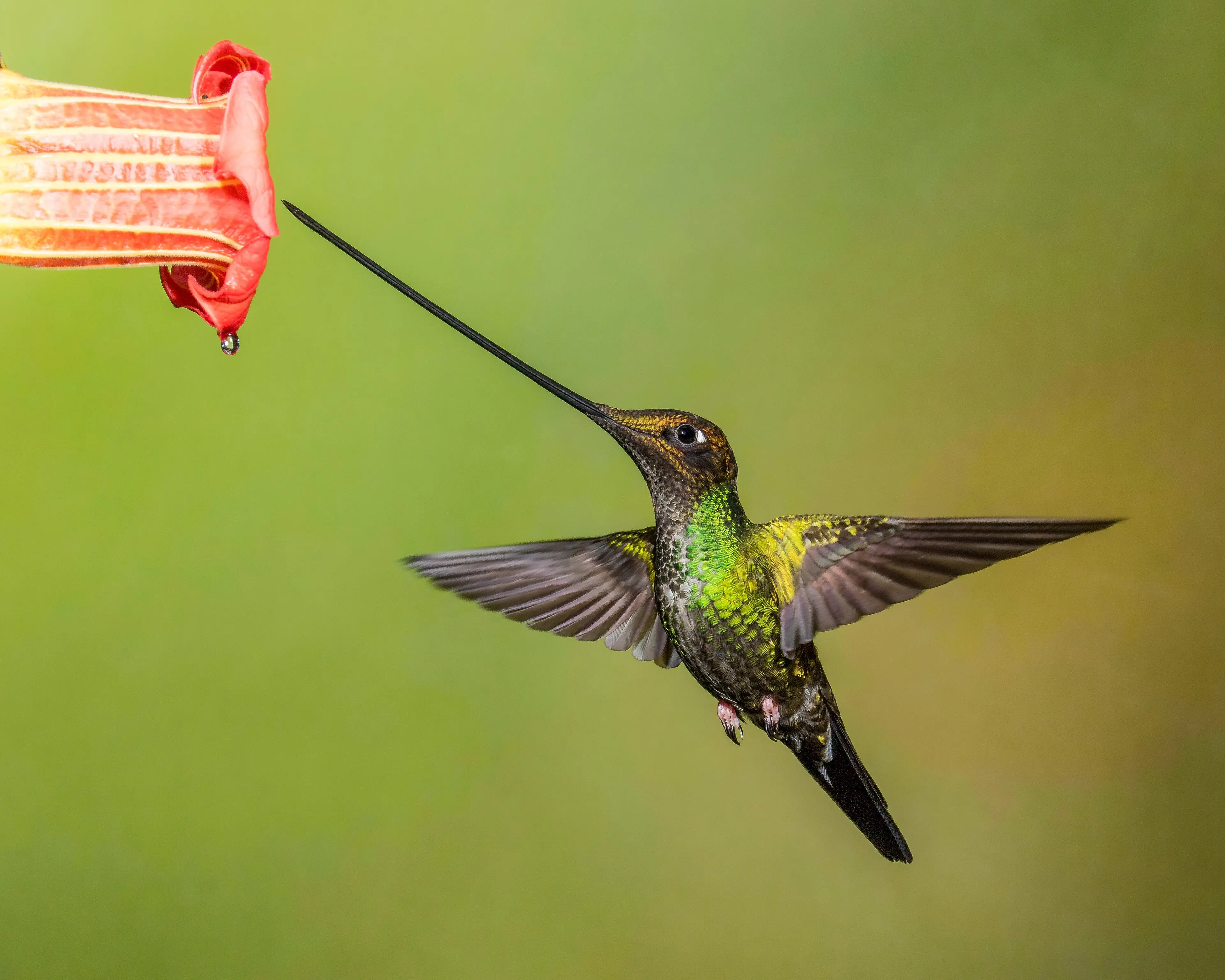

The birds of Ecuador number about 1,718 species, and the eastern Andes hold some of the most colourful. This guide covers 13 non-hummingbirds around Cuyuja, at about 2,330 m on the Papallacta–Baeza road. A 2019–2020 survey there logged 141 species, and the Blue-winged Mountain-Tanager was its most-counted tanager.
How we chose these birds of Ecuador
We are a family hummingbird lookout, not a tour company, so this list of birds of Ecuador is honest about what we have seen. A bird is here only if we photographed it on the farm, the Cuyuja survey recorded it, or it is a known bird of Guango or San Isidro on the same road.
The labels mean this. Photographed at San Pedrito: seen and photographed on our farm. Two non-hummingbirds on this list have earned it so far. Cuyuja survey: found in the 2019–2020 bird survey of Cuyuja parish (Reyes Vargas et al., 2022). Seen in the valley: regular at Guango, 11 km up the road, or at San Isidro, lower down near Cosanga.
Most sizes, altitudes and diets below come from the species accounts in Birds of the World, from the Cornell Lab of Ornithology; the few that do not are named in the sources. For the hummingbirds, see our sister guide to the hummingbirds of Ecuador.
The 13 birds of Ecuador's east slope at a glance
These 13 birds of Ecuador live between the páramo and the cloud forest around Cuyuja, on the Amazon side of the Andes. We have photographed two of them on our farm: the Rufous-breasted Chat-Tyrant and the Inca Jay. Six more farm birds that are not in the table come further down the page.
| English name | Scientific | Ecuador Spanish | Status near Cuyuja |
|---|---|---|---|
| Rufous-breasted Chat-Tyrant | Ochthoeca rufipectoralis | Pitajo pechirrufo | Photographed at San Pedrito, Sept 2023 |
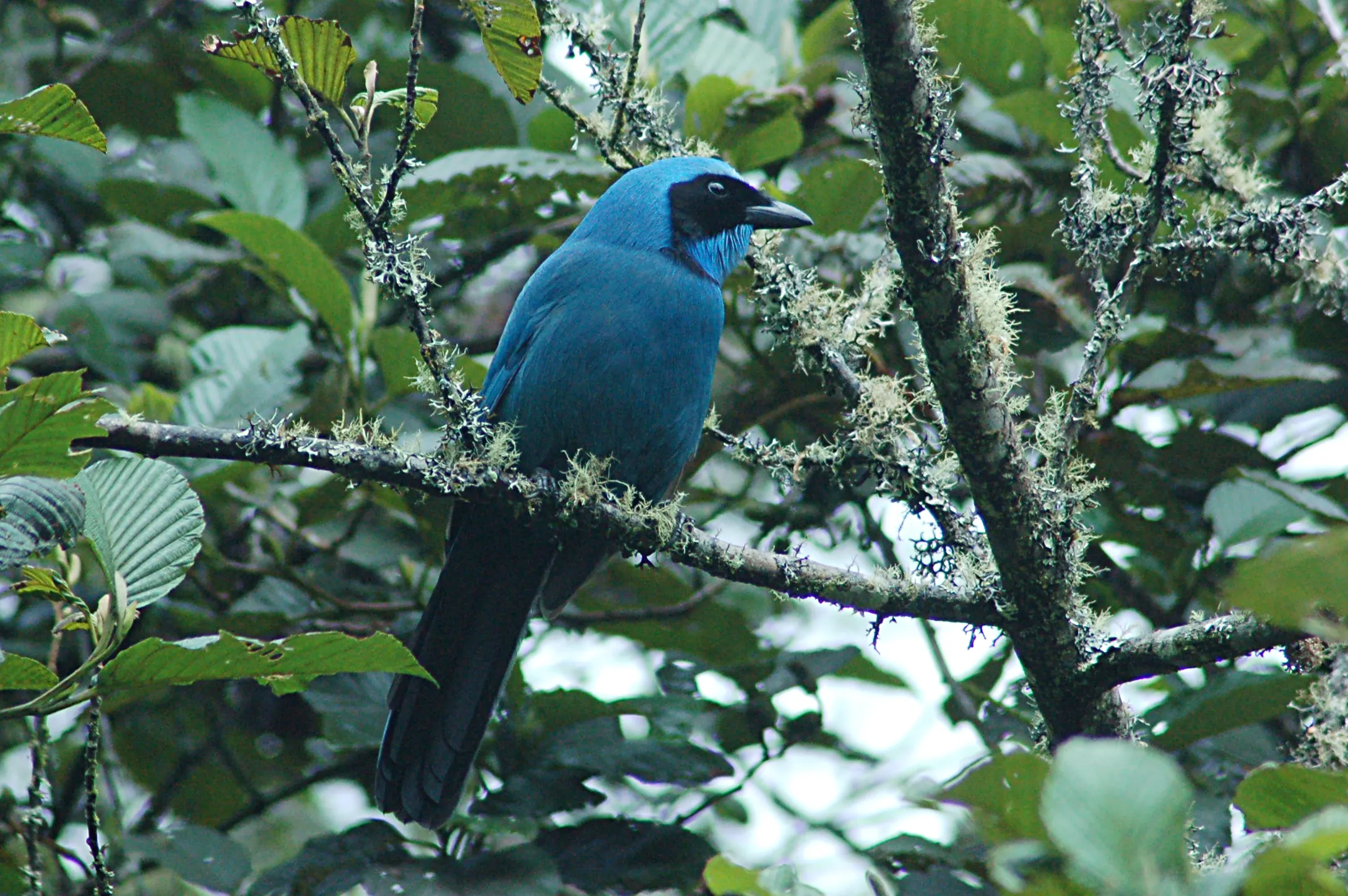
| Turquoise Jay | Cyanolyca turcosa | Urraca turquesa | Seen at Guango |
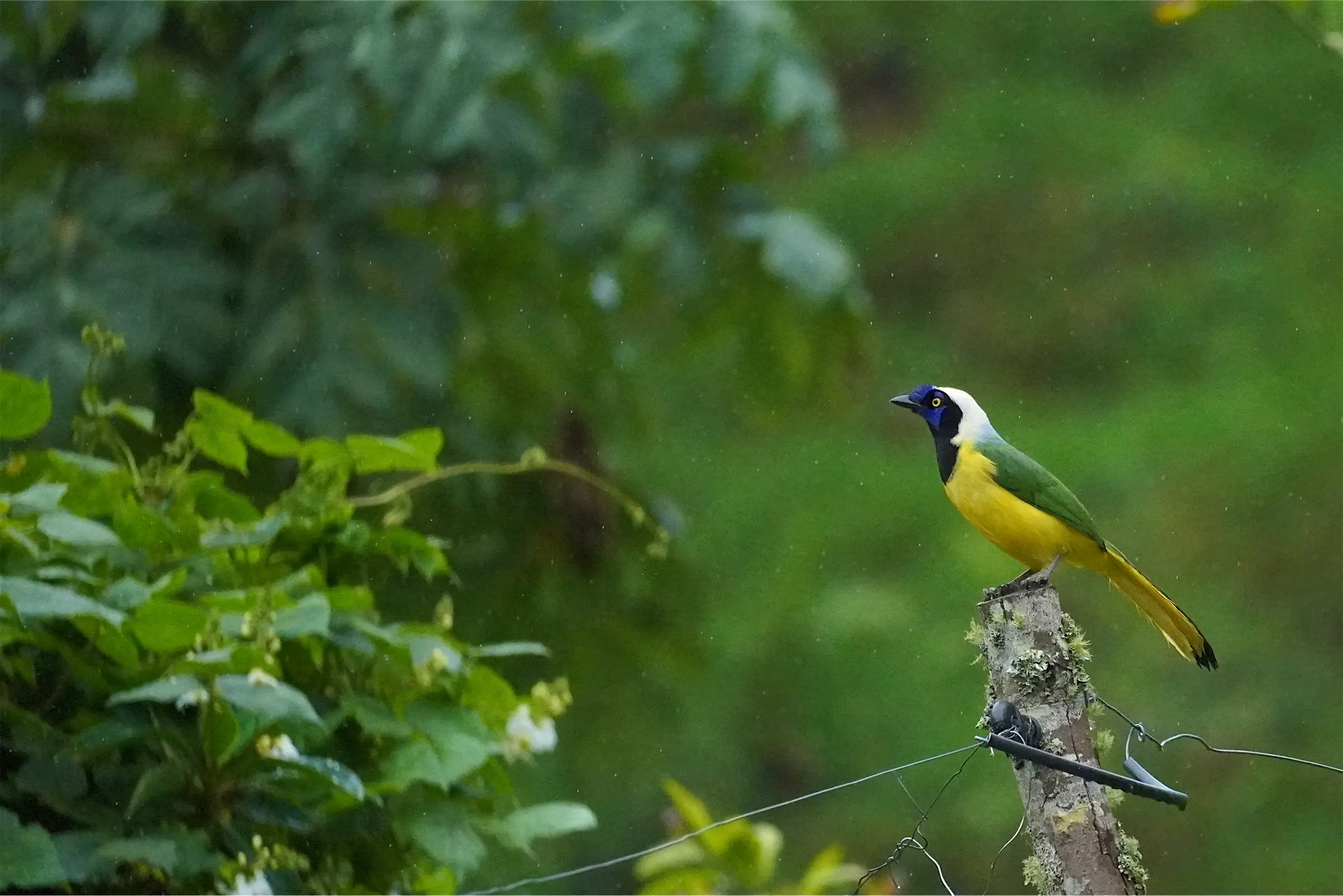
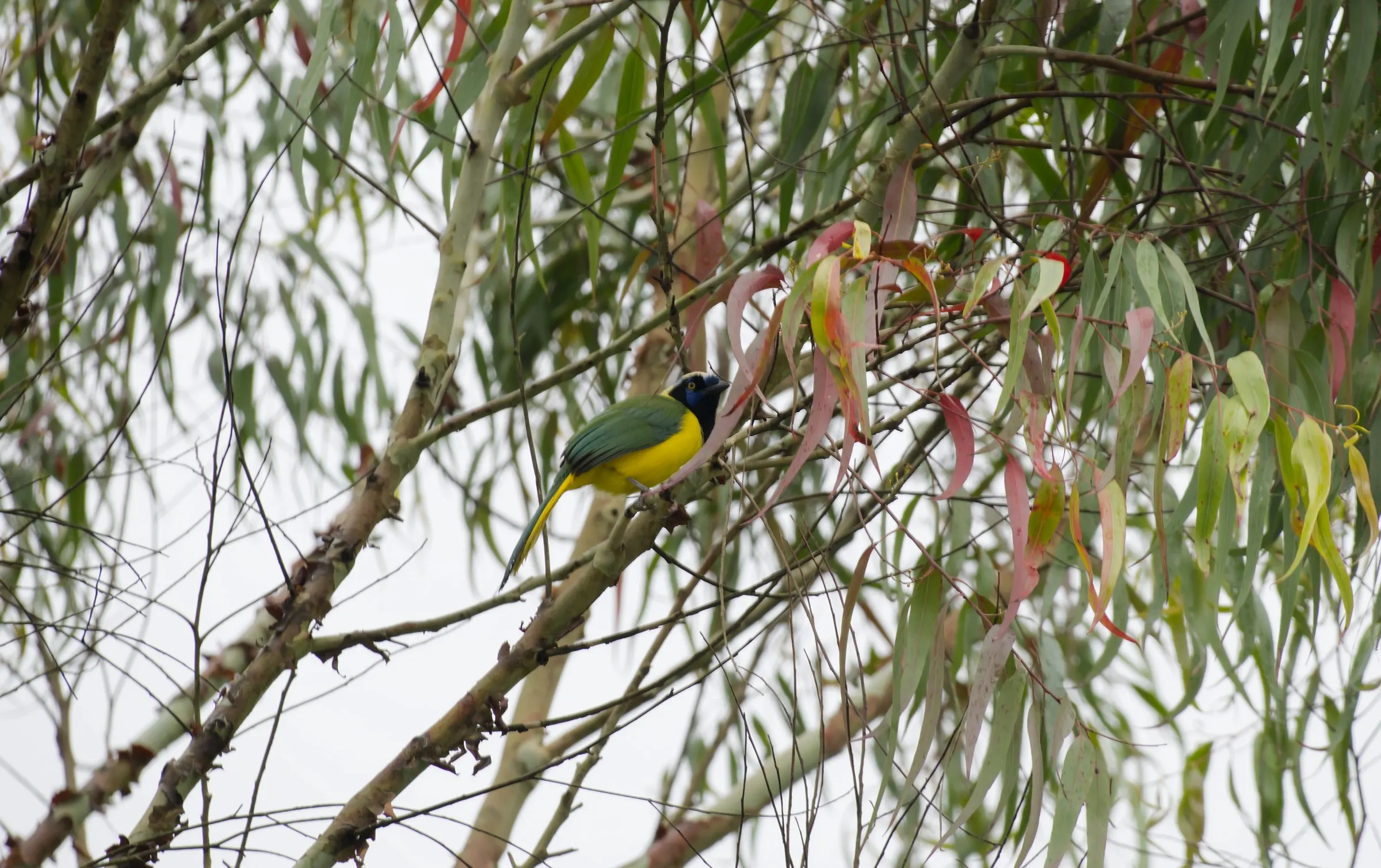
| Inca Jay | Cyanocorax yncas | Urraca inca | Photographed at San Pedrito |
| Blue-winged Mountain-Tanager | Anisognathus somptuosus | Tangara montana aliazul | Most-counted tanager in the Cuyuja survey (34) |
| Hooded Mountain-Tanager | Buthraupis montana | Tangara montana encapuchada | Guango; roaming flocks |
| Grass-green Tanager | Chlorornis riefferii | Tangara lorito | Recorded in Napo; mossy forest, 2,200–2,700 m |
| Blue-and-black Tanager | Tangara vassorii | Tangara azulinegra | Recorded in Napo; highest-living Tangara |
| Gray-breasted Mountain-Toucan | Andigena hypoglauca | Tucán andino pechigrís | Guango specialty, 2,200 m and up |
| Torrent Duck | Merganetta armata | Pato torrentero | Rivers; Cuyuja survey (6) |
| White-capped Dipper | Cinclus leucocephalus | Cinclo gorriblanco | Rivers; Cuyuja survey |
| Black-and-chestnut Eagle | Spizaetus isidori | Águila andina | Endangered; Cuyuja survey (4) |
| Andean Guan | Penelope montagnii | Pava andina | Cuyuja survey and Guango |
| Andean Condor | Vultur gryphus | Cóndor andino | Páramo above the valley, not the garden |
Rufous-breasted Chat-Tyrant: the first we photographed here
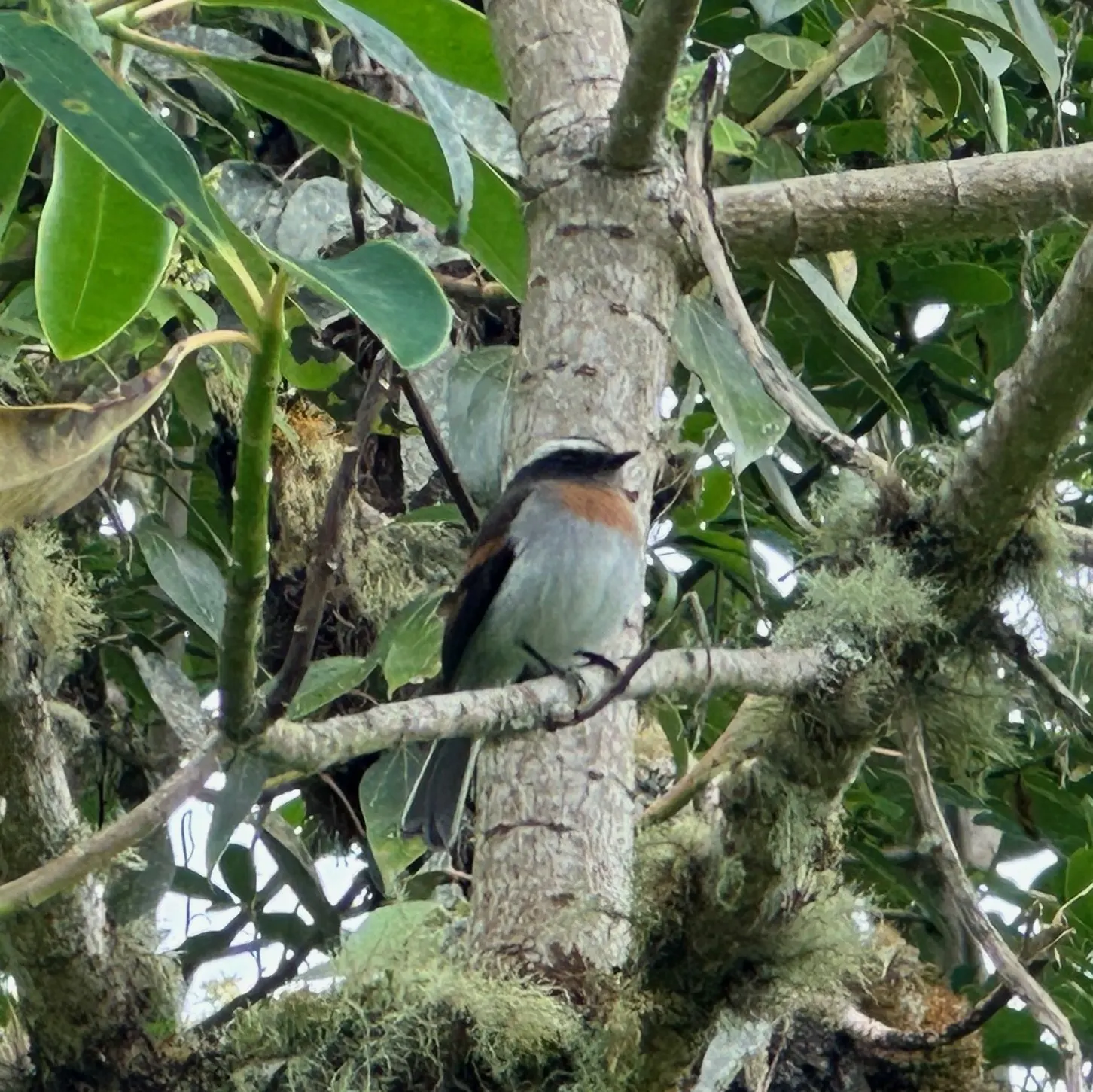
This small flycatcher was the first non-hummingbird we photographed at San Pedrito, in September 2023. It is 13–14 cm long and weighs about 13 g. Look for a long white eyebrow, a rich orange-rufous band across the chest and a white belly.
It lives along the borders of cloud forest, often beside roads, mostly at 2,000–3,600 m. Insects are its food. Watch it perch upright in the open, often jerks and looks perky, then sallies out or hovers to pick prey off the top of leaves. Pairs are common, and it is fairly common overall. In Ecuador it is more abundant on the eastern slope than on the western one.
Turquoise Jay and Inca Jay
Two jays are among the loudest, brightest birds of Ecuador's east slope. We have seen both around the farm. We photographed the Inca Jay on a fence post here in October 2026, and again in a eucalyptus; the Turquoise Jay is still on our list.
The Turquoise Jay is 30–32 cm long, bright turquoise-blue with a black mask and collar and an almost white forehead. It is fairly common in Ecuador and most numerous at 2,000–3,000 m, our exact band. This jay tolerates degraded forest and likes stands of alder at the edges. Small groups and mixed flocks are the rule, and it eats insects, berries, and sometimes the eggs and young of other birds.
The Inca Jay is green above and bright yellow below, with a black bib, blue patches on the face and a whitish crown. Its eyes are yellow. In South America it lives mainly above 1,400 m. Its diet is broad: insects, seeds, fruit, small lizards and frogs. Family groups defend a territory together.
Inca jay vs green jay: one species or two?
It depends on whose list you follow. eBird and the Clements checklist keep one species, the Green Jay (Cyanocorax yncas), and call the Andean birds "Green Jay (Inca)". The IOC World Bird List splits them, so the Andean bird becomes the Inca Jay.
The two groups really are different. According to its Birds of the World account, South American birds have a whiter crown and nape and a blue tuft at the base of the bill. They also differ in voice and social life, and they live in mountains rather than lowlands.
- Inca Jay (Andes): whitish crown, blue frontal tuft, yellow eyes, montane forest mainly above 1,400 m.
- Green Jay (Middle America and Texas): blue crown, no tuft, lowland woods and brush from sea level.
- On eBird: report the bird you see in Ecuador as Green Jay (Inca), species code grnjay.
Mountain-tanagers and other tanagers
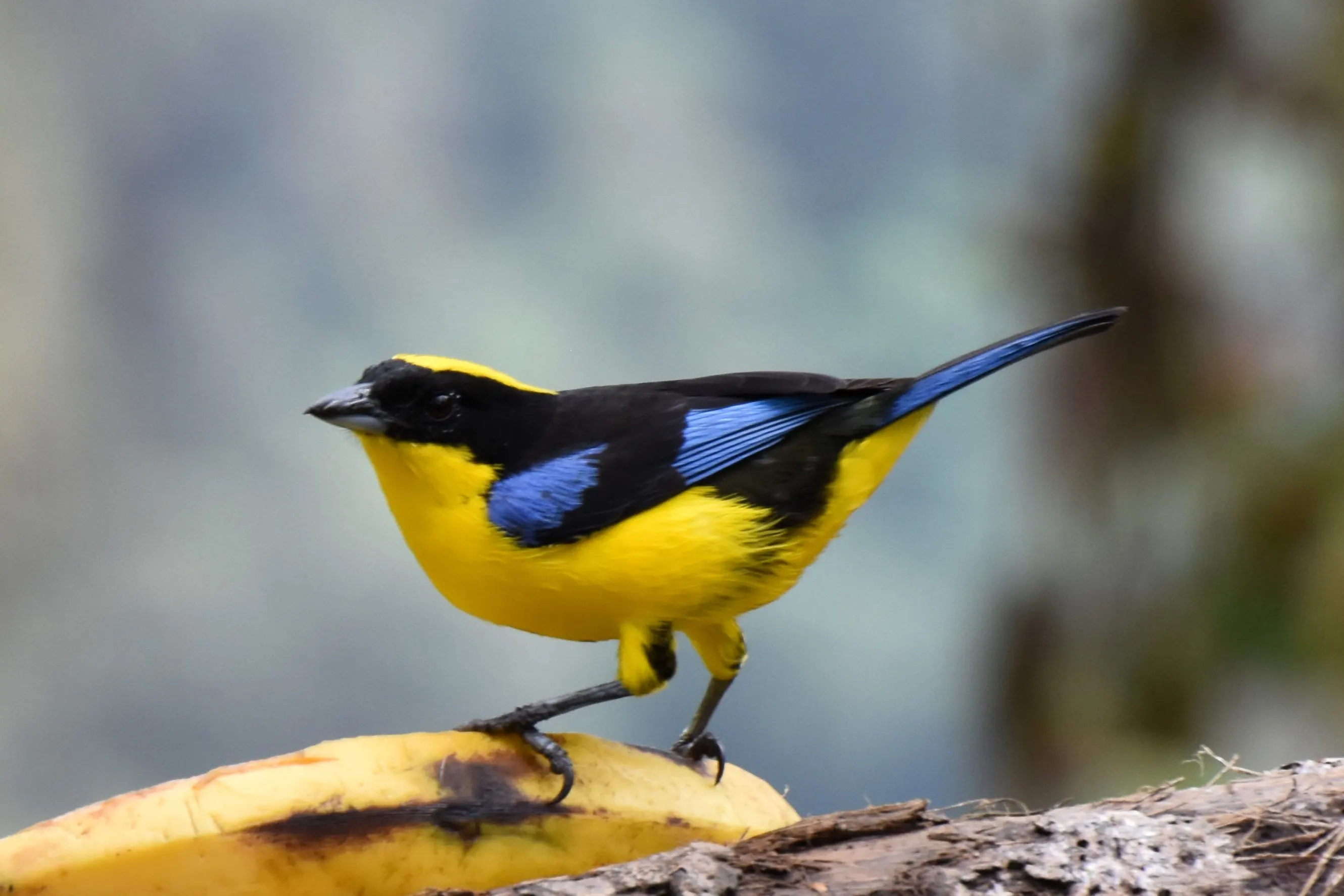
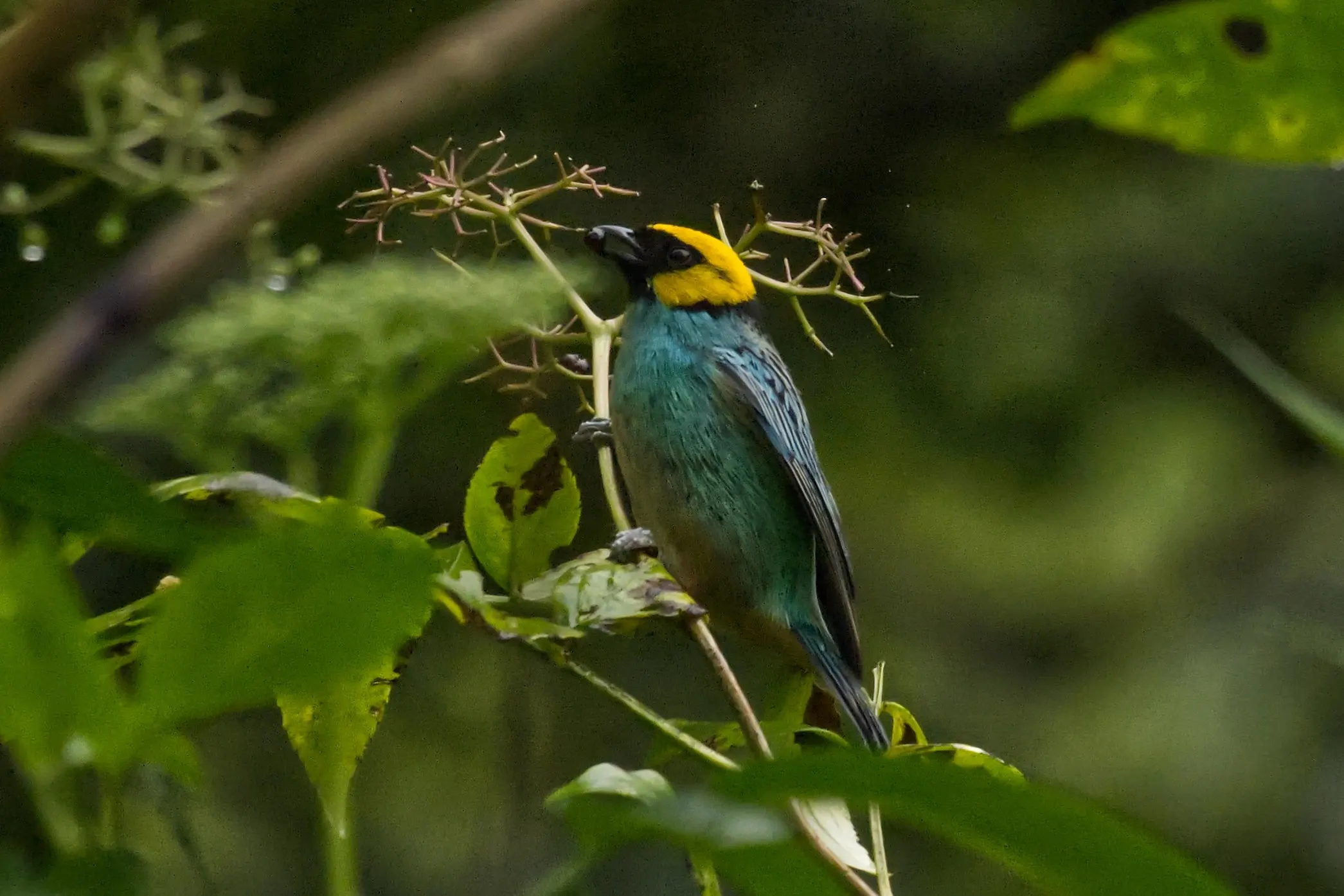
Tanagers are the colour of every mixed flock in these hills, and some of the most-photographed birds of Ecuador. We see tanagers around the farm too. In October 2026 one of them, a Saffron-crowned Tanager, finally stayed put for the camera.
- Blue-winged Mountain-Tanager: 16–17 cm, yellow, black and blue. In Ecuador it lives at 1,200–2,500 m, in groups of 3–10, and is often a core bird that mixed flocks form around. It was the most-counted tanager in the Cuyuja survey, with 34 birds.
- Hooded Mountain-Tanager: 21–23 cm and the largest mountain-tanager, with red eyes, a black hood and a milky-blue nape. Groups wander widely at 1,900–3,500 m, eating mostly berries and fruit.
- Grass-green Tanager: about 20 cm, bright green with a rufous face. It keeps to wet, mossy upper forest, often with bamboo, mostly at 2,200–2,700 m.
- Blue-and-black Tanager: about 13 cm. It lives at 1,500–3,500 m, higher than any other Tangara, and loves the fruit of Miconia shrubs.
Gray-breasted Mountain-Toucan
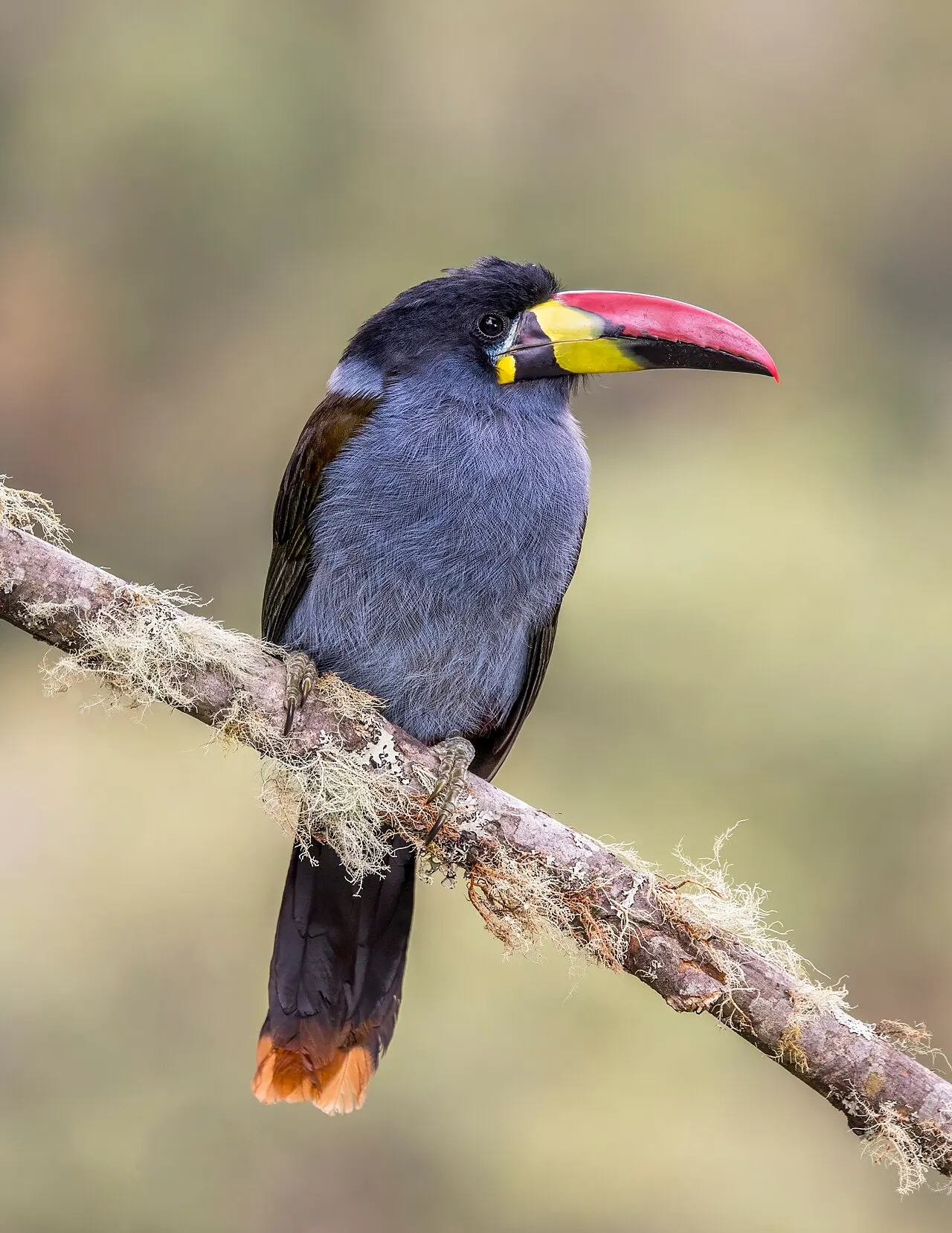
A 41–48 cm toucan with a black cap, blue-grey underparts and a bill banded red, yellow and black. It lives higher than any other toucan, generally at 2,200–3,650 m, and eats fruit such as wild blackberries and Cecropia.
It is a Guango specialty and one of the birds of Ecuador that visiting birders ask about most. At about 2,300–2,500 m and below it is replaced by the Black-billed Mountain-Toucan, so our farm sits right on that line.
Birds of Ecuador's rushing rivers
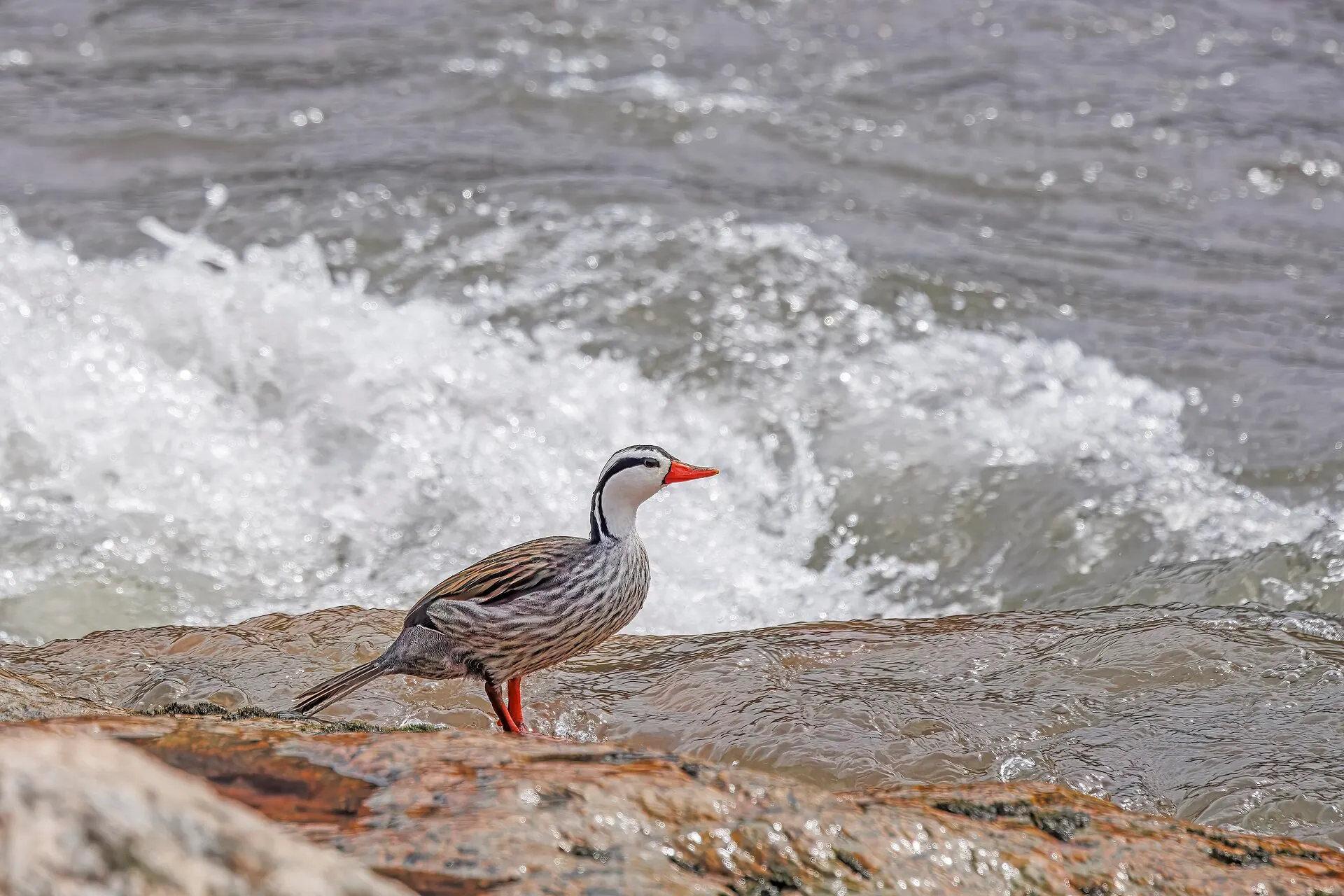
The Papallacta and Quijos rivers run beside the road, and two river birds of Ecuador are worth a stop. The Torrent Duck is about 41–43 cm long. It dives in whitewater for aquatic insects and rests on boulders between dives. The Cuyuja survey counted six.
The White-capped Dipper is a 13.5–15.5 cm black-and-white bird that bobs on rocks midstream. It feeds on aquatic invertebrates from the water's edge and usually lives at 1,000–3,400 m.
Black-and-chestnut Eagle and Andean Guan
Among the birds of Ecuador's montane forest, the Black-and-chestnut Eagle is one of the rarest. It is 60–80 cm long and globally Endangered. It hunts medium-sized birds and tree-dwelling mammals in old montane forest, usually at 1,300–3,000 m. Forest loss and persecution are driving its decline. The Cuyuja survey recorded four, which makes this valley important for it.
The Andean Guan is a 51–61 cm forest bird of the guan family. It lives up to 3,700 m, higher than any other guan, and eats mostly fruit plus some leaves. Like many large birds of Ecuador, it needs big tracts of forest.
What is the national bird of Ecuador?
The Andean Condor is the national bird of Ecuador, and it is the bird on the Ecuador flag: it stands on top of the coat of arms, at the centre of the flag.
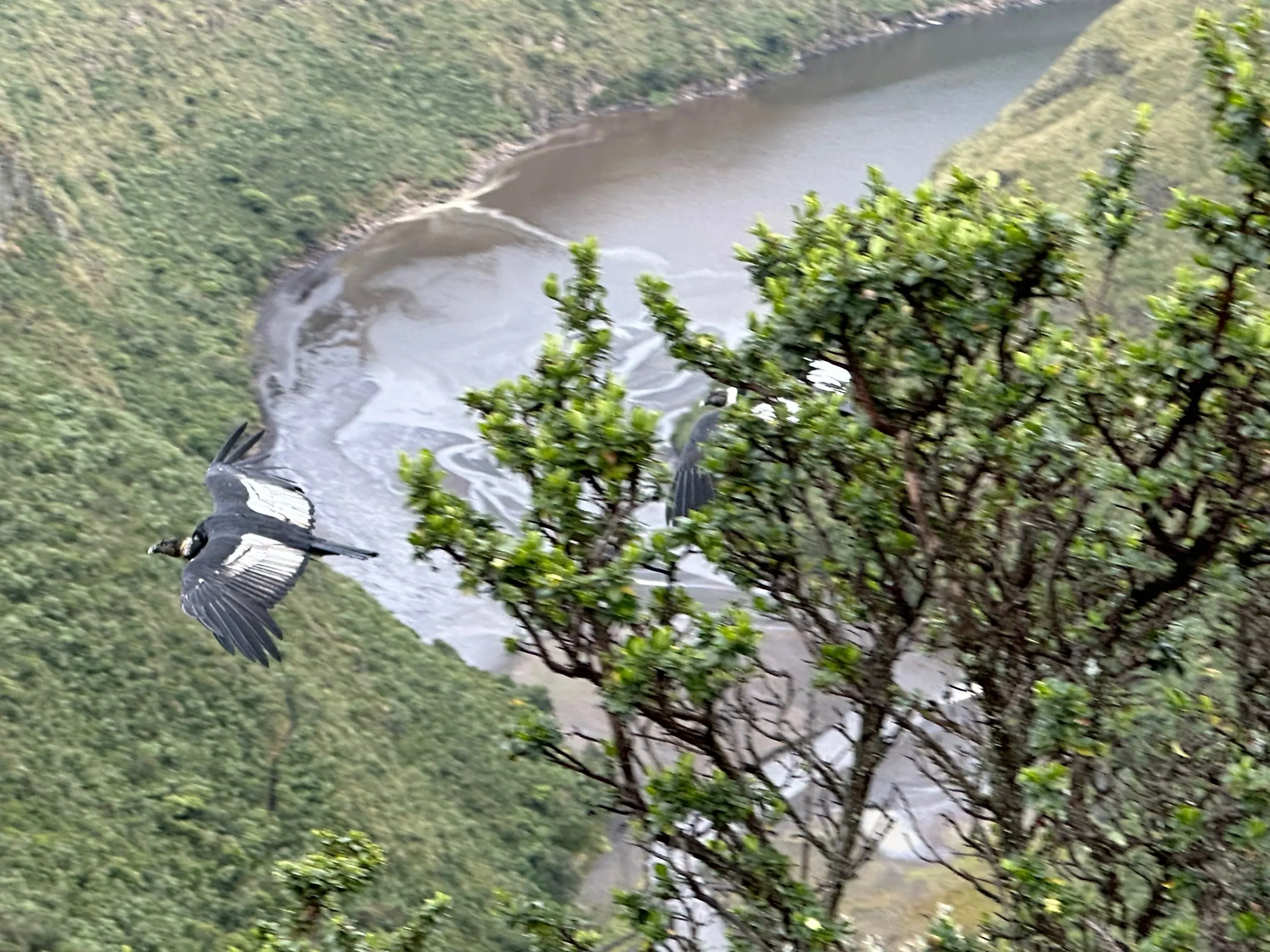
It is the largest of the birds of Ecuador: 100–130 cm long with a wingspan of 2.6–3.2 m, and males weigh 11–15 kg. Condors soar over open high country and feed on carrion. BirdLife lists it as Vulnerable. Ecuador's 2018 national census counted 150 condors, with an estimated 140–270 in the wild.
You will not see one from our garden. Condors belong to the páramo above the valley, such as the Antisana slopes and Cayambe-Coca. Our photo was taken near the Antisana in June 2026.
Five more birds we photographed at San Pedrito
These five are not on the list above. Three came on the same October morning, and each one sat still long enough for a sharp photo.
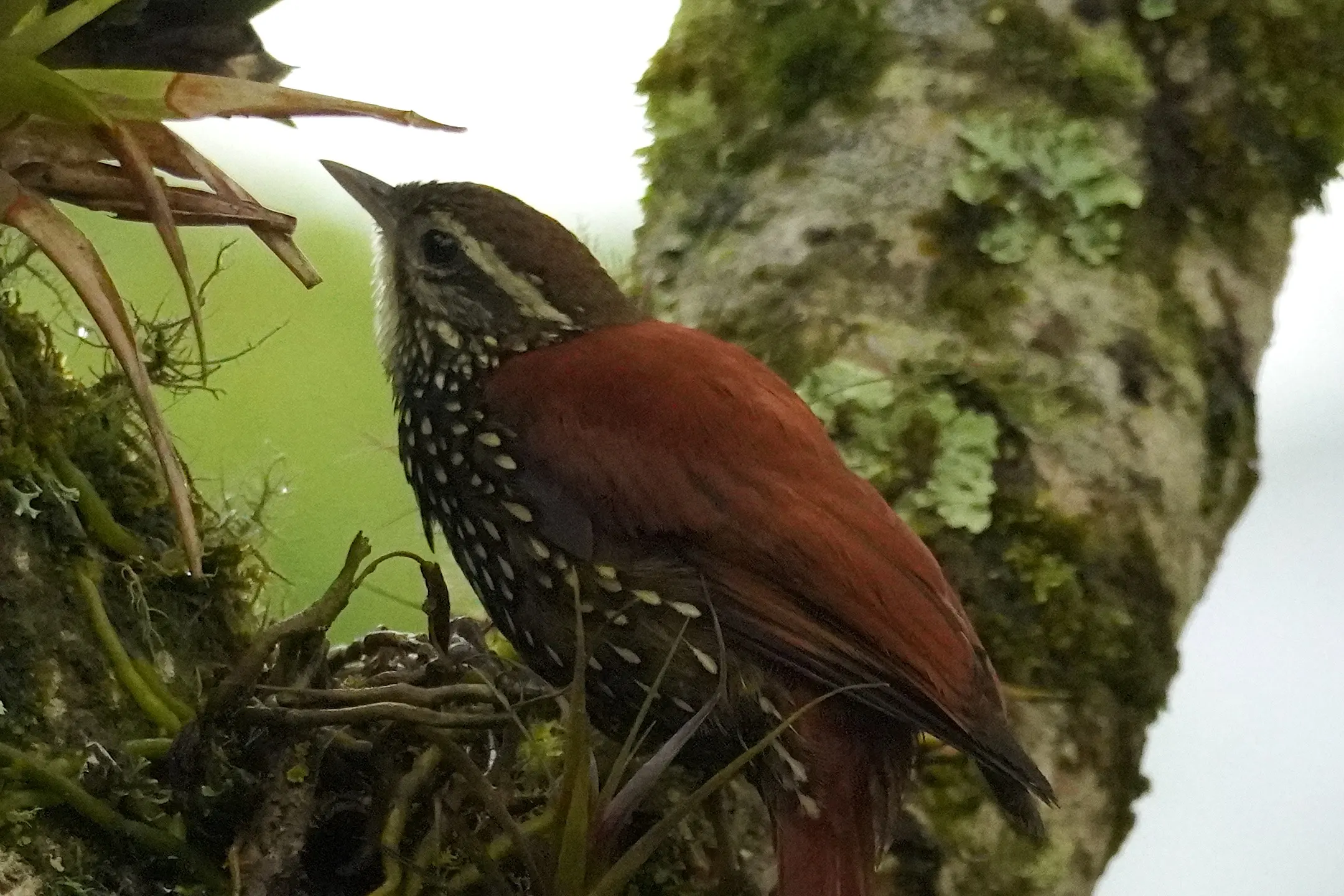
The Pearled Treerunner (Margarornis squamiger) climbs trunks and mossy branches like a small woodcreeper, bracing on its stiff tail. Its back and tail are rufous, the throat and eyebrow whitish, and the dark breast is covered in white spots edged in black, the "pearls" of its name. It is a regular member of the mixed flocks in wet, mossy forest high on the Andes.
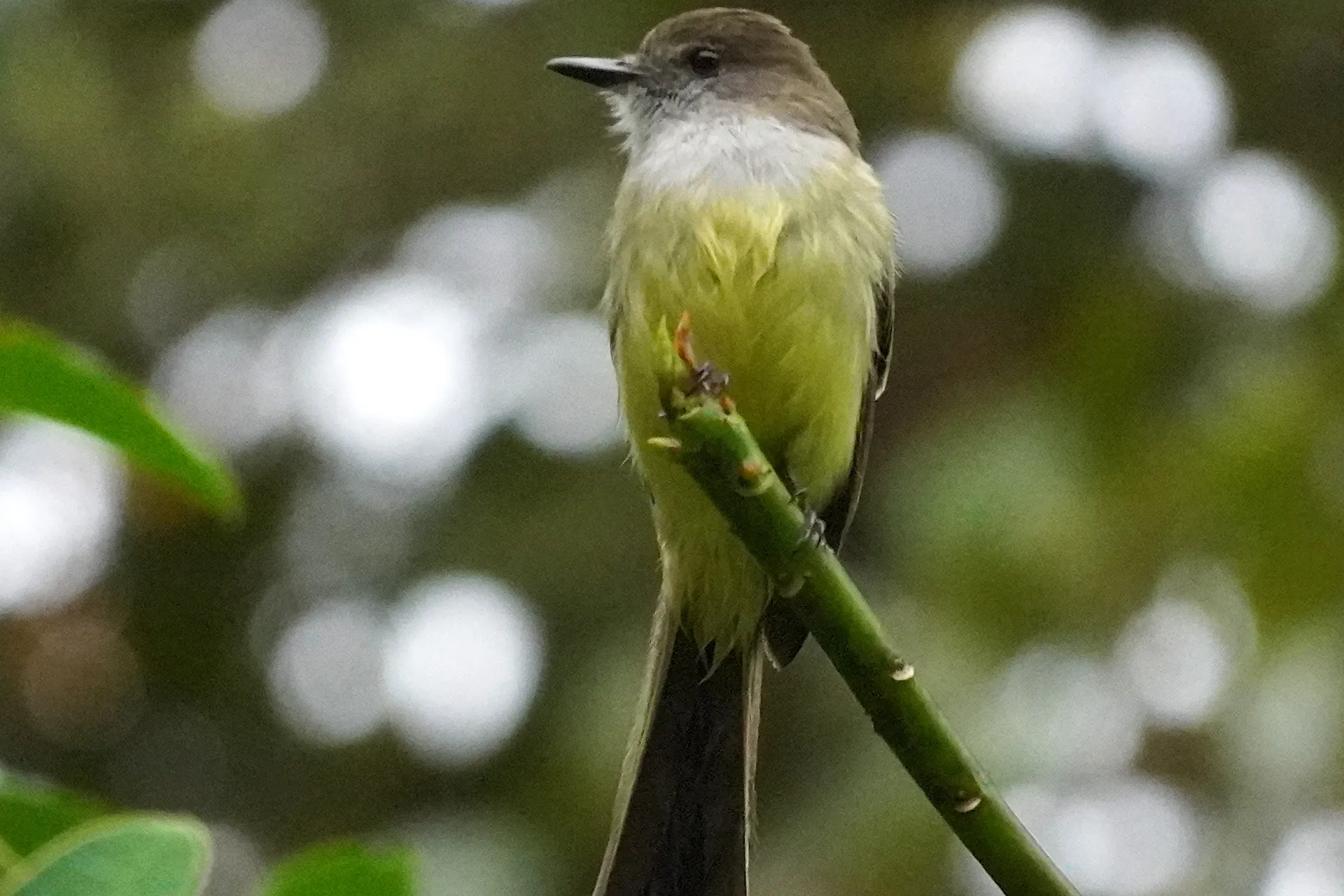
The Pale-edged Flycatcher (Myiarchus cephalotes) is grey-brown above, pale grey on the breast and yellow on the belly. The pale edges of its wing and tail feathers give it the name. It sits upright on an open perch and flies out to snap up insects, then often comes back to the same spot.
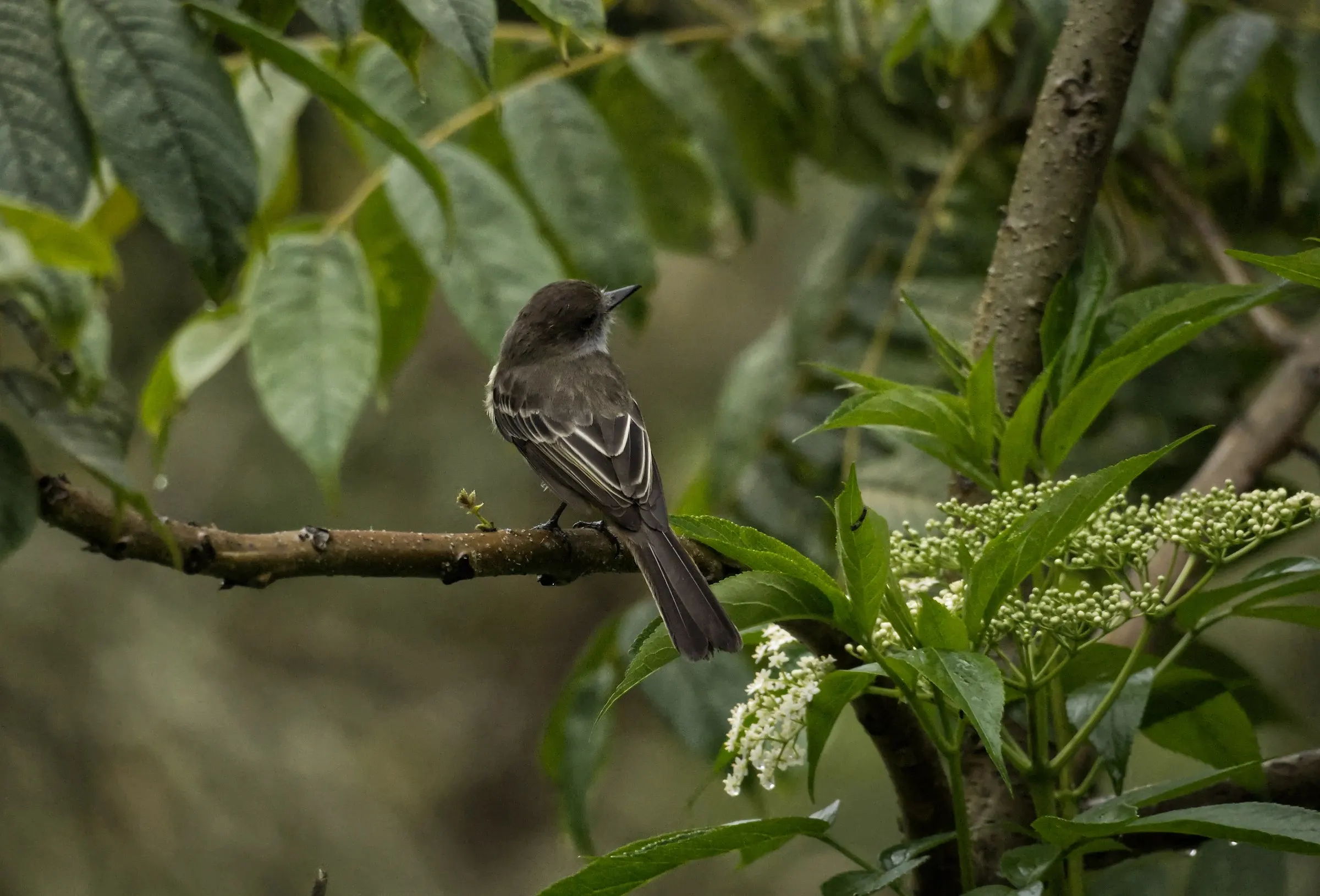
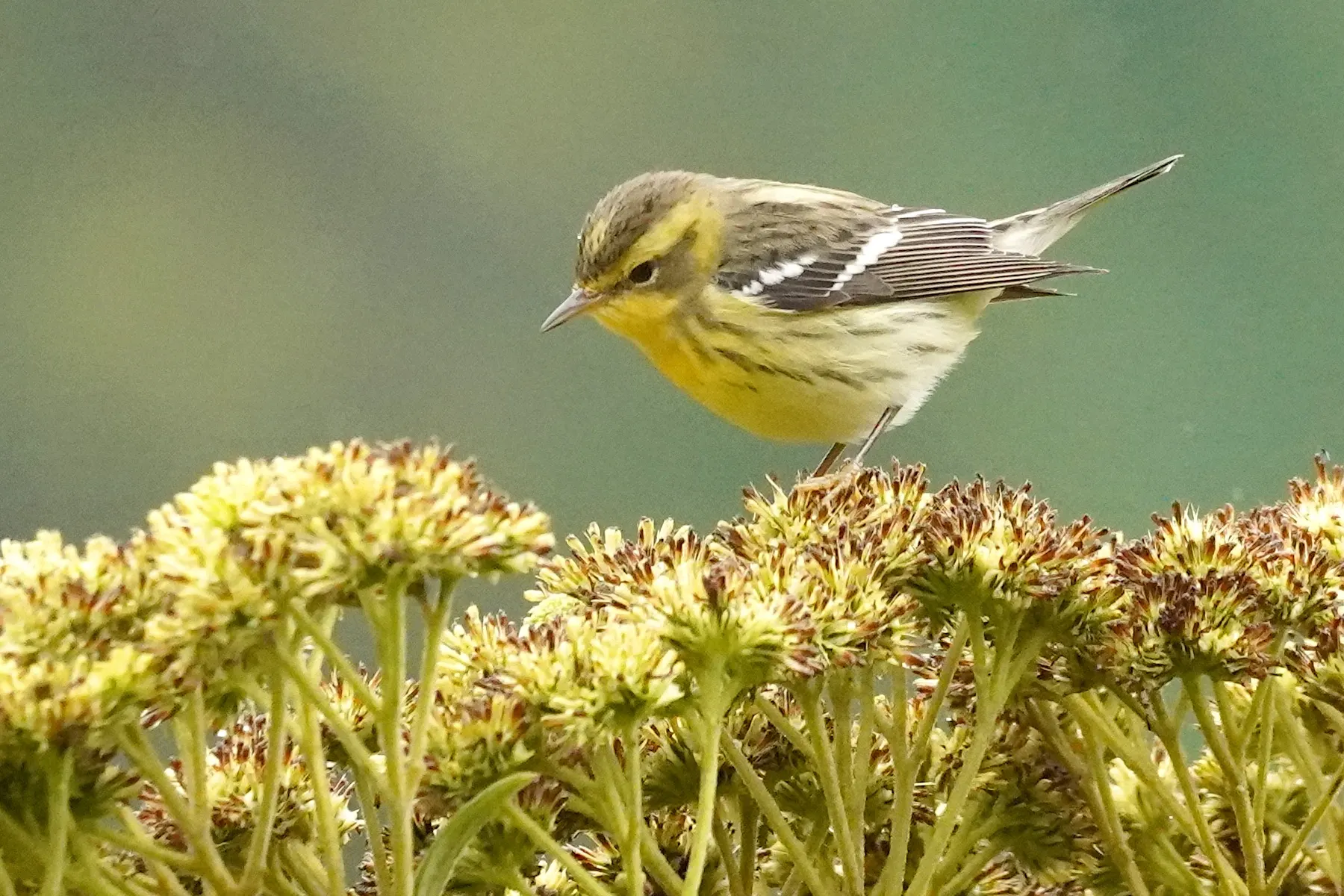
The Blackburnian Warbler (Setophaga fusca) breeds in the forests of Canada and the eastern United States and spends the northern winter in the Andes. Males have a flame-orange throat. Ours has a yellow face and a dark cheek, so it is a female or a young bird. Look for it from about October to April, usually moving with a mixed flock.
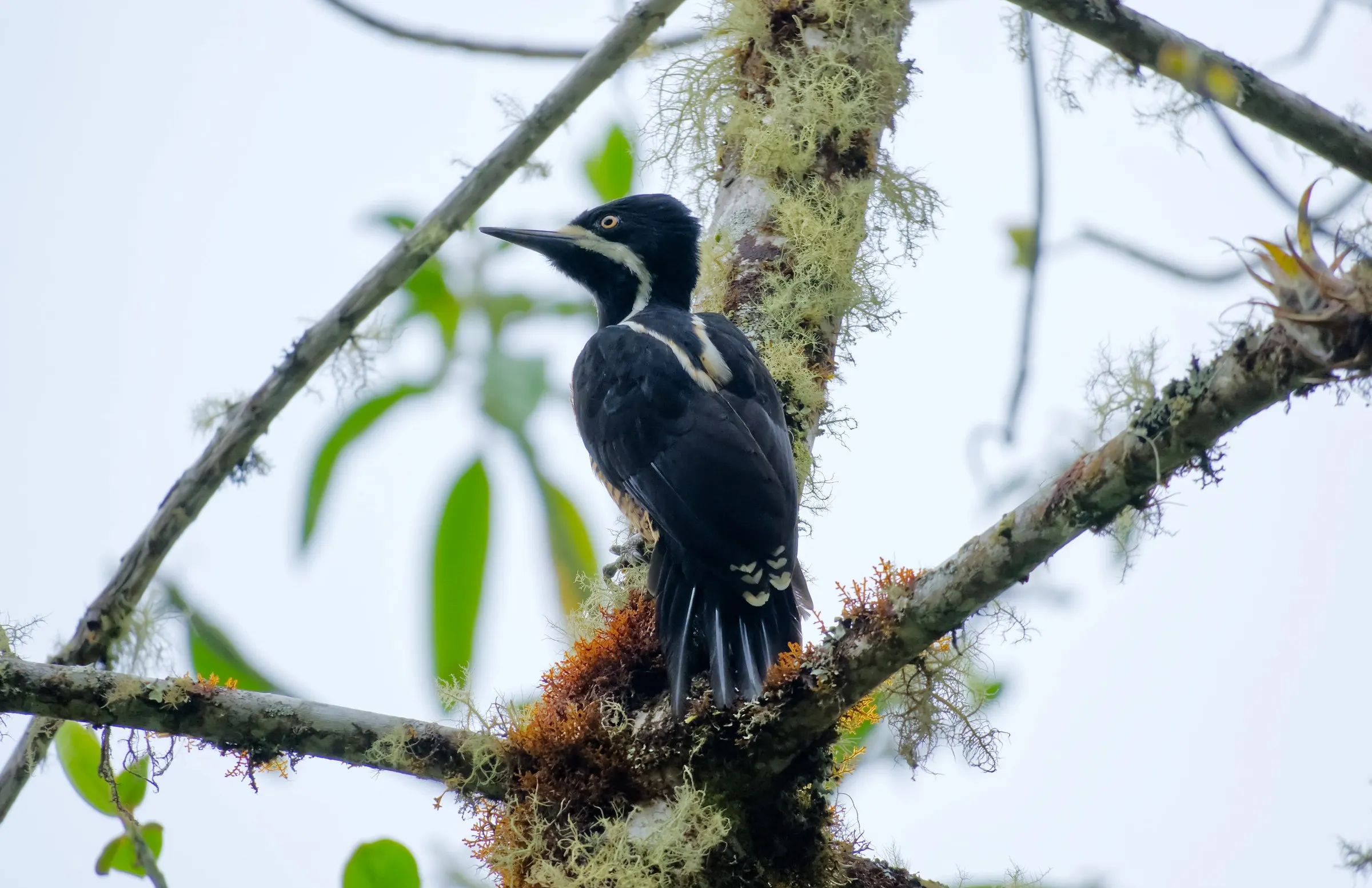
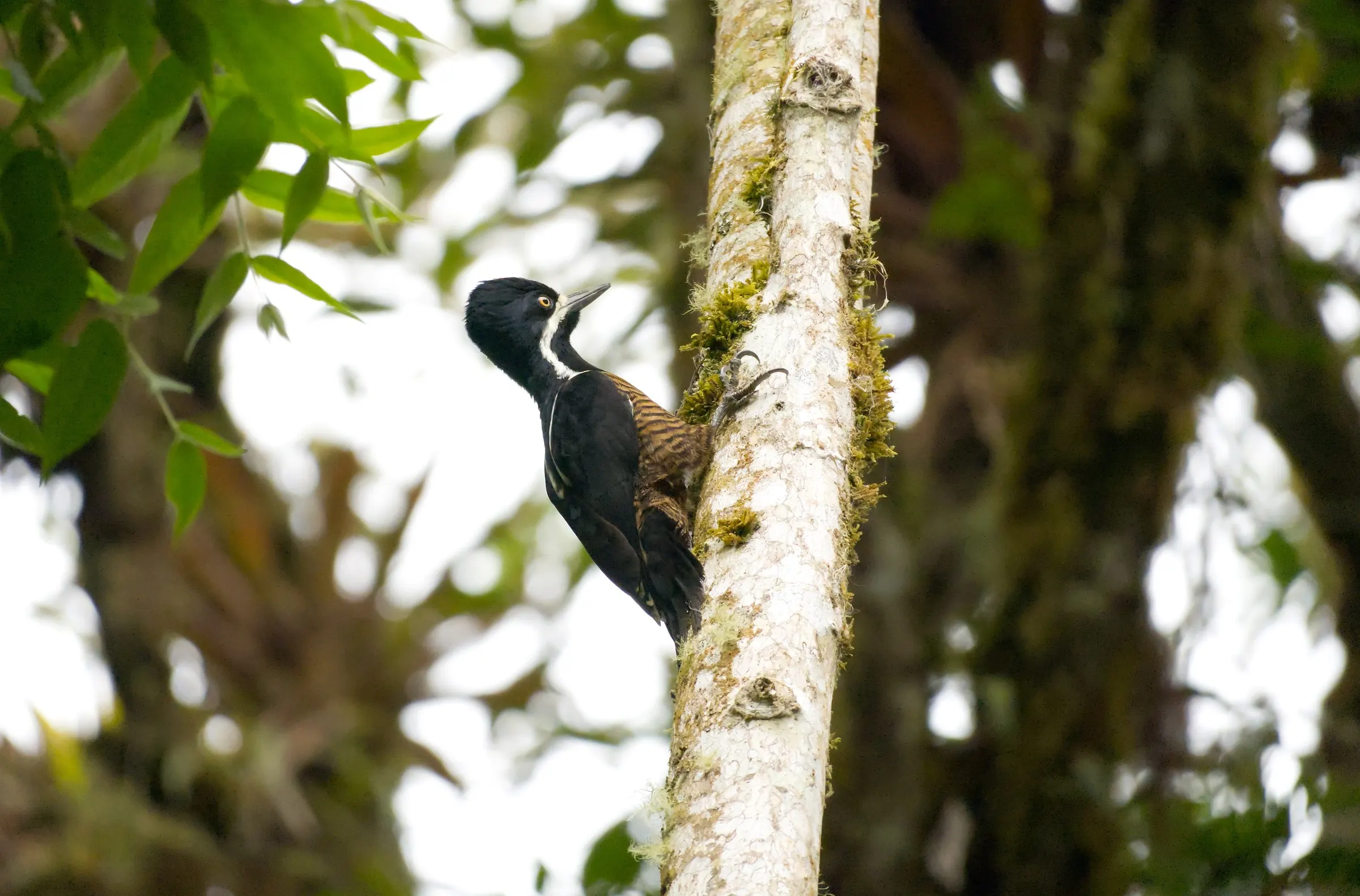
The Powerful Woodpecker (Campephilus pollens) is about 32 cm long. It is black above, with a white band from the bill down the neck to the sides of the breast, white on the lower back and cinnamon underparts barred black. It lives inside and along the edges of mature montane forest and cloud forest, mostly at 1,700–2,600 m, and forages at every level, often in pairs. Birds of the World says it is not often seen and needs a very large home range.
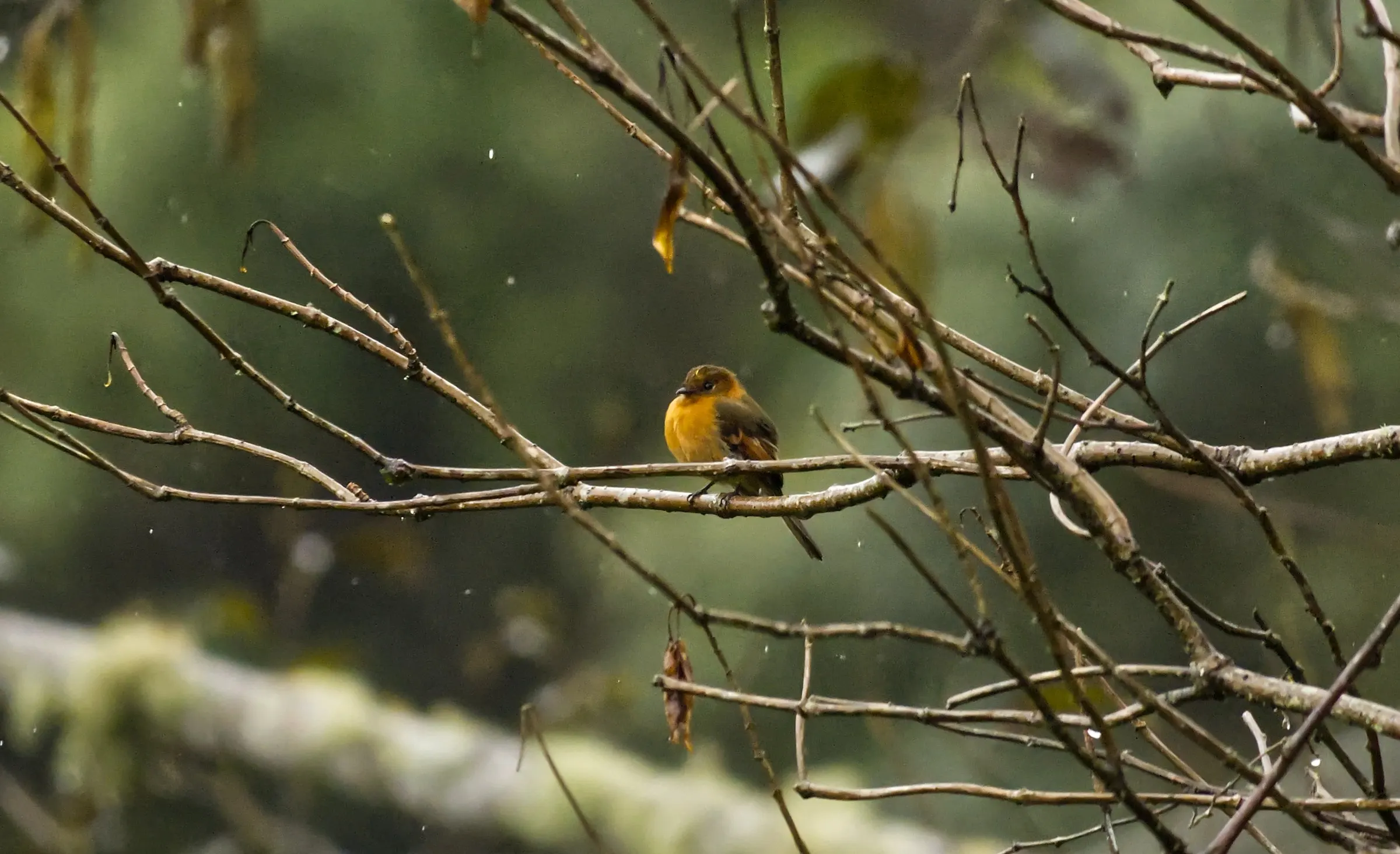
The Cinnamon Flycatcher (Pyrrhomyias cinnamomeus) is small, 11–13 cm and about 11 g. Its throat and breast are cinnamon-rufous, the back olive-brown, and the wings show two rufous bars. In Ecuador it lives at 1,200–3,000 m along forest edges, clearings and roadsides, where it is generally numerous. It sits on an open twig, darts out after an insect and usually returns to the same perch.
Where to see these birds of Ecuador on one road
One road gives you many of these birds of Ecuador in a single morning. From the páramo of the Papallacta pass you drop through Guango to Cuyuja and on toward Cosanga and San Isidro.
Mornings are best for flocks, when the birds of Ecuador's cloud forest are most active. Bring rain gear, and drive slowly along the rivers for ducks and dippers. Read our guides to the eastern cloud forest and to Cuyuja, then plan the drive with the visiting guide. San Pedrito is not open yet, about 30 minutes past Papallacta.
Birds of Ecuador: FAQ
What is the national bird of Ecuador?
The Andean Condor (Vultur gryphus), cóndor andino in Spanish. It is the national bird of Ecuador, Colombia, Chile and Bolivia. Ecuador celebrates a national condor day every 7 July.
What bird is on the Ecuador flag?
The Andean Condor. It sits on top of the coat of arms, in the centre of the flag, with its wings spread. Ecuador's National Assembly calls it the symbol of the strength of Ecuadorians.
How many bird species are there in Ecuador?
The birds of Ecuador number about 1,718 species, according to the 2021 Ecuador checklist (CERO), cited by the Cuyuja survey. That is roughly 18% of all the bird species in the world.
Are the Inca Jay and the Green Jay the same bird?
It depends on the list. eBird and the Clements checklist treat them as one species, the Green Jay, with an "Inca" group in the Andes. The IOC list splits the Andean birds as the Inca Jay.
Can I see these birds of Ecuador at San Pedrito?
Some of them. Eight of the birds on this page have been photographed on the farm: the Rufous-breasted Chat-Tyrant in September 2023; the Inca Jay, Saffron-crowned Tanager, Pearled Treerunner, Pale-edged Flycatcher and Blackburnian Warbler in October 2026; and a Powerful Woodpecker and a Cinnamon Flycatcher. Turquoise Jays come by too, but we have no photo of one yet.
Where is the best birding on Ecuador's east slope?
The Papallacta–Baeza road, with Guango, Cuyuja and San Isidro, covers páramo to cloud forest in one morning. You get mixed flocks in the forest, Torrent Ducks on the rivers and, higher up, condors over the páramo.
Sources
- Reyes Vargas et al. (2022), bird survey of Cuyuja parish, Siembra 9(2). doi:10.29166/siembra.v9i2.3725 (141 species; 1,718 for Ecuador after CERO 2021).
- Rufous-breasted Chat-Tyrant, version 1.0, Birds of the World (Farnsworth and Langham, 2020). doi:10.2173/bow.rbctyr1.01; eBird.
- Turquoise Jay, version 1.0, Birds of the World (McLean, 2020). doi:10.2173/bow.turjay1.01; eBird.
- Green Jay, version 2.0, Birds of the World (Giese and Hall, 2024). doi:10.2173/bow.grnjay.02; eBird.
- Blue-winged Mountain Tanager, version 1.1, Birds of the World (Hilty, 2021). doi:10.2173/bow.bwmtan1.01.1; eBird.
- Hooded Mountain Tanager, version 1.1, Birds of the World (Hilty, 2021). doi:10.2173/bow.homtan1.01.1; eBird.
- Grass-green Tanager, version 1.0, Birds of the World (Russell et al., 2020). doi:10.2173/bow.grgtan1.01; eBird.
- Blue-and-black Tanager, version 1.0, Birds of the World (Bernabe and Burns, 2020). doi:10.2173/bow.babtan1.01; eBird.
- Gray-breasted Mountain-Toucan, version 1.0, Birds of the World (Short and Kirwan, 2020). doi:10.2173/bow.gybmot1.01; eBird.
- Torrent Duck, version 1.0, Birds of the World (Eitniear, 2020). doi:10.2173/bow.torduc1.01; eBird.
- White-capped Dipper, version 2.0, Birds of the World (Pedigo et al., 2020). doi:10.2173/bow.whcdip1.02; eBird.
- Black-and-chestnut Eagle, version 3.0, Birds of the World (Rivas-Fuenzalida et al., 2024). doi:10.2173/bow.baceag2.03; eBird.
- Andean Guan, version 1.0, Birds of the World (del Hoyo and Kirwan, 2020). doi:10.2173/bow.andgua1.01; eBird.
- Powerful Woodpecker, version 1.0, Birds of the World (Winkler and Christie, 2020). doi:10.2173/bow.powwoo1.01; eBird. Length and altitude: Wikipedia.
- Cinnamon Flycatcher, version 1.0, Birds of the World (Farnsworth and Lebbin, 2020). doi:10.2173/bow.cinfly2.01; eBird. Size, and the Ecuador altitude and abundance from Ridgely and Greenfield (2001): Wikipedia.
- Andean Condor, version 1.0, Birds of the World (Houston et al., 2020). doi:10.2173/bow.andcon1.01; eBird.
- Asamblea Nacional del Ecuador (2011). Asamblea conmemora Día Nacional del Cóndor (condor on the coat of arms; national condor day, 7 July).
- Municipio del Distrito Metropolitano de Quito (2019). Conservación del cóndor andino en el Distrito Metropolitano de Quito (national bird of Ecuador; 2018 census, 150 condors).