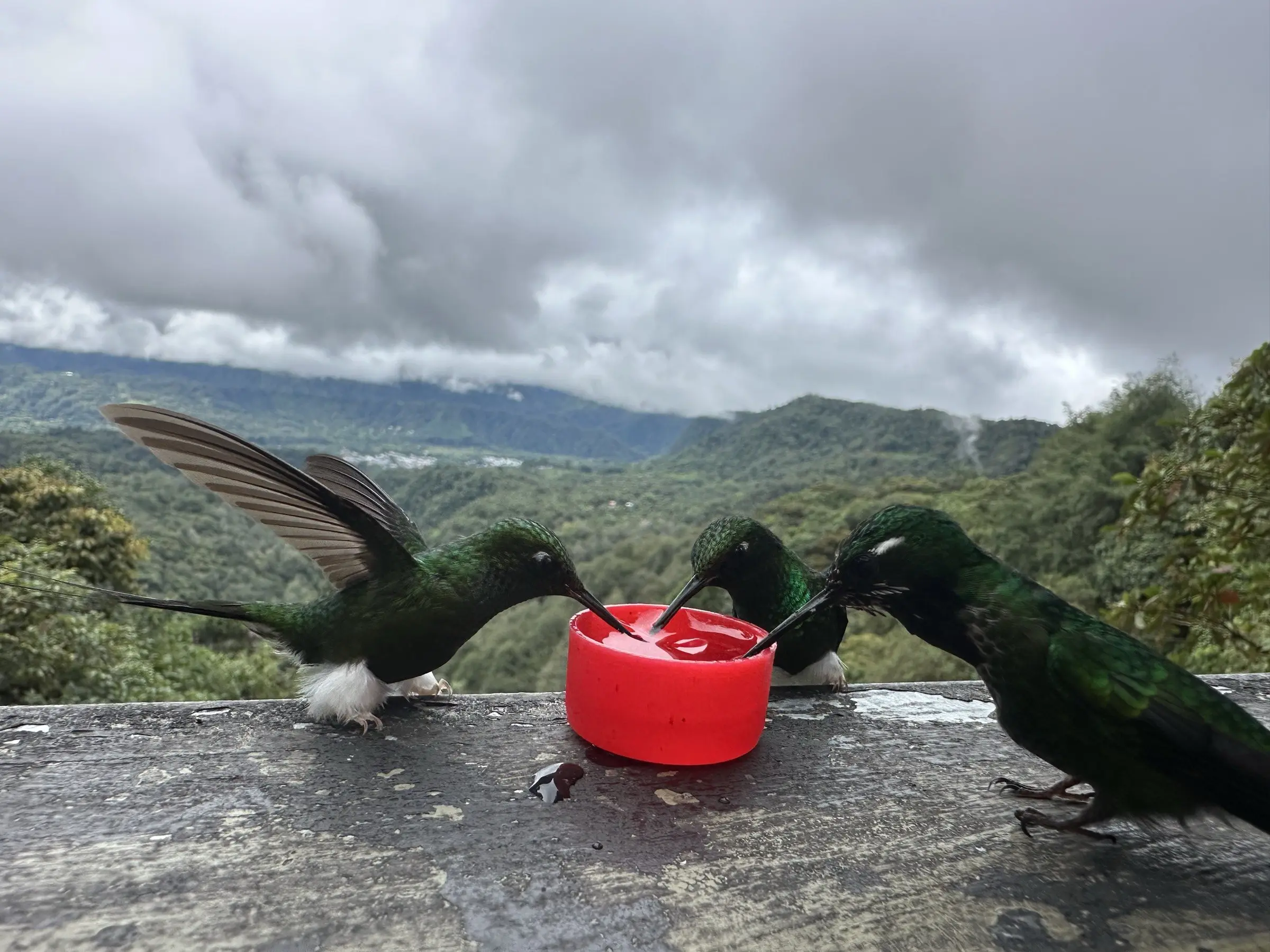
How to clean a hummingbird feeder: empty it, take it apart, scrub every piece with hot water and a bottle brush, wash it in one part white vinegar to four parts water, then rinse three times. Audubon advises that vinegar wash about once a week, and fresh nectar every 2–3 days.
How often should you clean a hummingbird feeder?
It depends on the heat. Warm nectar spoils fast, so clean daily in hot weather and about twice a week when it is cool.
The schedules below come from Audubon's feeding FAQ, the National Wildlife Federation (NWF) and the Cornell Lab of Ornithology. None of them gives an exact temperature for each step, so treat "hot", "mild" and "cool" as your own local weather.
| Weather | Empty, clean and refill | Source |
|---|---|---|
| Hot | Every day or every other day | Audubon, NWF |
| Mild or temperate | About every three days | Audubon, NWF |
| Cool | Twice a week is enough | Audubon |
| Any weather | Change sugar water at least every 3–5 days; scrub at least weekly | Cornell Lab |
| Cloudy nectar, mould, insects or a sick bird | Clean at once, whatever the date | Audubon |
If your birds drain the feeder faster than that, Audubon says to clean it every time it is empty. Never just top up old nectar. Pour it out and clean first. Audubon also suggests hanging feeders in the shade, which keeps the sugar water from fermenting.
What you need before you start
Knowing how to clean a hummingbird feeder starts with a few cheap tools. Keep them for the feeder only, and wash it outside the kitchen.
- A bottle brush long enough to reach the bottom of the reservoir.
- A small brush or cotton swab that fits inside the feeding ports.
- White vinegar and hot tap water.
- A handful of dry rice for stubborn grime, an old trick from Audubon.
- A basin or bucket, so you are not cleaning in the sink where you prepare food.
That last point comes from researchers at UC Davis. After finding abundant microbes in feeder sugar water, they advised people to avoid cleaning feeders where human food is prepared.
How to clean a hummingbird feeder in 7 steps
Here is the full routine, step by step. It takes about as long as making a fresh batch of nectar.
- Empty the old nectar. Pour it all out, even if it looks clear. Audubon says to discard any unused nectar each time you take the feeder down.
- Take the feeder apart. Separate the reservoir, base, flower ports, bee guards and any rubber seals.
- Scrub with hot water. Use the bottle brush on the reservoir and base. The Cornell Lab recommends hot water and a bottle brush at least once a week.
- Clean every port. Push the small brush or swab through each hole. Sugar dries inside the ports, out of sight.
- Wash in vinegar solution. Use 1 part white vinegar to 4 parts water. If the feeder is dirty, add some dry rice and shake hard; the grains act as an abrasive.
- Rinse three times. Audubon says to rinse well with warm water three times before refilling.
- Air-dry and refill. Let the parts dry, put the feeder back together and fill it with fresh 1:4 nectar at room temperature.
That is how to clean a hummingbird feeder for routine care. For the nectar itself, see our guide to what hummingbirds eat and the 1:4 recipe: one part white sugar to four parts water, no dye and no honey.
Vinegar, bleach or dish soap: which should you use?
Use hot water and vinegar for routine cleaning. Save dilute bleach for a deep clean, and skip dish soap altogether.
| Cleaner | Ratio | When | What the sources say |
|---|---|---|---|
| White vinegar | 1 part to 4 parts water | About once a week | Audubon; rinse three times |
| Strong vinegar soak | 1 part to 2 parts warm water | When you have spotted mould | NWF; soak for a few hours |
| Hydrogen peroxide | Not given | Routine cleaning | Audubon: hot tap water and hydrogen peroxide "works fine" |
| Dilute bleach | No more than 1 part to 9 parts water | Deep clean | Cornell Lab; rinse thoroughly and air-dry |
| Dish soap | Not recommended | Never | Audubon, NWF and Cornell: it can leave a harmful residue |
One note on the bleach figure. The Cornell Lab gives its 1:9 limit and a 10-minute soak for seed feeders. For hummingbird feeders it only says "a dilute bleach solution", followed by a thorough rinse and air-drying. We use the 1:9 limit as the strongest mix, never stronger.
Whichever cleaner you choose, the rinse matters as much as the wash. After bleach, keep rinsing until you can no longer smell it, then let the parts dry in the open air.
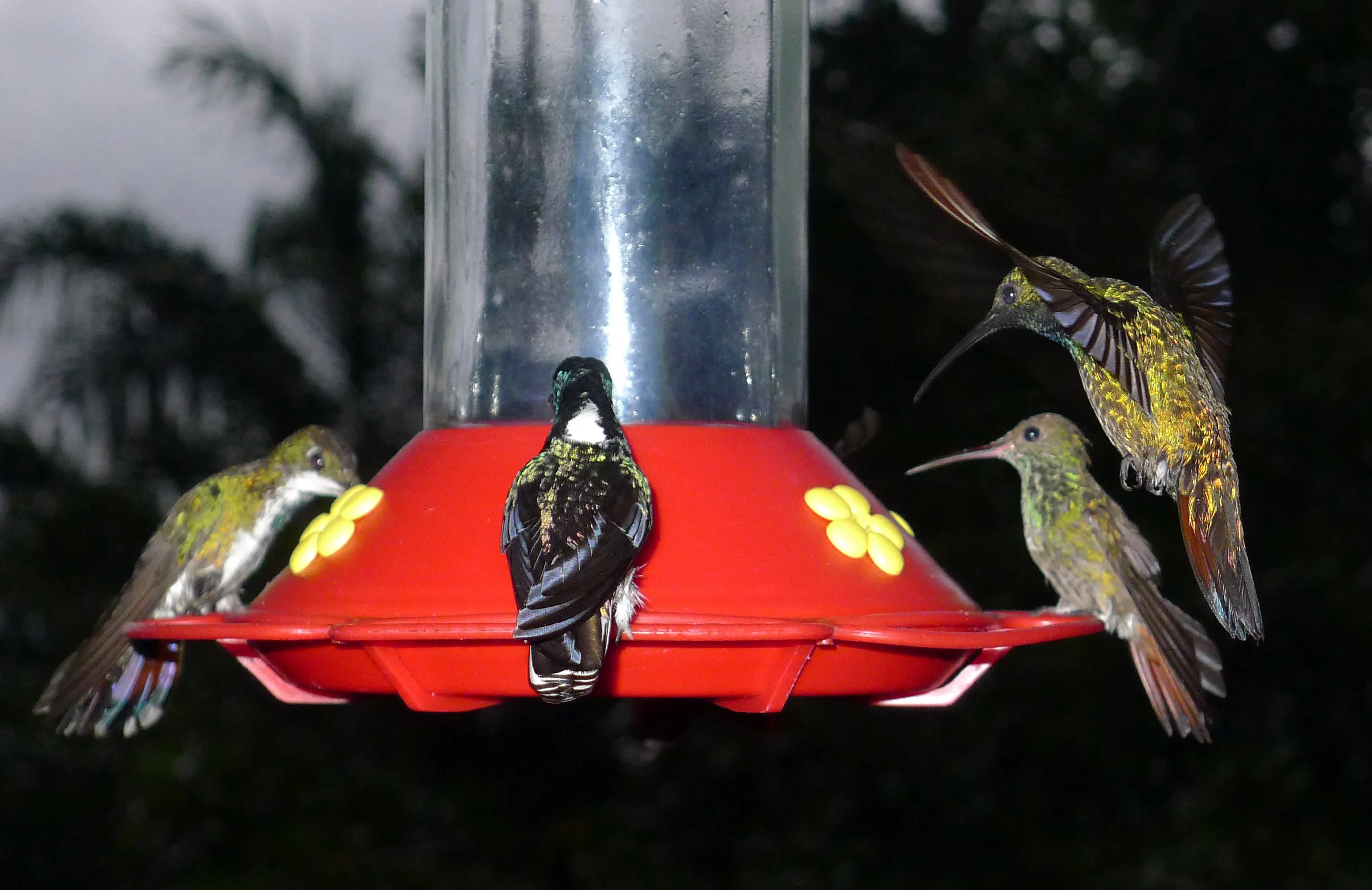
How to clean a hummingbird feeder with black mould
Soak it longer and stronger. The NWF suggests one part vinegar to two parts warm water for a few hours when you have spotted mould.
After the soak, scrub with the bottle brush and use the rice trick for spots you cannot reach. Pay special attention to the ports and seals. If dark spots will not come off a small plastic part, we would rather replace that part than keep using it.
Why be so careful? A 2025 case from the USGS National Wildlife Health Center describes a Broad-tailed Hummingbird in Arizona with yeast infiltrating its mouth and tongue (presumptive Candida). The report notes that this disease is widely attributed to contaminated feeders, or to nectar made with honey. It concludes that scrupulous cleaning may prevent it.
Perspective matters too. A 2019 study in Proceedings of the Royal Society B found abundant bacteria and fungi in feeder sugar water, even in feeders that no bird had visited. Most were not pathogens. Regular cleaning keeps it that way.
Signs the nectar has spoiled
Fresh nectar is as clear as water. Spotting spoiled nectar early tells you when, not just how, to clean a hummingbird feeder. Clean it at once if you notice any of these:
- Cloudy or milky nectar. Audubon says clean immediately, however long it has been.
- Mould inside the reservoir or around the ports.
- Insects in the nectar or crowding the ports.
- A sick bird has been using the feeder.
Bees, ants and wasps are a separate problem with their own fixes. We cover them in how to keep bees and ants away from hummingbird feeders.
Glass vs plastic feeders, ports and brushes
The best feeder is the one you can clean completely. Look for a wide mouth, parts that come apart and ports a brush can reach.
We found no study comparing glass and plastic feeders for hygiene. The practical differences are simple. A glass reservoir is easy to scrub and lets you see cloudy nectar at a glance. Plastic is lighter and does not break if you drop it, but not every plastic feeder can go in a dishwasher. The Cornell Lab suggests a hot dishwasher cycle for seed feeders, so check the maker's instructions before you try it with a nectar feeder.
Ports deserve the most attention. Removable flower ports and bee guards hide dried sugar underneath. If a feeder has ports that do not come out, a narrow brush becomes essential. Knowing how to clean a hummingbird feeder is half the job; choosing one that is easy to clean is the other half.
How to clean a hummingbird feeder in a cool, wet cloud forest
Cool weather slows spoiling, but constant moisture does not help. At our farm in Cuyuja, both are true every day.
The Cuyuja parish government reports mean temperatures of 10–16 °C and humidity above 80% all year. A study of the parish gives rainfall of 1,000–1,500 mm a year in the upper zone and 3,000–3,500 mm lower down. By Audubon's schedule, our weather counts as cool: twice a week.
Rain is the other issue. Water dripping into open ports dilutes the nectar and wets the feeder. So we plan to hang feeders under a roof edge and to empty any feeder that has taken in rain, whatever the schedule says.
How we plan to clean our feeders at San Pedrito
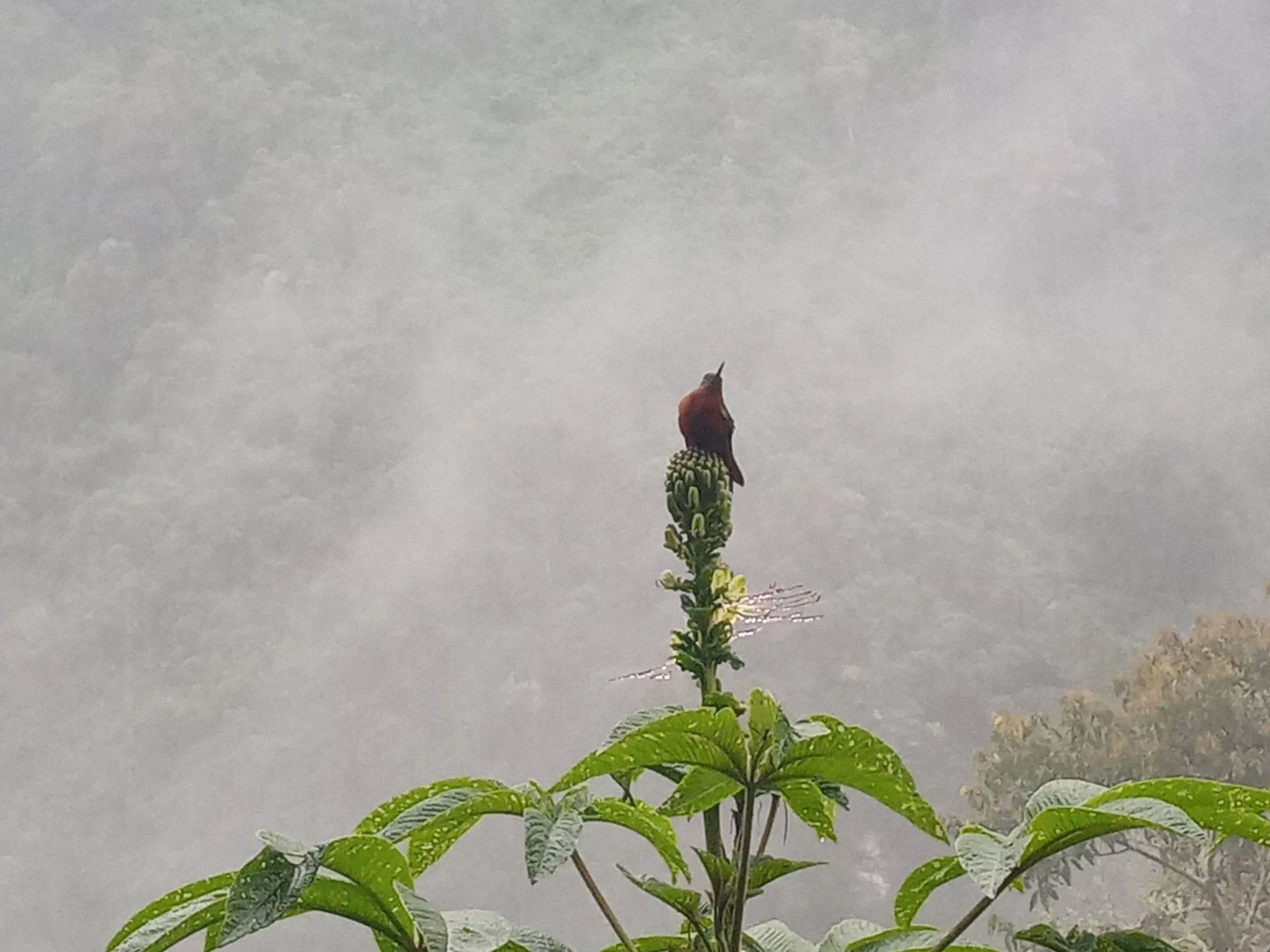
Finca San Pedrito, our family hummingbird lookout, is not open yet. We have no feeder records of our own so far, so this is our plan for how to clean a hummingbird feeder at 2,330 m, not a tested routine.
- Check every feeder daily and change cloudy nectar at once.
- Do a full clean at least twice a week, following the 7 steps above.
- Keep a second set of feeders, so one set dries while the other is out.
- Wash them in a basin outdoors, never in the kitchen.
- Keep native flowers around them, so the birds never depend on sugar water alone.
When we open, we will update this page with what we learn. Learning how to clean a hummingbird feeder in a cloud forest is exactly the kind of first-hand detail we want to share.
How to clean a hummingbird feeder: FAQ
How often should you clean a hummingbird feeder?
Every day or two in hot weather, every three days in mild weather and twice a week when it is cool, according to Audubon. Clean it at once if the nectar turns cloudy or you see mould.
Can I clean a hummingbird feeder with vinegar?
Yes. Audubon recommends one part white vinegar to four parts water about once a week. Rinse well with warm water three times before you refill.
Can I use dish soap on a hummingbird feeder?
Audubon, the National Wildlife Federation and the Cornell Lab all advise against it. Soap can leave a residue that harms the birds, so use hot water, vinegar or a dilute bleach solution instead.
Is bleach safe for hummingbird feeders?
A dilute solution is, if you rinse thoroughly. The Cornell Lab says you can fill hummingbird feeders with dilute bleach, then rinse well and let them air-dry before refilling.
How do I get black mould out of a hummingbird feeder?
Soak it for a few hours in one part vinegar to two parts warm water, as the National Wildlife Federation suggests. Then scrub, add dry rice and shake if needed, and rinse well.
Do I need to clean the feeder if the birds haven't drunk the nectar?
Yes. Microbes grow in sugar water whether birds visit or not, a 2019 study found. Audubon also says to keep cleaning on schedule even when the nectar goes untouched.
Sources
- Audubon, How to create a hummingbird-friendly yard (clean every 2–3 days; 1:4 vinegar about weekly; dry rice; rinse three times; cloudy nectar).
- National Audubon Society (2017), Hummingbird feeding FAQs (schedule by weather; hydrogen peroxide or weak vinegar; avoid dish soap).
- National Wildlife Federation, Your guide to hummingbird feeders (every day or two in heat, about every three days when mild; 1:2 vinegar soak for mould; avoid soap).
- Cornell Lab of Ornithology, All About Birds (2024), How to clean your bird feeder (sugar water every 3–5 days; hot water and bottle brush; no soap; dilute bleach, at most 1:9).
- USGS National Wildlife Health Center (2025), Presumptive Candida stomatitis in a Broad-tailed Hummingbird.
- Lee, Tell, Hilfer & Vannette (2019), Microbial communities in hummingbird feeders are distinct from floral nectar and influenced by bird visitation, Proc. R. Soc. B 286: 20182295; and UC Davis news release.
- GAD Parroquial de Cuyuja, Datos generales (10–16 °C, humidity above 80%).
- Reyes Vargas et al. (2022), Siembra 9(2): e3725 (rainfall in Cuyuja parish).